




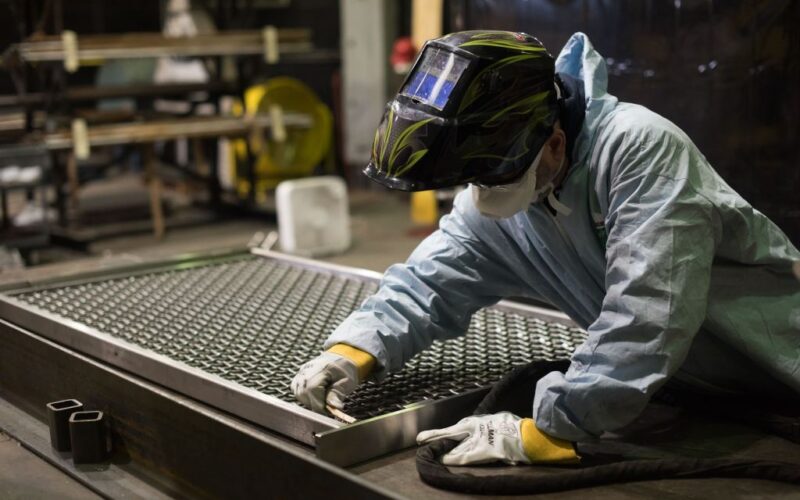
As part of the MTA’s push to install platform barriers in more than 100 stations across the New York City subway system, welders and machinists at the MTA’s Tiffany Iron Shop in Hunt’s Point earlier this week did what they’ve been doing since the spring — turn piles of stainless steel into safety equipment meant to keep New Yorkers off the tracks.
“We fabricated over 1,800 railings,” Luis A. Garcia, general superintendent of iron operations at the Tiffany shop, told the Daily News during a recent visit to the metalworking shop. “That’s for the whole of 2025.”
The platform barriers, which first started showing up in January 2024, were initially derided as a low-tech solution to straphanger safety.
The first test run — rolled out at the W. 191st St. station on the No. 1 line followed by a handful of other stations — consisted of squared-off steel fencing with hardware-store mesh, painted safety yellow.
“Social media had a lot of say on it, in terms of, ‘is this the best that transit can do?’” Anthony Storniolo, NYC Transit’s assistant chief officer of track and infrastructure told The News. “[They were] bright yellow and steel, and they’re very primitive looking.”

But by the time spring 2025 rolled around — and Gov. Hochul pledged to have the barriers installed in 100 stations by the end of the year — the workers of the Tiffany Shop had put the finishing touches on a more elegant design.
After moving to a gray-paint version of the initial design with more rounded edges, the MTA ultimately settled on a stainless steel barrier, designed in concert with the workers at the Tiffany shop, that includes a swept-back handrail and larger mesh panels that will resist corrosion, even when its power-washed by station-cleaning crews.

But even for a specialty shop like Tiffany — or its sister shop in Brooklyn, the Cozine Shop, which also makes the platform barriers — working in stainless steel required additional tooling and training.
The metal is harder, it’s slower to cut, and it’s trickier to weld.
“We had to send a lot of our welders to recertify for TIG welding — advanced arc-welding,” said Danny Ortiz, a supervisor at the shop.
About 40 welders were retrained in total.
On a recent Monday, the shop was building barriers ahead of the 115th station installation — at the Kingston-Throop C train station in Bedford Stuyvesant. At one end of the shop, machinist Junior Reid milled channels in stainless steel stock where the steel mesh would eventually sit. At the other end, ironworker Leslie Bascom ran a bandsaw cutting spacers from 1/2″ steel.

Nearby, welders O’Neil Guy and Stanley Punch laid out the frame of a barrier with squares, checking the angles and tapping the pieces into position, before Guy flipped down his welding mask and picked up a torch.
The tacked-together frame was hoisted and carted over to another set of workstations, where welders Jameel Ayub and Luis Echevarria worked to finish the welds and add the thick feet through which the barriers would be bolted to the subway platform.

The smallest of the barriers weigh over 100 lbs. The heaviest, a three-panel barrier running 12 feet long, weight just under 350 lbs.
“These barriers have made a real difference for riders by giving them an extra sense of security on a crowded platform,” Hochul told The News in a statement.
“I saw early on the value here, and that is why I challenged the MTA to install barriers at 100 additional stations this year, a milestone that I am encouraged to see them exceed.”

MTA Chairman Janno Lieber told The News the plan had initially been to hire outside contractors to build half of the barriers needed to hit the governor’s 100-station target.
But “the in-house team proved they could do it much faster and cheaper,” Lieber said. “Soon after we got started it became so apparent that these guys were the way to go.”
An MTA spokesman told The News that keeping the work in-house meant that installation cost the MTA approximately $100,000 per station, as opposed to $300,000 per station with outside contractors. The materials and fabrication are estimated at about $150,000 per station.
The stainless design — which Lieber credited to the Tiffany Shop — is “visually attractive, and in line with the visual vocabulary of our subway system,” the transit boss said. “We wanted something that felt like a permanent part of the system.”
“They take a lot of pride in what they’re doing,” Lieber said of the metalworkers.

Storniolo agreed.
“Here in Iron, we take pride in what we do,” he said. “There’s contractors that pretty much do everything that we do, but I just don’t think the quality is there.”
“We kind of know the system a lot better than a contractor knows the system,” he added.
Transit advocates have spent years calling on the MTA to install full floor-to-ceiling barriers with automated doors — a more high-tech setup found in multiple transit systems worldwide.
The MTA has long warned that most subway stations in the system — many of which are more than 100 years old — are simply too thin or not flat enough to support such a system.
The smaller, passive barriers, however, can be adapted to the needs of nearly any station, the Tiffany Shop workers said.
“There’s nothing, really, that’s standardized,” said George Wilson, the Tiffany Shop supervisor in charge of fabrication. “Some of the stations get 24 [inch rails], 30 [inch rails], 36, and it just goes all the way up; 144-inch rails are the biggest we make.”
The metalworkers said that as the MTA continues to roll out platform barriers, they are preparing for more challenges — like installing the fences on elevated platforms, where anchors will need to be installed from underneath the elevated track.
“Although it looks the same to people standing on it and waiting on a train, it’s different,” Storniolo said of the system’s elevated structures. “That’s our next challenge.”