

When Brian Cashman and seven other Yankees delegates met with Masahiro Tanaka in January 2014, the contingent had to not only make a strong impression, but a quick one.
With Tanaka eager to get back to his native Japan so as to not disrupt his training, his representatives ushered teams in and out of a private residence in Beverly Hills over the course of two days. Only a few hours were allotted to the Yankees as they tried to court the coveted right-hander.
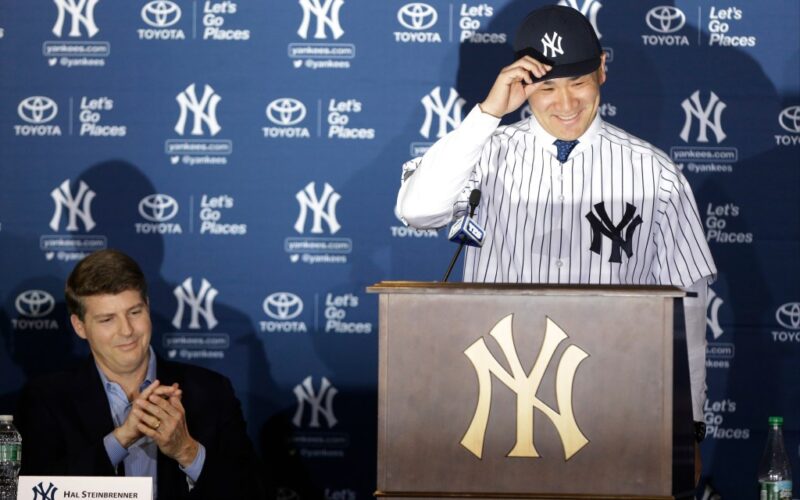
That sales pitch included lots of conversation, an MTV Cribs-style video of Yankee Stadium’s amenities, and a clip of Hideki Matsui — the greatest Japanese player in Yankees history — speaking directly to Tanaka. The recruiting effort ultimately resulted in Tanaka signing a seven-year, $155 million contract with the Bombers.
The Yankees haven’t convinced a Japanese star to sign with them since.
Cashman recently lamented that, saying “too many years” have gone by.
“We have been very aggressive in the more recent market, but fell short,” the general manager continued. “Those players made the decision to go play for the Dodgers, and clearly the success has followed them.”
Cashman was alluding to the Yankees being finalists for Yoshinobu Yamamoto two offseasons ago — though their bid fell $25 million short of the $325 million deal he got from the Dodgers — and their interest in Roki Sasaki, who ended up in Los Angeles last winter.
With Shohei Ohtani leading the trio — L.A. skipper Dave Roberts is also part Japanese — the well-funded Dodgers have won back-to-back championships, including one over the Yankees, while establishing themselves as the team in Nihon. Such status has helped the Dodgers off the field, too, as there are mega-millions to be made off the baseball-crazed country’s infatuation with the team.
Cashman noted that the Dodgers have a geographical advantage being on the West Coast, and he called Ohtani, a two-way superstar who never showed much interest in the East Coast, “a great lure” for Los Angeles ever since he signed a heavily-deferred, 10-year, $700 million deal ahead of Yamamoto. With the game’s most talented player on hand, location on their side, deep coffers and name-brand recognition, the Dodgers have become an assumed favorite whenever an elite Japanese player becomes available.
However, the top Japanese free agent this winter, Tatsuya Imai, has already distanced himself from speculation that he will team up with his fellow countrymen in Los Angeles.
“Of course, I’d enjoy playing alongside Ohtani, Yamamoto and Sasaki,” the right-hander told former pitcher Daisuke Matsuzaka on the Japanese show, “Hodo Station,” in November. “But winning against a team like that and becoming a world champion would be the most valuable thing in my life.
“If anything, I’d rather take them down.”
Imai’s agent, Scott Boras, added that his client is “very geographically open.”
The 27-year-old, part of a Japanese free agent class that also includes corner infielders Kazuma Okamoto and Munetaka Murakami, hasn’t expressed a need to team up with other Japanese players, either. Imai is simply focused on joining a contender.
Those stances and comments could be strategic — why rule out suitors? — but they bode well for the Yankees, who want to restore their presence in Japan and have several question marks in their rotation.
While Cashman wouldn’t say how serious the team’s interest in Imai is, he did mention speaking to Boras about the pitcher, who should get a nine-figure deal. Meanwhile, multiple industry sources have said that they expect the Yankees to pursue Imai since the offseason began.
Imai, posted by Nippon Professional Baseball’s Saitama Seibu Lions on Nov. 18, has until 5 p.m. ET on Jan. 2 to pick on a new team.
Could his decision — or perhaps that of another Japanese free agent — finally bring some representation back to a Yankees organization that once had the largest foothold in the country?
“Do I feel it would be good to have Japanese representatives?” owner Hal Steinbrenner recently said, echoing a question. “Of course.”
EARLY MISSES AND MATSUI
Funny enough, Steinbrenner’s father, George, intensified his interest in Japanese players after seeing what an on- and off-field boon Hideo Nomo was for the Dodgers in 1995.
With the late owner craving entry into the market, the Yankees rushed to pay the Seibu Lions roughly $350,000 for Katsuhiro Maeda, an eccentric fireballer with no command. A failed prospect in Japan, Maeda never pitched in the big leagues.
The Boss’ search then led him to Hideki Irabu in 1997. The Padres originally purchased the righty from the Chiba Lotte Marines, but Irabu insisted he would only play for the Yankees, prompting a trade to New York.
The power play came with a four-year, $12.8 million contract and plenty of regrets, as Irabu, uncomfortable under the New York spotlight and struggling with the culture shift, posted a 7.09 ERA in his first MLB season. Once considered “the Nolan Ryan of Japan,” Irabu was deemed a “fat, pussy toad” by Steinbrenner in 1999 after he failed to cover first base.
Irabu, who committed suicide in 2011, didn’t pitch for the Yankees again after that season and ended his MLB career with a 5.15 ERA a few years later.
The Yankees didn’t give up after adding a few unsuccessful pitchers and pilfering the Dominican-born Alfonso Soriano from the Hiroshima Toyo Carp in 1998, though, as they formed a strategic partnership with the Yomiuri Giants in 2002. Assistant general manager Jean Afterman, who previously represented Nomo, Irabu and Soriano, played an instrumental part in forging that relationship, which focused on merchandising, marketing and TV broadcasting, as well as the sharing of baseball-related insights.
Shortly thereafter, the Yankees finally found a true Japanese star when the Giants’ Matsui agreed to a three-year, $21 million contract in December 2002.
“Godzilla” went on to enjoy a stellar seven-year career in pinstripes, which included World Series MVP honors in 2009, and has remained an ambassador of sorts for the organization, assisting its pursuits of other Japanese talents.
Boosted by a media magnet in Matsui, the Yankees quickly became appointment viewing in Japan and agreed to sponsorship deals with prominent companies in the country. With merchandise sales booming, the club eventually became the first MLB team to open a business office in Japan.
In 2004, the Yankees began the season in the Tokyo Dome against the Devil Rays. The trip also saw the Yanks play exhibitions against the Yomiuri Giants and Hanshin Tiger, which harkened back to the Japan-based games Babe Ruth and Lou Gehrig once appeared in.
That Yankees team included stars such as Derek Jeter and Alex Rodriguez, but Matsui naturally stole the show during the trip.
”It’s a little bit like The Beatles arriving in New York,” Afterman said at the time.

POST-MATSUI
While Matsui and the Yankees enjoyed immense popularity in Japan, the team didn’t monopolize the talent that followed him to the states.
As the years went by, other Japanese players spread out across the majors. With Ichiro Suzuki already a phenomenon in Seattle before Matsui arrived, the Red Sox outbid the Yankees for Matsuzaka in 2006. The Yankees landed Kei Igawa, another disappointment on the mound, that same offseason.
Yu Darvish, arguably MLB’s most successful Japanese hurler, received a low bid from the Yankees in 2011 before becoming a Ranger.
But with Matsui’s career coming to a close in Tampa Bay, the Yankees acquired Suzuki from the Mariners during the summer of 2012. While Suzuki was past his prime at that point, the trade sparked a new wave of Japanese baseball fans clamoring for Yankees apparel.
At one point in 2012, the Yankees had three Japanese players, as Hiroki Kuroda — a dependable rotation piece first with the Dodgers and then in New York — and Ryota Igarashi — a reliever who flamed out with the Mets before pitching in two games for their crosstown rival — joined Suzuki.
The following summer, Matsui signed a one-day contract to retire as a Yankee. The symbolic gesture unofficially closed one chapter of Japanese stardom in the Bronx right before Tanaka penned another. Once again, the Yankees benefited outside the lines from a surge in Japanese exposure and interest as Tanaka became a fan favorite and postseason hero throughout his seven seasons with the team.
“We’ve had some amazing [Japanese players] that are great personalities, tremendous players,” Cashman said, expressing his personal admiration for Matsui, Tanaka, Suzuki and Kuroda. “I think all of them enjoyed the city significantly, and one still lives here year-round now in Matsui. So I think having great players and some of the great players from Japan is always a benefit.”
WHAT’S NEXT?
The Yankees have not employed a Japanese-born player, star or otherwise, since Tanaka’s last MLB season in 2020. They have maintained strong scouting in the country, as well as business relationships, but no Japanese representation on their roster.
Hal Steinbrenner called such representation “an important thing,” as he has seen the Dodgers reap rewards on and off the field. However, he downplayed the idea that business is a motivating factor.
“What that translates into from my perspective, I don’t know, nor can I quantify it,” Steinbrenner said, though he added, “baseball is king of Japan.”
Cashman is more concerned with ending a 16-year championship drought than the bottom line, but he acknowledged that a Japanese player would create various revenue streams for the Yankees.
“I have nothing to do with our business side, so I can’t really speak to that,” he said several days before Steinbrenner called the club’s profitability into question. “There is the belief or understanding that, obviously, it opens up different business, marketing, signage, what have you. But that’s not my area. If I do a good job on the baseball side, then everybody else in the company can capitalize on whatever comes their way. Our ticket director sells more tickets. The YES Network can have higher ratings, and the signage price tags can go higher, I guess.”
Maybe Imai can help with that if the Yankees can stomach his own price tag. Okamoto, another Boras client, is also a platoon fit as a right-handed hitter who possesses contact and power while manning first and third. But he could receive a full-time gig — and appropriate compensation — elsewhere.
The slugging Murakami is less of a fit given his struggles with strikeouts, contact and velocity from the left side. There are also concerns about his defense.
If the Yankees were to sign one of those players, Cashman said they would have to hire support staff, such as an interpreter, as the transition from NPB to MLB comes with a language barrier and culture shock.
“That’s not going to be a problem,” Cashman said, noting that the team doesn’t currently have those positions filled since there’s no Japanese player on the roster.
Agencies representing Japanese players sometimes already employ support staffers and make referrals to teams when their client is signed. Agencies can also handle various family services for their clients.
Should none of the aforementioned players join the Yankees this winter, other opportunities will present themselves in the future.
Japan’s best now routinely migrate to the big leagues each offseason, and modern technology and scouting has mitigated the risk of players turning out like Irabu or Igawa. The Yankees, meanwhile, aren’t being secretive about their desire to get back on the board.
“We definitely want to be a player in the Japanese market,” pitching coach Matt Blake said. “There’s obviously a lot of talent coming over that’s helped teams stateside. So whether that’s this year or next, I know we definitely want to have a stronger presence again.”
Added Steinbrenner: “We’ve tried, and we’ll continue to try.”