


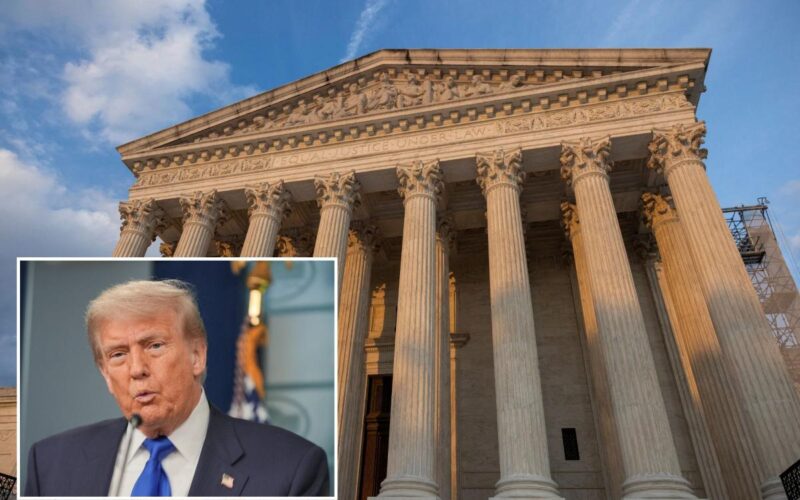
WASHINGTON — The Supreme Court agreed Friday to hear arguments about the constitutionality of President Trump’s day one executive order declaring that children born to parents in the US illegally or temporarily are not American citizens.
The justices will hear Trump’s appeal of a July lower-court ruling that struck down the restrictions on so-called “birthright citizenship,” which have not taken effect anywhere in the country.
The case, Trump v. Barbara, will be argued in the spring, with a decision expected by the end of June.
The Jan. 20 order would only grant automatic citizenship to children with at least one parent who is a US citizen or legal permanent resident.
The concept of birthright citizenship stems from the 14th Amendment, which stipulates that “[a]ll persons born or naturalized in the United States, and subject to the jurisdiction thereof, are citizens of the United States and of the State wherein they reside.”
Trump maintains that birthright citizenship has been abused and ushered in an era of “birth tourism,” in which foreign nationals travel to the US solely to give birth to new citizens.
In a series of decisions, lower courts have struck down the executive order as unconstitutional, or likely so, even after a Supreme Court ruling in late June that limited judges’ use of nationwide injunctions.
The justices, however, did not rule out other court orders that could have nationwide effects, including in class action lawsuits and those brought by states. The justices did not decide at that time whether the underlying citizenship order was constitutional.
The case under review comes from New Hampshire, where a federal judge blocked Trump’s citizenship order July 10 in response to a class-action lawsuit that included children of foreign nationals.

The administration had also asked the justices to review a ruling by the San Francisco-based Ninth Circuit Court of Appeals
That court ruled July 23 that a group of Democratic-led states that sued over Trump’s order needed a nationwide injunction to prevent the problems that would be caused by birthright citizenship being in effect in some states and not others.
The justices took no action in that case.
The administration has asserted that children of noncitizens are not “subject to the jurisdiction” of the United States and therefore not entitled to citizenship.
“The Fourteenth Amendment’s Citizenship Clause was adopted to grant citizenship to newly freed slaves and their children — not … to the children of aliens illegally or temporarily in the United States,” Solicitor General D. John Sauer wrote in urging the high court’s review.
Twenty-four Republican-led states and 27 Republican lawmakers, including Sens. Ted Cruz of Texas and Lindsey Graham of South Carolina, are backing the administration.
With Post wires