




At long last, surprising no one, Senate Republicans have blocked bills to extend Obamacare subsidies, sidestepping one more chance to address the issue careening towards a Dec. 31 cliff after which premiums for more than 20 million Americans will skyrocket.
So the Democrats were right and this was the point of the longest-ever government shutdown, but they gave in only for the promise of a vote, and now have little leverage.
There is a bipartisan group in the House seeking a vote to extend the subsidies for one year or two years, but so far the bulk of neither party is interested. So here we are back at square one, or rather worse than that, because the nation sustained economic and institutional damage and put millions of people into uncertainty and fear, all to end up with nothing.
We’d love here to be able to say that we used our sage expertise to predict that the GOP was never going to find a way to play ball on Democrats’ efforts to extend these subsidies, but quite frankly, even a reasonably well-informed toddler probably could have seen this coming.
This is not some sort of abstract ideological issue. For all of Republicans’ complaints that Democrats are focused on nebulous social structures as opposed to kitchen table issues, this is a very real economic problem for millions of people nationwide, with immediate impact.
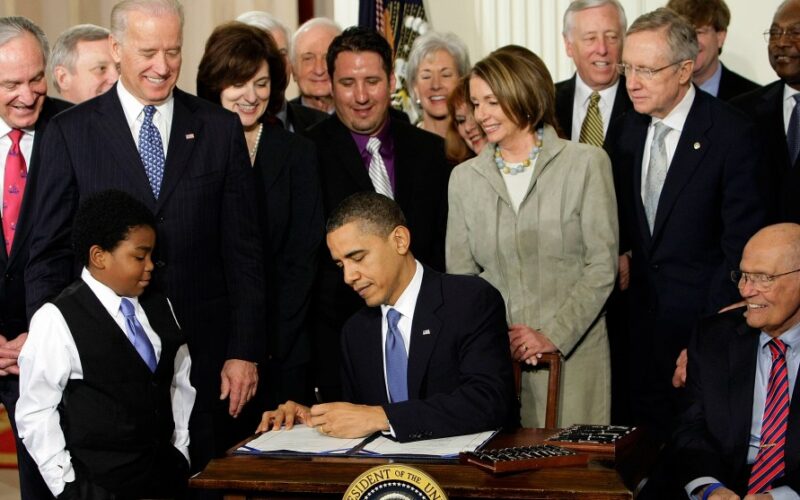
The GOP has had a decade-plus to come up with a viable alternative here — they’ve been pledging to overturn the whole of the Affordable Care Act and replace it with something different since the moment Obama’s signature was drying on the legislation — and here we are with nothing actionable on the table.
The most they’ve got seems to be handing everyone a little bit of money per month and directing them to negotiate down some of the highest health care prices on earth until they can afford it. We suppose at least that’s a more evolved plan then their other proposal, which seems to be just chiding people to avoid getting too sick and needing expensive medical care.
If you’re thinking “I don’t have Obamacare so, this doesn’t affect me,” we’ve got some bad news. The thing about insurance is that it is designed to work best the more people — and particularly low-risk people — are enrolled in the same risk pool.
Once premiums spike, it’s likely that a lot of folks, especially younger, healthier ones, decide that they can forgo insurance altogether, which, since the Supreme Court struck down the ACA mandate, is something that they can do without penalty. That will raise costs on every other person who retains insurance under the ACA, as well as everyone else who has coverage through those same private insurers, which is to say anyone not enrolled in Medicare or Medicaid.
Efforts to preserve the subsidies are not a vote of confidence in our health care system as currently constituted, and it makes sense to rethink our approach long term. At the end of the day, we spend as much or more per capita as peer industrialized countries for far worse outcomes, and it’s simply unconscionable that people are routinely unable to afford therapeutics as crucial and as basic as insulin.
For now, though, the imperative must be to keep subsidies from driving off a cliff and hurting millions of people across the country. There are some bipartisan solutions already in play, but they’re not getting much traction. GOP lawmakers shouldn’t have to wait to see constituents suffer to change course.