




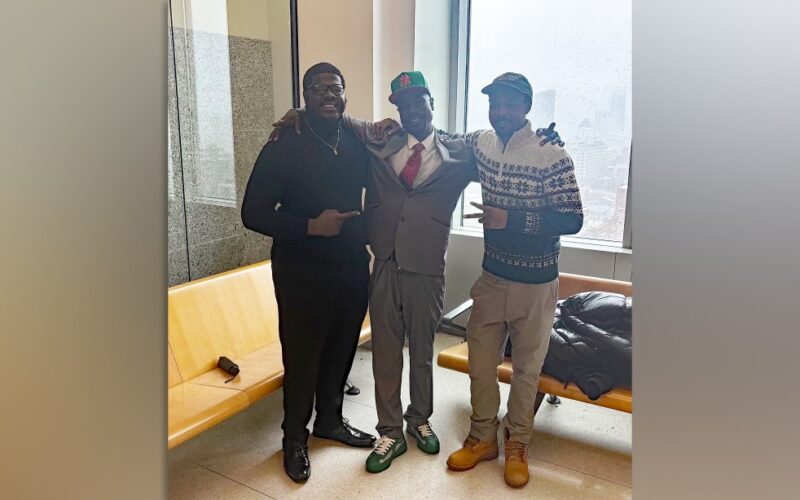
A Brooklyn man who served 11 years in jail for a murder he did not commit received an early Christmas gift on Friday — his freedom.
Derrick Ulett, 38, was already out on bail awaiting a second trial on charges that he shot a man to death outside a Brooklyn apartment building in 2008.
But Ulett, a husband, father and son, was not truly free until a Brooklyn judge dismissed the murder charges against him, siding with defense attorneys who have said for years that the case against Ulett was built on lies.
“It’s a blessing, man,” an emotional Ulett said outside Brooklyn Criminal Court. “It took 17 years to get us here. I’m just ready to just be a free man fully now.”
The once-solid case against Ulett fell apart six years ago when his defense team discovered prosecutors withheld critical surveillance footage and relied on deeply flawed evidence, according to the Legal Aid Society.
By that time, Ulett had already served 11 years of his life-in-prison sentence, after he was convicted of fatally shooting Ruben Alexandre outside an apartment building in Flatbush.
A Freedom of Information Act request led to the discovery of crucial surveillance video of the shooting that was never introduced during the trial, footage that contradicted the testimony of a key witness, Ulett’s lawyers said.
Not only did prosecutors at the time fail to disclose the evidence, they told the jury that no such video even existed.
“Where is that video surveillance?” a prosecutor told jurors during the trial’s summation. “Wouldn’t you think, ladies and gentlemen, that if there was video camera surveillance at 48 St. Paul’s Place, that would be very important, that possibly could show what it was that took place. Don’t you think it would have shown who actually shot [the victim]? We don’t have that video!”
But they did have the video, and, after an exhaustive round of motions, the New York Court of Appeals in 2019 reversed Ulett’s conviction and ordered a new trial.
Further investigation revealed other flaws, including autopsy photographs from an entirely different dead person. Recordings of 911 calls described a shooter whose description did not match Ulett.
“This is one of these cases where it’s not a dismissal because a retrial wasn’t viable after 17 years,” said Erin Darcy, the Legal Aid Society’s homicide defense task force supervisor. “This case was dismissed because it was built on lies. The foundation of this prosecution was untruthful witnesses, misconduct by law enforcement and, most importantly, burying critical evidence.”
Ulett said he is ready to move on with his life, which was difficult to do before the charges were dismissed.
“I’ll definitely be able to pursue a lot of jobs that I wasn’t able to pursue before,” he said. “And I’m going to be able to just, you know, go forward with my life and not have to have that black cloud over me or my son. My son is doing very well in college right now. And it’s just a lot right now, man, it’s a great, great burden that is off of me.”
Ulett, who cleans rooms at New York-Presbyterian Hospital, said he wants to go back to school and get credits to be an X-ray technician. In the meantime, he said he wants to continue building his relationship with his 20-year-old son.
“I’m just so glad that I was able to make it back in time to be here,” he said. “When I left, he was only 3 years old. I came back and he was 16, you know. So it was just a process.”
So is life.
“Christmas came early, so we’re gonna start celebrating now,” Ulett said.