




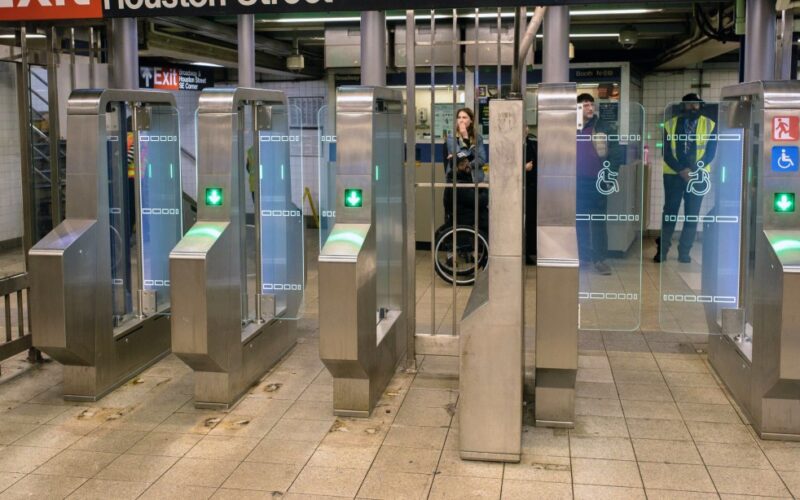
The MTA’s years-long quest for a turnstile successor took another step forward on Friday, with the unveiling of a new bank of fare gates at two subway stations.
The modern fare gate design foregoes the traditional rotating turnstiles that have defined subway entrances for decades, and replaces them with motorized, plexiglass panels that move aside when someone has paid the fare.
“They’re going to improve the passenger experience, and ensure that we minimize fare evasion,” said Jamie Torres-Springer, the MTA’s head of construction and development. “You’ll see more gates being rolled out across the boroughs over the coming days and weeks.”
New fare arrays opened Friday morning at the Broadway-Lafayette station for the B, D, F, M and No. 6 trains in SoHo, as well as at the Third Ave.-138th St. station for the No. 6 line in Mott Haven, in the South Bronx.
Both stations are testing fare arrays built by U.S. firm Conduent, one of three firms vying for a contract to replace the turnstile citywide. STraffic, which manufactures fare gates for the Washington, D.C., Metro, and Cubic, which piloted a version of their technology at the Sutphin Blvd.-Archer Ave. station in Queens in 2023, are also in the running.
Evan Simko-Bednarski / New York Daily News
MTA construction boss Jamie Torres-Springer, left, and Chief Accessibility Officer Quemuel Arroyo announce the debut of new subway faregates Friday at the Broadway-Lafayette station serving the B, D, F, M and No. 6 trains. (Evan Simko-Bednarski / New York Daily News)
The modern fare gates are expected soon at the 42nd St.-Port Authority station on the A, C and E lines, the Bedford Park Blvd. station on the B and the D lines, and at transit hub Atlantic Ave.-Barclays.
“Our initial pilot is to roll it out at 20 stations throughout the subway system,” Torres-Springer said.
In addition to being harder to jump over or duck under, the new fare gates are designed to make it easier for straphangers who use a wheelchair — or who are carrying luggage or pushing a stroller — to get to the trains.
“This is a look into the future, folks,” said Quemuel Arroyo, the MTA’s chief accessibility officer.
“The point of this pilot is really to enhance what access looks like at the MTA,” he said, “and give people that grace to enter with ease, smoothly, like everybody else.”
Sensors on the gates will sound an alarm should someone try to sneak through without paying. The sensors are also supposed to help the gates determine when someone is entering with large luggage, and should also allow children below 40 inches tall — who the MTA lets ride for free — get into the subway system without ducking beneath the barrier.
The MTA expects to make a decision on fare gates sometime next year. The agency’s five-year capital budget has earmarked $1.2 billion to put fare gates in 150 subway stations.