




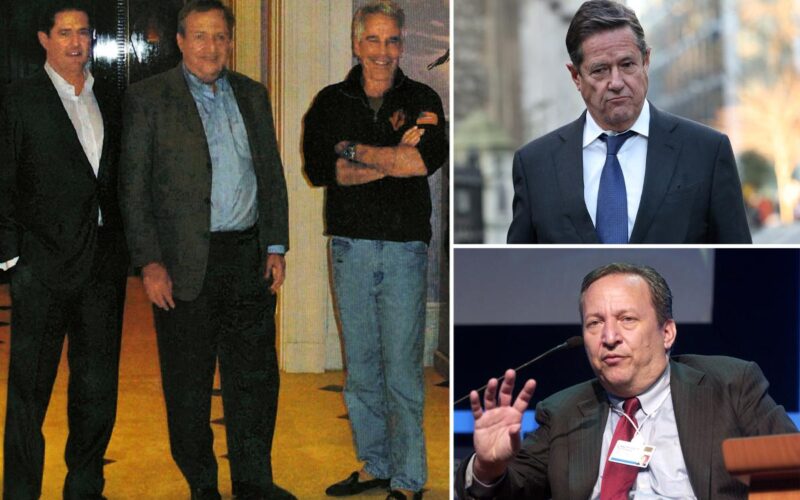
Jeffrey Epstein named Jes Staley and Lawrence Summers as executors of his estate in draft wills, newly released Justice Department records show — a revelation that brings fresh scrutiny to the late pedophile and financier’s ties to powerful men.
The documents, unsealed this week as part of a Justice Department release under the Epstein Files Transparency Act, show Epstein designated Staley, the former Barclays chief executive, and Summers, the former US Treasury secretary and ex-Harvard president, for key roles in managing his estate.
Staley was first named in January 2012 as a “successor executor,” tasked with carrying out Epstein’s will if the primary executors could not serve, according to records cited by the Financial Times.
Staley also appeared as a full executor in two subsequent wills dated September 2013 and November 2014.
The second will also listed Summers as a successor executor.
Neither man appeared in Epstein’s final will from 2019, which was also included in the DOJ release.
Staley’s lawyer and Summers were approached for comment, according to the Financial Times.
The disclosures land as Staley continues to face fallout over his relationship with Epstein, which regulators and courts have concluded he repeatedly downplayed.
Earlier this year, Staley failed to get a lifetime ban imposed by UK regulators overturned after a judge ruled that he had “acted without integrity” by falsely claiming he did not have a close relationship with Epstein.
The ban bars Staley from holding senior roles in the UK financial services industry.
In court testimony, Staley sought to distance himself from Epstein by describing their connection as a “close professional” relationship.
In March, he told a court that he had turned down a request from Epstein to serve as a trustee of his estate — arguing that the refusal showed the two men were not personally close.
Under the terms of Epstein’s estate planning, executors of the will and trustees of the estate were separate roles.
The 2019 letter at the center of Staley’s regulatory case stated that he did not have a close relationship with Epstein.
In that document, the chair of Barclays told the FCA: “Jes has confirmed to us that he did not have a close relationship with Mr. Epstein.”
Regulators and judges later found that characterization misleading.
Summers, meanwhile, has faced renewed criticism over his own dealings with Epstein following a steady stream of disclosures detailing the extent of their relationship.
Emails released by a congressional committee last month showed Summers maintained a relationship with Epstein until 2019, the year Epstein died by suicide in a New York jail.
In response to those disclosures, Summers said he was “deeply ashamed” of the relationship.
He stepped back from public commitments, including serving on the board of OpenAI, his roles at think tanks and his teaching duties at Harvard University, where he has been a tenured professor since 1983.
The new DOJ release that included the executor designations largely consisted of material tied to the judicial proceedings surrounding Epstein and his longtime associate Ghislaine Maxwell.
Maxwell was convicted in 2021 on federal trafficking charges related to Epstein’s abuse of underage girls.
The document dump also included unusual and previously disclosed items connected to Epstein’s efforts to conceal his movements and identity.
Among them was an Austrian passport issued in 1982 that bore Epstein’s photograph but listed a different name.
The passport was found in a safe at Epstein’s mansion, alongside 48 diamonds, according to the records.
In 2019, lawyers for the creep said he acquired the passport in the 1980s, when hijackings were prevalent, for travel connected to the Middle East.
A prosecutor investigating Epstein later identified an Austrian national with the same name as the one on the passport. The man was living in New York.
Investigators recommended contacting the individual to ask whether he had any reason to know why a passport from his native country, bearing his name, would feature Epstein’s photograph and be stored in Epstein’s safe.
The Financial Times said it approached the Austrian man for comment.
The latest disclosures are part of a broader release of thousands of unclassified documents ordered under the Epstein Files Transparency Act, which was enacted last month and compelled the Justice Department to turn over material related to the disgraced financier.
In July 2019, Epstein was arrested on federal sex-trafficking charges and pleaded not guilty.
He died by suicide weeks later at the Metropolitan Correctional Center in Manhattan, according to the New York City medical examiner and a subsequent DOJ inspector general report that detailed extensive jailhouse failures.