



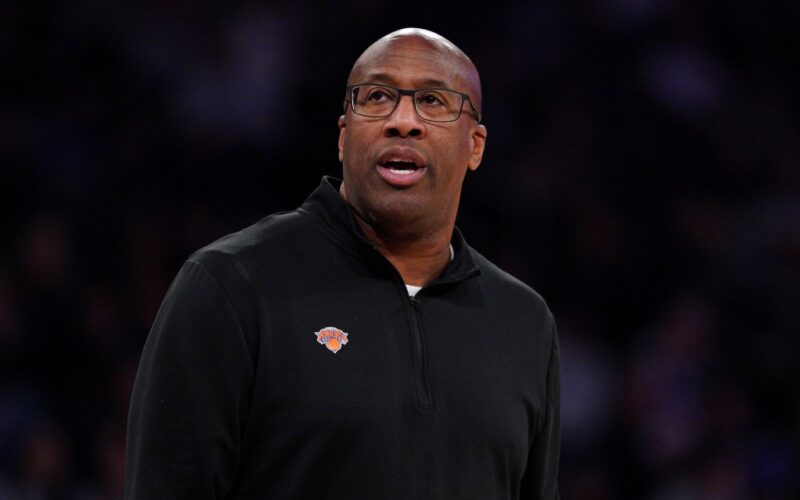
Shot distribution? Not so much. Ball distribution and body movement? Those are musts for head coach Mike Brown’s new offensive system.
Shot distribution has been a sticking point in recent games, culminating with Monday’s loss in Detroit. It was the Knicks’ season-worst fourth loss in a row, a 31-point defeat to a Pistons team expected to stand in-between New York and its championship aspirations.
In that game, Karl-Anthony Towns and OG Anunboby — New York’s two highest-paid players — took four shots apiece and combined for only 11 points while Jalen Brunson took 21 shots and Mikal Bridges shot 10.
In the previous game, a loss to the Philadelphia 76ers, Towns took one shot in the first quarter while Brunson and Bridges combined to shoot 13 times. By halftime, the All-Star big man was one-of-six from the field for two points compared to 20 total shots split near evenly between the two Villanova products.
Brown said shot distribution isn’t the biggest indicator of his offensive efficiency. But it’s a red flag if players are standing around idly, watching one player with the ball instead of working in tandem to run the offense.
“Shot distribution, no. Body and ball movement, yes,” Brown said ahead of tipoff against the Los Angeles Clippers on Wednesday. “I’m more apt for body and ball movement because shot distribution is going to vary.”
Brown used a Hall of Fame example. He harkened back to his time as an assistant coach with the Golden State Warriors, who won four championships in an eight-year span. Brown was an assistant on Steve Kerr’s bench for their final three title runs in 2017, 2018 and 2022.
And the Warriors had established a clear pecking order that could vary game-to-game but largely remained the same.
“One of the greatest shooters of all-time that I’ve been with in the past is Steph Curry. He may go the first half with five shots or three shots or whatever, and maybe he ends with 12 or 15 [shots] if he didn’t get that in the first half, but at the end of the day, it’s all gonna be whatever it needs to be,” Brown said. “At the end of the day, Steph’s gonna have the most shots, [Kevin Durant]’s gonna have the second-most shots, Klay [Thompson] may have [the third-most], and that’s what you’re looking at, because not everyone’s gonna have their average of shots every game.”
Yet far too often — for stretches that seem to last a lifetime — the Knicks don’t get into any offense.
They don’t touch the paint, spray the ball out the perimeter, reverse the ball from one side of the floor to another, play with pace or make quick decisions in the half court, each being staples of Brown’s up-tempo, free-flowing offense.
Instead, the offense stagnates. It looks like years past, where players took turns playing hero ball, beginning with New York’s score-first point guard. And it’s especially true in the first quarters, where Brunson trails only Luka Doncic in both scoring (10.5 points) and shot attempts (7.5) on the season. The Knicks’ captain leads the NBA in both opening period points and field goal attempts over his last four games, but he is one of only two players in the category with a losing record during that stretch (0-4). The other is Indiana’s Pascal Siakam, the lone offensive engine for an injured Pacers team.
Clippers head coach Tyronn Lue said it can take a team quite some time to adjust to new philosophies when they’ve been with the same coach for an extended period of time. The Knicks fired head coach Tom Thibodeau, who held the job since 2020, and are clearly still learning what Brown wants on offense.
“If you’ve been with a coach for five or six years, it’s a little different to try to change their habits and things they’ve been doing in the past,” Lue said ahead of tipoff against the Knicks. “But it takes about 25 to 30 games to figure out what a coach wants to do offensively and defensively.”
Brown knows there’s a delicate line to walk. His two-best players are tremendous individual offensive talents who need the ball in their hands to be effective. But the ball is sticking at rates the team hasn’t seen since last season. The ripple effect of the defense collapsing is no coincidence.
The Knicks own a bottom-three defense over the life of their four-game losing streak and are fifth-worst in defensive efficiency over their last eight games.
“When you go through times like this is where you rely on what your standard is. Our standard is about sacrifice, it’s about competitive spirit, it’s about connectivity, and it’s about a belief while being held accountable — starting with me — and then you lean on your staples on both sides of the ball, and when you do that, it can help you get through some of those rough patches. And maybe you lean on this staple a little bit more than the next one,” said Brown. “Maybe you play a little bit faster instead of always worrying about touching the paint because we’re not always figuring that part [touching the paint] out.
“There are different things you can do, but you really rely on the things or the foundation of what your philosophy is and what you’re trying to put in place for the group. And hopefully they continue to embrace it and find different aspects of it to hang their hats on over the course of this time.”