




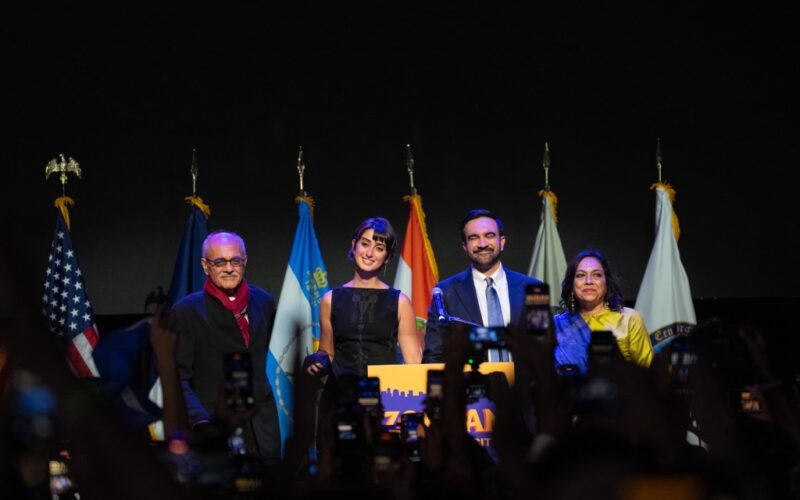
Mayor Mamdani’s election has been hailed as transformative in more ways than any other election in recent history with both adherents and opponents noting its many pathbreaking aspects ranging from his clearly professed faith, his youth and his iconoclastic ideas on economic and social issues among others. Less noted is the incredible mosaic of voters from an astonishing medley of countries that propelled him into office.
A big component of that mix was voters from the Indian subcontinent better known as South Asia. While he has often spoken about his South Asian background and even waded into the politics of that region voters, other than those with ties to that part of the world, are mostly unaware that South Asia as a unified construct not only does not exist but, in fact, is a brew of seemingly immiscible faiths, languages and races that episodically boils over onto the global stage.
The mayor’s roots from his mother’s side is from post-independent India while his father’s side goes back to undivided British India, an entity that spawned three separate countries in the post war era including two, India and Pakistan, that have been continually at war since their birth.
It is striking, therefore, that New Yorkers from the two countries overwhelmingly voted for him seemingly in a rebuke to the polarizing and vicious politics that have bedeviled both countries for more than seven decades. That may owe, in part, to the oft expressed affection and interest the mayor has for both countries.
But it was Mamdani’s recent interaction with a Pakistani aunty (in his parlance) when the ever-present arresting smile on his face was replaced with a welling of tears. It was an image that went on to generate a wellspring of warmth and hope in her home country. The idea that someone from that region and of their shared faith can reach a pinnacle of American government was electrifying to her fellow citizens.
However, across the border in India the response has ranged from tepid acknowledgement of his electoral success to anger over his missive to a jailed Indian dissident. That is a pity as the mayor’s victory shows that it is entirely possible for people of putatively opposite faiths to come together on social and economic issues.
During his interaction with the Pakistani aunty Mamdani acknowledged having visited her home country but there is no extant record of his having visited India. A visit there may be a high bar to overcome given his stance vis-à-vis the politics of the Indian government but it would arguably be more impactful than even a presidential visit if only because of his potential ability to thaw the decades long frost that hangs over the two countries by bringing along people of divergent faiths and beliefs as he has shown in his electoral run.
It was during a visit in early 2020 to Pakistan for the Lahore Literary Festival that I saw the curiosity if not yearning on the part of regular citizenry to get a glimpse of life on the other side that was clouded by the nearly impenetrable bureaucratic process to obtain a visa to cross the border for citizens of either country. The situation had only worsened on a more recent visit last month when a South Asian version of the 38th Parallel that separates the two Koreas had been imposed on the border separating the two countries.
With his propensity to touch upon issues and areas that transcend city governance, an initiative of this kind by Mamdani could easily be viewed as part of a broader remit. The mayor could embark on it with a symbolic walking across the only land border crossing between India and Pakistan on the outskirts of Lahore. An out-of-the box initiative such as this by the mayor likely will bring immeasurable and immediate benefits.
It is no accident that a defining feature of intractable hostilities between nations is the fact that the peoples involved have little to no interaction with each other resulting in prejudice, bigotry and an “othering” of the other side. The bully pulpit of New York City’s mayoralty is a powerful tool to propel a transformative initiative that could bring an end to the decades of conflict and foster peace. That would be a tremendous gain not just for the two countries directly involved but also for New York City and the U.S.
Dandapani is a New York City hotelier who is writing here in his personal capacity.