



Riding a four-game losing streak with one game at home before embarking on a four-game West Coast road trip, the Knicks had no choice but to beat Kawhi Leonard’s rolling Los Angeles Clippers, winners of seven of their last eight games, on Wednesday night, as dropping a fifth could have ushered in a free-fall of diabolical proportions.
The Knicks did win, 123-111, in a turn of events that may have saved a spiraling season—because Mike Brown held a mirror in front of his team during practice at the Tarrytown training facility on Tuesday. The Knicks hated their reflection so much, they changed their ways, and at Madison Square Garden, the trajectory of the rest of their year.
“I know our guys care. I know they want to win, and it’s my time to keep it real with them, tell the truth,” Brown said before his team went on to win the most important (official) game of his Knicks career. “But also coach them and show them confidence and strength during this time. And that’s while trying to help them, so that’s all I’m trying to do.”
Brown helped his team through the second-biggest victory of their season, the first being the NBA Cup win over the San Antonio Spurs, a game that marked the turning point for a team that would go on to undo the good the they’d done to begin Brown’s first year on the job.
Whether or not his Knicks can stick to his script the rest of the way remains to be seen. But for one ostensibly fleeting night, the Knicks played Knicks basketball again. And at long last, Brown found a way to get through to his team, and in doing so, he saved New York City’s best chance at reaching the NBA Finals in an contentious Eastern Conference playoff race.
“I applaud our guys because we hit some adversity, and we could have gone this way and another guy could have gone that way, and another guy could have gone that way, but one of our standards is staying connected, and it’s up to me and KAT [Karl-Anthony Towns] and Jalen [Brunson] to keep the group uplifted and connected as well as everybody else in that locker room,” he said. “The guys did a heck of a job, and we’ve been doing it for most of the year. So it’s not surprising when we do [execute our principles]. It’s more surprising when we don’t.”
“When you lose four in a row, the message is, man, effort. Go back to what we we’re doing to get those wins previously,” added Miles McBride. “It wasn’t a secret: The games that we lost, it was a lot of stagnant play, a lot of guys trying to make plays on their own, including me.
“So [Mike’s] message was just play the right way.”
***
If a player isn’t touching the ball on offense, then he’s not going to give full effort elsewhere on the floor. Fans may not like it, but it’s a simple fact of the NBA.
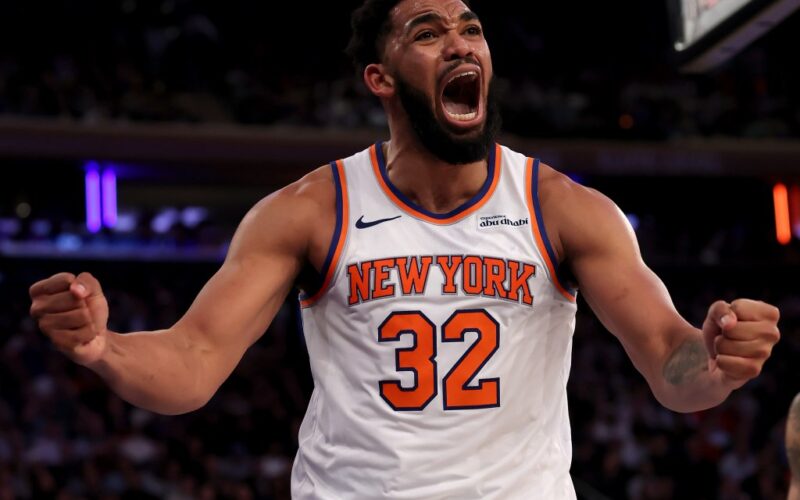
It’s not necessarily about shots, says Mike Brown, something Karl-Anthony Towns echoes after breaking out of his slump with 20 points, 11 rebounds and seven assists against the Clippers. Towns shot 6-of-18 from the field and 0-of-4 from three-point range.
Yet the Knicks outscored the Clippers by 16 points in his 31 minutes on the floor. On the contrary, over his previous four games (featuring three Knicks losses), Towns shot 4-of-9 from the field against the New Orleans Pelicans, 5-of-10 against the San Antonio Spurs, 6-of-16 against the Philadelphia 76ers and an unfathomable one-of-four against the Detroit Pistons. Towns had just two points in the first half of the loss to the Sixers and two field goal attempts in each half against the Pistons.
It’s a microcosm of everything that went wrong with the offense, because Towns is a player the Knicks traded Julius Randle, Donte DiVincenzo and a first-round pick to acquire in a deal with the Minnesota Timberwolves, a five-time All-Star reigning as one of the most gifted scoring seven-footers in NBA history.
And he’d been effectively frozen-out by an offense that forgot how to move the ball.
Yet on this night, Towns missed twice as many shots as he attempted. But the ball found him, over and over. The Knicks’ big man began looking like an All-Star again, and he scored nine points in the fourth quarter, helping the Knicks increase their lead to 15 against a tough Clippers team.
“I just try to impact winning, man, when the ball hits my hands and I get a chance to impact the game offensively, especially, I want to do that,” said Towns. “And that’s not just by shooting. That’s by getting my teammates involved, making the right play that gets the next person the shot—the hockey assist. Any time I touch the ball, I’m trying to be aggressive with my playmaking, whether that’s making a play or making a play for my teammates.
“But I just want to impact winning every single day and just give ourselves the best chance to win the game and our fans a chance to cheer.”
Thirty-six hours earlier, Brown would present to his team the cold-hard truth that would get them moving the ball again.
“Tonight was a night that I think us in the locker room did a great job of hearing what [Mike] said yesterday and what he presented to us and trying to play off of that information,” said Towns. “And I thought we did a good tonight of getting stops, moving the ball and I don’t think we pushed the pace as well as we could have, but I think we did a good job today of doing what we needed to do to get the job done.”
***
The offense had slowed down to a standstill.
It was the elephant in the room as the Knicks begun their downward spiral, which unofficially began after the NBA Cup victory but officially started when Josh Hart left the rotation on Christmas with an ankle sprain.
The Knicks beat the Cleveland Cavaliers, but they lost their starting playmaker—their quarterback. Because while Jalen Brunson is ostensibly a point guard, he is really a natural-born scorer. His default setting is to put points on the board.
But it went too far, and it created a ripple effect that led to selfish decisions elsewhere on the roster to shoot the ball at inopportune moments. The Knicks went from playing a free-flowing, up-tempo, equal-opportunity offense to one where Brunson would frequently use the game’s opening possessions for himself. The rest became a race to 10 field goal attempts from his teammates in their limited touches.
Brown presented at least three damning statistics that offered his team an unfiltered look at itself in the mirror, the Daily News has learned. Two are well-known: paint touches and spray threes (i.e. drive-and-kick), each of which were trending toward season lows during the stretch.
The third? The News highlighted this trend following the loss to the 76ers: Brown showed his players the team numbers for passes per game. It was a laughable amount.
And Brunson knew it began with him as the head of the snake and the captain in orange and blue.
“Whatever it took to win. I think we were pretty desperate for a win, and they had two on the ball on me for the majority of the game,” he said. “So I tried to attack it and tried to get off [the ball] quick to see if we could get an advantage playing four-on-three, and at the end I got away from it but just reading what the defense was playing.”
On the Knicks’ opening offensive possession, Brunson blew by Kawhi Leonard with a crafty in-and-out, got two feet into the paint to force then rifled a pass to OG Anunoby in the corner.
A paint touch spray by definition.
Anunoby snap-drove, touched the paint, then hit Brunson, who had relocated to the opposite corner.
Another paint touch spray. Plus-10 team chemistry.
The possession resulted in a turnover, but it signaled something greater: Brown’s message, indeed, got through to his team. This time, they wouldn’t deviate. Thirty-one assists on 47 made field goals. Brunson posted the most efficient 25-plus-point game of his career: 26 points on 9-of-12 shooting from the field and four-of-five shooting from deep plus seven assists and two turnovers just 48 hours after he finished with zero assists, six turnovers and 25 points on 21 shot attempts in a 31-point loss to the Detroit Pistons.
Does ball movement on offense get teammates engaged elsewhere on the floor?
“It shouldn’t, but I think for the most part, we played a little desperate tonight. We needed a win, and I think the way we competed, the way we played in the first half was Knicks basketball,” said Brunson. “And we just kept playing that way and found a way to win. But just keep believing in the process and not being so result-based. I think the way we played tonight was good, we’ve just gotta continue to learn from it.”
The Knicks learned the hard way, but they learned nonetheless. This team is built to move the ball. When that doesn’t happen, the house of cards falls apart. And the Knicks couldn’t see the mess they made until their head coach saved their season, holding a mirror to a group blinded by bright lights in Las Vegas, where they hoisted a trophy unworthy of a championship banner.
“I have to make sure that I understand and I have some patience when we [deviate] because they’re human, and I’m human, and everyone’s gonna make mistakes or revert back,” said Brown. “You just hope it’s not for a long time. And when it happens, you’re like ‘OK, that’s who we are.’
“And I feel that they feel pretty good about it, too, because [tonight] just proves or shows that they’re capable to play that way any time they want.”
“[Maintaining this style of play] shouldn’t be difficult,” added McBride. “It’s about effort. It’s about bringing it every night, being able to look in the mirror and know that you gave it your all. So we should be able to bring it every night. Our job is to do this.”