



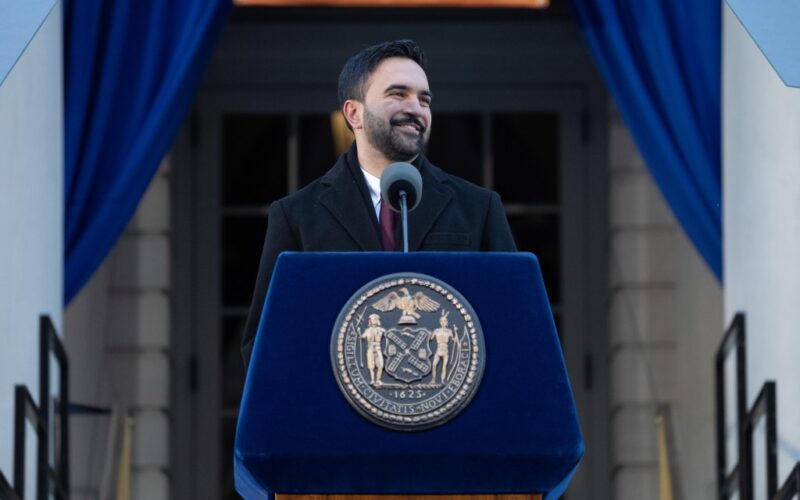
New York’s new mayor says he wants to be the mayor of working people — committed to affordability, fairness, and dignity in a city that has become increasingly unaffordable and unfair for ordinary families.
That’s an admirable goal. But Mayor Mamdani’s first acts in office reveal a contradiction that threatens both his credibility and his agenda.
Within hours of taking office, he rescinded former Mayor Eric Adams’s executive orders barring city support for the Boycott, Divestment, and Sanctions (BDS) movement against Israel and adopting the International Holocaust Remembrance Alliance (IHRA) definition of antisemitism. These were not perfunctory moves; they were deliberate policy statements by the mayor of the city with the largest Jewish population in the world.
Mamdani didn’t have to begin his tenure this way. He could have focused on housing, transit, sanitation, or grocery costs — the very issues he campaigned on. Instead, he chose to make Israel, and by extension New York’s Jewish community, an early defining issue of his mayoralty.
By discarding the IHRA definition, the mayor did not expand free speech — he dismantled the most widely accepted framework for identifying antisemitism, including the double standards often applied to Israel. The IHRA definition matters precisely because antisemitism so often disguises itself as something else.
Endorsed by more than 45 countries, 30 U.S. states, and thousands of institutions, IHRA begins with a clarifying principle: “Criticism of Israel similar to that leveled against any other country cannot be regarded as antisemitic.” That statement alone refutes claims that IHRA is meant to silence debate.
Antisemitism has always shape-shifted to suit the politics of its era — and the perceived transgressions of the Jewish community. IHRA instead helps institutions recognize familiar patterns: denying Jews the right to self-determination, applying standards to Israel no other democracy faces, or rationalizing violence against Jews in the name of ideology. These examples do not restrict speech; they define when it becomes discrimination. By rejecting IHRA, Mamdani deprived New York of a responsible and widely shared standard — and sent a troubling signal about whether Jewish concerns will matter at all.
His embrace of BDS raises similar alarms. More than 30 states have adopted anti-BDS policies under both Democratic and Republican leadership. The principle is straightforward: taxpayer dollars should not fund organizations that discriminate against Israeli-linked individuals or institutions.
BDS doesn’t target governments but people — artists, academics, small business owners, and workers, many of them New Yorkers. When city leaders legitimize BDS, they are not advancing justice; they are validating a movement that singles out Jews and Israelis for exclusion.
The problem isn’t criticism of Israel; it’s selective moral judgment masquerading as solidarity. Wrapped in the language of progressivism, it isolates Jews — many of them working-class New Yorkers — from the very coalitions they help build.
Mamdani presents his politics as a fight for fairness and unity. Yet his rhetoric assumes that Jewish identity is synonymous with privilege, that Jewish concerns are secondary — or suspect. That assumption is wrong. And it would be intolerable if applied to any other minority.
Imagine a mayor who claimed to champion working people while dismantling protections against anti-Latino discrimination because of opposition to Mexico’s government. Or one who dismissed concerns from Black New Yorkers by citing disagreements with African leaders. Or one who justified policies targeting Muslim institutions by pointing to grievances with Middle Eastern regimes. Such behavior would be instantly recognized as discriminatory and disqualifying.
Yet when it comes to Jews, this double standard often passes as principle.
Words from leaders shape behavior. Progressives have long argued — often rightly — that incendiary rhetoric from public officials can legitimize harassment, intimidation, and violence. Why should a different standard apply here?
When the mayor demonizes Israel, refuses to reject slogans historically tied to violence against Jews, and dismantles safeguards against antisemitism, he helps create an environment where New York Jews feel less safe. That connection is visible in rising antisemitic incidents and the daily security burdens borne by Jewish schools and synagogues. And Mamdani should stop convincing himself that because some progressive Jews support him or that a few fringe Jewish organizations agree with his indictment of the current Israeli government, that this will shield any in our community against the spread of antisemitism.
A mayor who governs by carving out exceptions to whom fairness applies cannot unite this city. New York deserves better.
Moore is president of the Jewish Community Relations Council of New York. He previously served as chair of the board of UJA-Federation of New York and president of City Parks Foundation.