




In the upcoming 2026 New York State legislative session, a critical bill — End Health Professionals’ Complicity in the Torture of Detained or Incarcerated Individuals Act will be considered. Sponsored by Sen. Julia Salazar and Assemblymember Anna Kelles, in its essence, this bill requires health care professionals to report abuse of incarcerated individuals at the hands of correctional staff.
An immediate question would ask why a law is needed to ensure ethical behavior by the helping professions — those considered to be on high moral ground to begin with. The assumption is that they would naturally report or otherwise intervene in any brutality.
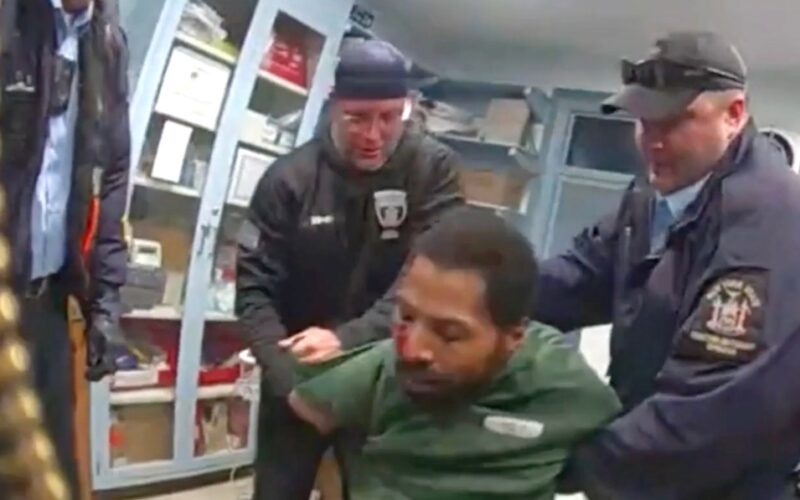
Yet, in the widely viewed videos of the murder of Robert Brooks at New York’s Marcy Correctional Facility, the public saw otherwise. As the handcuffed Brooks was being mercilessly beaten to death by officers, the cameras also captured nurses who stood by impassively.
While these nurses represent the extreme end of the spectrum, inside correctional facilities, powerful forces inhibit normal ethical behavior, something I learned in my five-year tenure in the Rikers Island mental health department. In only my second week at the jail, I encountered a man who’d been badly beaten, who confided that he’d been beaten by guards.
In response I sought out my supervisors, envisioning them picking up the phone immediately. Instead, they told me to pull up a chair. In one sentence they laid out the reality of working in a jail: “We are guests in their house.” What this meant was that guests who questioned their hosts’ actions face retaliation. We were to do nothing. I was stunned.
But in the ensuing years, I came to understand. Health care professionals do not operate autonomously inside correctional facilities. They rely on guards to bring people to clinics for treatment. Nor are they provided with their own sets of keys to access infirmaries, clinics, housing units and psych wards. Every door must be unlocked by a guard. For someone falling out of their favor, summoned detainees may not be “produced,” and for staff trying to navigate the facility, there may be long delays in doors being unlocked. Messages are delivered.
But the messages weren’t always subtle. When a physician’s assistant documented his honest impressions of a detainee’s injuries — refusing the explanation that he’d slipped in the shower — he was told by the warden, no less, that his safety could no longer be guaranteed. And then, there were whispers about health care staff who were a little too vocal, finding their tires slashed when their workday ended.
While abuse was usually delivered discreetly, its evidence was everywhere, from gurneys rolling into the clinic after a rough housing search, to ungodly shrieks coming from the receiving rooms. And then, there was the abuse we learned about in our sessions. In one case, I had been working with a veteran suffering from bipolar disorder. Not yet stabilized on medication, he was manic, proselytizing to one and all.
One morning, he showed up for his session, uncharacteristically quiet, his eyes blackened, front teeth gone. “The guards knocked out my teeth,” he sobbed. I was horrified and my immediate reaction was that we report it. “No!” he cried. “Next time they’ll kill me.” I knew he was right. If the Marcy videos did nothing else, they showed that the danger inside these facilities is very real.
But now, this bill offers a potential solution. Utilizing a safe reporting mechanism, it requires health care professionals to report abuse, taking such reports out of the hands of a personal decision fraught with risk — to a matter of law. The implications are far reaching — with the recognition that abuse reports are not discretionary, but mandatory, retaliation would be minimized. Most importantly, the understanding that abuse will be reported would offer a powerful deterrent against brutality toward the incarcerated.
Far too often, imprisonment goes beyond the loss of liberty, to include beatings, humiliation and murder, perpetrated by correctional staff — abuse that is far more pervasive than “a few bad apples.” But with health care professionals no longer unwittingly complicit with abuse, this law stands to firmly disrupt this dangerous culture. The ultimate result would be a safer environment for the incarcerated, most of whom will return to society. People who have been punished but treated humanely have a far greater chance of successfully reintegrating into society, an important consideration for all of us.
Buser, the co-director of Social Workers & Allies Against Solitary Confinement, is the author of “Lockdown on Rikers: Shocking Stories of Abuse and Injustice at New York’s Notorious Jail,” based on her work as an assistant mental health chief on Rikers Island.