
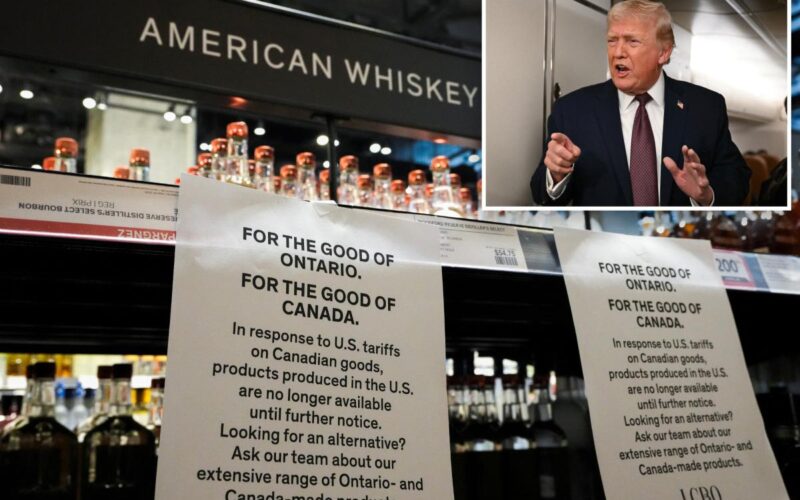
President Trump is reportedly pressing Canada to lift a sweeping boycott of US-made alcohol as new data shows American distillers getting hammered by a collapse in sales north of the border.
Several Canadian provinces, including Ontario, Quebec and British Columbia, yanked US wine and spirits from government-run liquor stores after Trump launched a trade war last year — a move that has cost American booze makers millions of dollars in lost sales, Bloomberg News reported.
US trade rep Jamieson Greer reportedly warned last month that conducting a successful review of the US-Mexico-Canada Agreement — in which many products are still exempt from US tariffs — hinged on provinces lifting their US booze bans
Brown-Forman, the maker of Jack Daniel’s, told Bloomberg that its Canadian organic net sales plunged more than 60% in the first half of its 2026 fiscal year, with Chief Executive Officer Lawson Whiting calling the boycott “worse than a tariff.”
Smaller producers have been hit even harder.
Minnesota-based Phillips Distilling said its Canadian sales dropped by roughly 70%, forcing the company to shift production of its Sour Puss brand to a contract manufacturer in Montreal to keep supplying the market.
Phillips Distilling CEO Andrew England told Bloomberg News that the loss amounted to about 15% of the company’s branded business.
“It was very frustrating,” he was quoted as saying. “If you take away 15% of our branded business, that’s a big problem.”
England added that he had “no idea how this is going to settle out with the US and Canada, which is why we need to operate separately in Canada, and just get on with it.”
Jim Beam paused production at its main US distillery after weakening demand led to a glut of unsold whiskey, though the company did not cite the Canadian boycott as one of the reasons for the move.
Still, the damage from the boycott is visible in national trade data.
In October, American exports of wine to Canada fell 84% from a year earlier, while exports of distilled spirits dropped 56%, according to the US Department of Agriculture.
Canada, once the top export market for US wine, has since seen bilateral wine trade plunge 91%, according to a complaint filed by the American wine industry.
Most Canadians continue to back the boycott of US-made alcohol, viewing it as a direct response to Trump’s escalating trade war.
Nearly three-quarters of Canadians support keeping made-in-USA booze off store shelves, according to a late December Nanos Research Group poll, while just 20% favor resuming sales.
That hard line reflects growing anger over Trump’s aggressive tactics toward Canada, including tariffs on steel and aluminum and threats to slap punishing import taxes on the country’s auto sector.
Throughout last year, Trump talked about annexing what he called “the 51st state” through “economic force,” ruffling feathers in the Great White North, though he appears to have dropped the line.
The White House has been defending the president’s trade policies, noting that his tariffs have generated about $236 billion for the US treasury.
“President Trump’s skillful use of tariffs has created unprecedented market access for American products to economies that in total are worth over $30 trillion with over one billion people,” White House spokesperson Kush Desai told The Post.
“As these trade deals and the Administration’s pro-growth policies of deregulation and working-class tax cuts take effect, it’s going to be bottoms up for American distillers, brewers, and winemakers.”
Public opinion surveys show opposition to US goods is strongest in provinces hit hardest by Trump’s sector-specific tariffs, including Ontario, Quebec and British Columbia.
About 71% of Canadians say they are now less likely to buy US-made products than they were before the trade war, according to Nanos, suggesting public support for keeping the boycott in place has hardened.
Most Canadian provinces control liquor sales through government-run monopolies, allowing officials to swiftly and uniformly pull US alcohol from shelves.
Provinces including Ontario, Quebec, British Columbia, Nova Scotia, Manitoba, Newfoundland and Labrador and Prince Edward Island all operate provincially owned liquor boards that can remove products by directive.
Alberta and Saskatchewan were the lone exceptions, continuing to sell US booze throughout the boycott because both provinces rely on fully privatized liquor retail systems.
The Post has sought comment from the Canadian government, Brown-Forman and Phillips Distilling.