




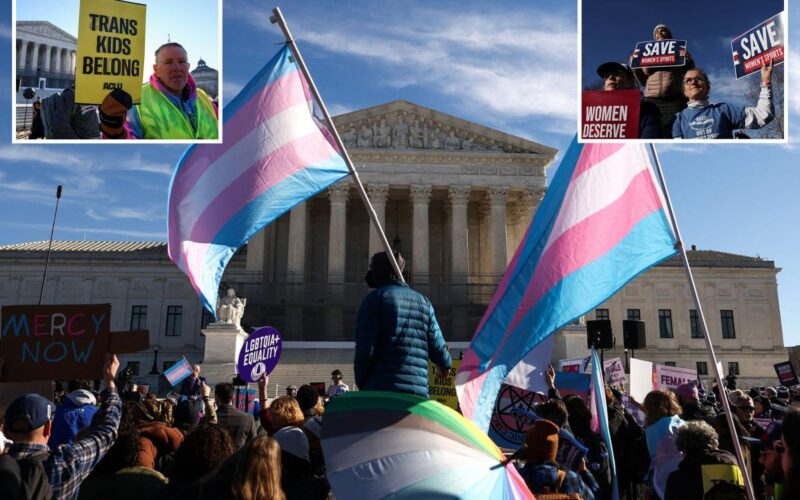
WASHINGTON — The Supreme Court indicated Tuesday that it would uphold landmark bans on transgender female competitors playing girls’ sports in Idaho and West Virginia.
In back-to-back oral arguments lasting more than three-and-a-half hours, members of the six-judge conservative majority asked pointed questions of attorneys representing challengers to the two state laws.
Twenty-seven states currently have laws on the books restricting or banning athletes who were born as biological males from competing in women’s sports.
“Given that half the states are allowing it — allowing transgender girls and women to participate — and about half are not, why would we, at this point … jump in and try to constitutionalize a rule for the whole country?” conservative Justice Brett Kavanaugh asked an attorney challenging Idaho’s ban.
“There’s still, as you say, uncertainty and debate.”
In the first case before the court, Lindsay Hecox, 24, was challenging Idaho’s Fairness in Women’s Sports Act, which restricts trans women from joining female sports teams in all state institutions from elementary school through college.
Hecox, an aspiring track and cross-country athlete for Boise State University, had argued the state law violated the Equal Protection Clause of the 14th Amendment.
The second case was a challenge from Becky Pepper-Jackson’s mother to West Virginia’s Save Women’s Sports Act. Pepper-Jackson transitioned from male to female during the third grade, before going through male puberty.
Lower courts have blocked Idaho’s and West Virginia’s laws from going into effect, allowing Pepper-Jackson to compete for her school in girls’ track.
“Do you think that the success of trans athletes in women’s sports is proportional to the percentage of trans athletes who participate in women’s sports?” conservative Justice Samuel Alito asked Hecox’s attorney, Kathleen Hartnett, at one point.
Hartnett contended that her team’s briefs to the Supreme Court showed “that’s a bit overstated,” and noted that Hecox didn’t make the cut at BSU.
Alito also pressed Hartnett about “what it means to be a boy or a girl or a man or a woman,” with the attorney declining to give a definition.
“Let’s take, for example, an individual male who is not a good athlete, say, a lousy tennis player, and … wants to try out for the women’s tennis team, and he said, ‘There is no way I’m better than the women’s tennis player.’” conservative Justice Clarence Thomas said.
“How is that different from what you’re being required to do here?” he asked, referring to Idaho’s law.
Liberal justices made sure to grill attorneys for Idaho, West Virginia, and a Trump administration lawyer defending the bans.
“Is treating someone who is transgender, but who does not have, because of the medical interventions and the things that have been done … the same threat to physical competition and safety and all the reasons the state puts forward – that’s actually a different class, says this individual,” Justice Ketanji Brown Jackson, who famously declined to define a woman during her confirmation hearings in 2022, asked Idaho Solicitor General Alan Hurst. “So you’re not treating the class the same. And how do you respond to that?”
The West Virginia case also dealt with whether Title IX, which bans sex-based discrimination in schools that receive federal money, means that states can’t prevent transgender individuals from competing in women’s sports.
Notably, President Trump had used Title IX as the basis for his executive order last year targeting states that allow transgender women to compete in women’s sports.
“If they’re right about the facts, then we should lose,” said Joshua Block, an attorney for Pepper-Jackson, said, suggesting the case should be kicked to the lower courts to sort out the science of athletic competition.
Heading into the arguments, many experts were carefully watching conservative Justice Neil Gorsuch, who shocked observers five years ago in Bostock v. Clayton County, by joining the liberal minority in finding that employees can sue for discrimination over sexual orientation and gender identity under Title VII of the Civil Rights Act.
Back then, Gorsuch had famously been quiet during oral arguments, and conservatives had a 5–4 majority. Now they have a 6–3 majority and, on Tuesday, Gorsuch was quite vocal, pressing all sides.
“I’ve been wondering what’s straightforward after all this discussion,” Gorsuch grumbled at one point during a technical exchange about what type of protected class transgender individuals might be after Hartnett said she was trying to find a “straightforward” answer for the high court.
This is the first time that the Supreme Court has had to address the culture war issue of transgender competition in women’s sports, though last year, it ruled that states can ban transgender treatments for minors.
A decision in the cases, Little v. Hecox and West Virginia v. B. P. J., is expected by the end of June. Although it heard them separately, the Supreme Court could address them in the same opinion.