




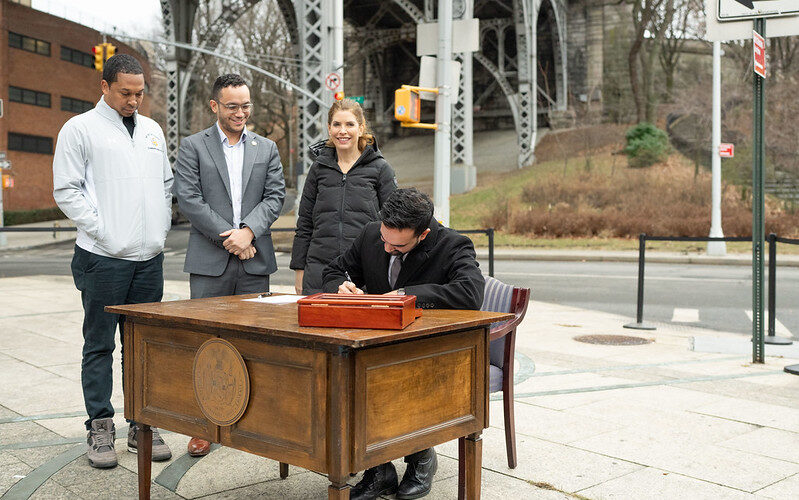
Mayor Mamdani has rightly been focusing on the small ball of “sewer socialism” in his first days in office. He is trying to get stuff done, like shoveling potholes at the foot of the Williamsburg Bridge and imagining walk-able streets. These actions matter to people, but the mayor is looking for a bigger pay-off. He wants — and he absolutely needs — to stir a new faith in and trust in government.
No surprise then on Saturday, he announced a $4 million commitment to building more public bathrooms across the city.
While making his pitch for more toilets, the mayor couldn’t resist a pun or two, but he quickly pivoted to more serious matters. He pointed out what all New Yorkers know, that the city doesn’t have enough public places to go. Currently New York City lags behind St. Louis and Iceland in toilets per capita with only 1,000 or so public bathrooms for its 8 million residents and legions of suburban-based stock traders and tourists from far-flung places.
But the mayor wasn’t just playing a numbers game. More than streetscapes or potholes, public bathrooms embody his blueprint for a new municipal social contract, a city made fairer and less mean by a repurposed, generous, and muscular government.
“In the greatest city in the world,” Mamdani asserted, “you should not have to spend $9 to buy a coffee just to be able to find a little relief.”
Truly public bathrooms open to everyone, not pay toilets masquerading as cafes, as the mayor points out, aren’t just a matter of inconvenience, they are essential to equality.
Equality of movement in a city covered by subways where people leave home to go to work, to school, and to eat, requires public bathrooms. Without this critical infrastructure, the comings and goings of many are constrained. More public bathrooms — especially well-maintained, single-stall, rather than sex-segregated, bathrooms open from morning to night — will make the city more accessible to more people.
But public bathrooms can do even more. They can show, not just tell, citizens about government.
Here, Mamdani would do well to look to the past. In 1902, the wealthy philanthropist and reformer, R. Fulton Cutting, wrote a letter to the New York Times calling for $250,000, or roughly $9.6 million today — in municipal funds to build new public restrooms across the city.
“The great public works,” Cutting asserted, “such as bridges, tunnels, concourses, docks, and reservoirs, are accepted as matters of course, and are but vaguely appreciated by the majority of our citizens.” That’s because, he continued, these investments “do not come home to the people.” But public bathrooms “lying at the very doors of the masses, speak eloquently of the concern of officials for those to whom ordinarily the Government is something remote and apart.”
Then, Cutting came to his main point. You have govern small if you want to eventually govern big. Public bathrooms, he said, “citizens can be made to feel the intimate regard for governmental powers.” Public bathrooms, in other words, weren’t just something he and his associates needed when they were away from home. They could make clear to ordinary people, better than any other action, the value of government and the concern of public officials for the well-being of everyone. This goodwill could, in turn, be leveraged down the line for more expansive government action.
That’s what Mamdani needs to do. He needs to “prove,” as he promised in his inaugural address, that “the city belongs to the people.” Public bathrooms can make that case, and the even larger case, that a big government committed to fairness and equality is built on a combination of robust spending and intimate actions. Now Mamdani needs to imitate Cutting in one other way. He needs to double, or maybe, triple his public bathroom spending. It will pay off.
Simon is a history professor at Temple University who has just finished writing a history of public bathrooms in the U.S., “For Customers Only: Public Bathrooms and the Making of American Inequality,” which is being published in September by the University of Chicago Press.