



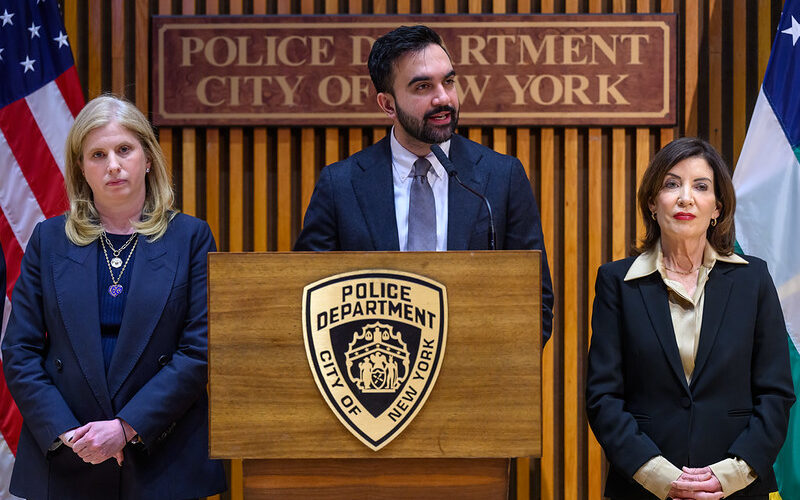
Last week, Mayor Mamdani, Police Commissioner Jessica Tisch, and Gov. Hochul announced at a joint press conference that in 2025, shootings reached their lowest level on record. For anyone spoiling for a fight between an unabashedly progressive mayor and a police chief hired by a more traditionally “tough-on-crime” mayor, it may have been a letdown. But for those who understand what it takes to deliver public safety, it was no surprise at all.
To truly deliver community safety, collaboration is the only way. Mamdani, Tisch, and Hochul’s unified front stressed the importance of the many roles — police officers, mental health workers, community violence interrupters, and more — that need to play their part to keep communities safe. This comprehensive approach has been pivotal for other mayors who have driven historic crime declines, like Boston’s Michelle Wu and Baltimore’s Brandon Scott.
This kind of government collaboration is exactly what Mamdani’s Department of Community Safety (DCS) will strengthen. As similar agencies have done across the country, it will transform New York’s safety infrastructure by coordinating and expanding existing tools like crisis response, peer support, violence intervention, and trauma recovery. As Mamdani said, “It is about supplementing, as opposed to supplanting, the work that the NYPD does.”
I have spent 17 years helping cities and their police departments — including NYPD — build and sustain effective safety solutions. As Mamdani’s administration builds DCS, I see three key actions that will help it thrive alongside existing services, most notably the NYPD.
First, the city must continue to center collaboration between agencies, including NYPD, FDNY, Health + Hospitals, the Department of Social Services, and others, from the earliest planning phases. Cities that have successfully created these departments prioritized this engagement. In Albuquerque and Durham, N.C., future collaborators were part of the planning from the beginning. And in New Orleans, the health and police departments jointly developed new protocols to guide collaboration between police and crisis responders.
While not new to New York, this kind of coordination is underutilized and episodic. Early partnership will set the stage for a respectful, collaborative relationship between DCS and NYPD, from leadership down to rank-and-file. The success of our neighbors in Newark, where police and the Newark Community Street Team meet weekly to discuss violence reduction, offers an excellent model.
As part of this collaborative process, the city and its agencies will have to make consequential decisions about each agency’s responsibilities. In the past, lack of clear guidance has led to problems like confrontations between police and violence interrupters. Mamdani would not speculate on whether DCS would have handled the incidents that led to two tragic shootings by NYPD officers last week, but with clear guidelines for first response, no one will have to guess. These decisions must be informed by evidence and experience alike, including ongoing input from New Yorkers accessing services.
Second, the administration should support 911 call takers, a critical first gate to emergency response, with high-quality training and revised protocols to guide them in dispatching the right first responders. Further, embedding behavioral health professionals at 911 call centers would help reduce unnecessary dispatching of NYPD by resolving calls over the phone and making best use of DCS and other first response options. After all, more than 60% of 911 calls in New York are for noncriminal matters.
Finally, DCS will need to use data to guide its work. This will require data-sharing from other city agencies, principally NYPD. Last week, Tisch highlighted how data guides NYPD strategy and that the department has “better data and more refined systems than [it has] ever had.” Barring confidential information, all agencies should have real-time access to the same data and regularly publish data on safety outcomes to share with the public. In the past, New York has led the way on such collaboration with innovations like the Crisis Management System and NeighborhoodStat. Now, New York has the opportunity to learn from its own experience and that of others.
New York didn’t become the safest large city in the country by accident — it’s the product of coordination, data, and a willingness to evolve. Building DCS is the next step in that evolution. Done right, it will allow the city to prevent harm before it occurs, respond more effectively when crises arise, and ensure the NYPD can focus on the serious crimes that most threaten New Yorkers’ security.
Gilbert is the director of the Vera Institute of Justice’s Redefining Public Safety initiative and served on the Mamdani administration’s Community Safety transition team. She formerly held positions in the Mayor’s Office of Community Mental Health and the NYPD.