




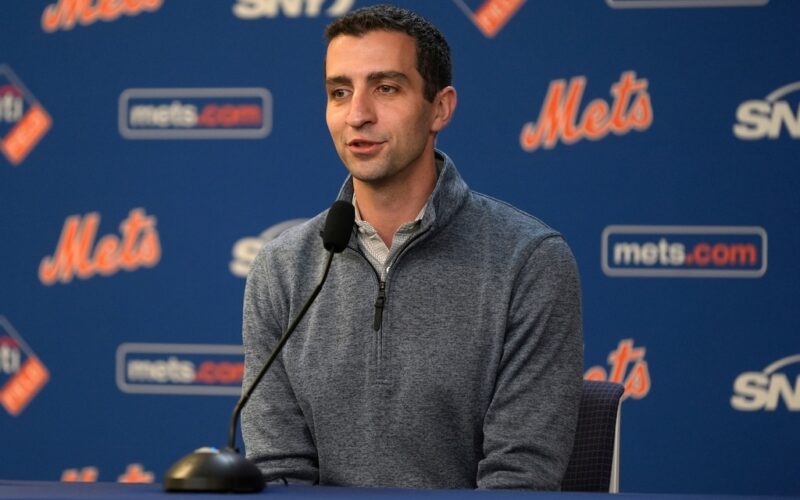
Following the end of the 2025 season, Mets president of baseball operations David Stearns took an unofficial poll of executives and coaches throughout the league to find out how the team was viewed throughout a turbulent season. The answer he found laid the foundation for the Mets’ offseason.
“We have to be better at keeping runs off the board,” Stearns said Tuesday at Citi Field during a roundtable with New York beat reporters. “Our pitching and defense has to be better. When I talked to either coaches at other teams, or managers at other teams, or executives at other teams in the weeks and months after our season, and I asked them, ‘Hey, what do you got on us?’ Like, ‘What do you think about our team?’ almost all of them, the first thing out of their mouths was, ‘Your defense wasn’t close to good enough.’”
As a team, the Mets had -13 Outs Above Average in 2025, 21st in the league. A -6 Fielding Run Value was also 21st, and their 0.3 Fangraphs defensive rating was 19th. The Mets had players capable of making dynamic defensive plays and there were plenty of highlight-reel catches from center fielder Tyrone Taylor, but the routine plays and the fundamental plays weren’t made with the regularity necessary to keep opponents from scoring.
There were also bad reads and late attempts to cut runners off. They played lazy at times.
This was the genesis of Stearns’ decision to prioritize “run suppression” this winter. It was also part of what led to the decision to break up the team’s homegrown core of Pete Alonso, Brandon Nimmo and Jeff McNeil, and the overhaul of the coaching staff under manager Carlos Mendoza.
“It wasn’t just us; this was something the league picked up on very quickly last year,” Stearns said. “Especially teams that played us over the last month or six weeks.”
So when it was reported that the Mets had made right fielder Kyle Tucker an offer for up to $50 million a year this week, some questioned the move. Juan Soto, the Mets’ current right fielder, did not have a great year defensively in 2025 (-13 FRV, -12 OAA), and neither did Tucker, another left-handed hitting right fielder, though his metrics were far better than Soto’s during his only season with the Chicago Cubs (0 FRV, -2 OAA).
The obvious answer is that Tucker is one an elite player, arguably a top-10 outfielder in the league, and his defensive performance with the Chicago Cubs was uncharacteristic.
A four-time All-Star with a career OPS+ of 140, his bat is impactful, and the Mets are lacking a proven impact bat beyond Francisco Lindor and Soto. As the team is currently constructed, switch-hitting Jorge Polanco or the right-handed Mark Vientos are the most likely candidates to hit behind Soto. Polanco, 32, is a good hitter coming off of a great season at the plate (.263 average, .821 OPS, 26 home runs), and Vientos has the potential to be the right-handed protection Soto needs, but he’ll need to have a bounce-back season after a down year.
Stearns isn’t concerned about one specific hitter behind Soto, instead, looking at the lineup as a whole.
“When I think about protection, I think about 1-9 in a lineup,” Stearns said. “I think there are a number of different ways you can protect players. I think you can protect them, obviously, with a bat behind them, you can also protect them [by] getting runners on base ahead of them. It’s really tough to walk Juan Soto all the time if there’s someone standing at first base.”
The Mets lost two significant run producers in Nimmo and Alonso, and a hitter who can hit anywhere in the order in McNeil. While Stearns is confident that the offensive production will be there with or without a player like Tucker, a big bat isn’t necessarily what he’s looking for.
“I don’t think we necessarily focus on exclusively replacing the home runs,” he said. “Home runs are important; I think we’re going to hit plenty of home runs this year. I think we’re going to be able to be a good team and win games in somewhat different ways than maybe we have over the past couple of years, and I think the roster we’re putting together will reflect that.”
Stearns has familiarity with Tucker from his time in the Houston Astros front office and was on staff when the club drafted him fifth overall in 2015. There are plenty of concerns beyond his defense, including whether or not a quiet guy like Tucker can handle playing in New York, and a position switch for either him or Soto. But those concerns seem to mostly come from outside of the organization.
A $50 million AAV suggests that the Mets believe last season was an aberration defensively. Tucker, who will be 29 on Saturday, has typically been a plus defender throughout his career.
The Mets also expect more from Soto and the rest of their position player group. Stearns has made it clear that he expects more from everyone in the field next season in order to win.