



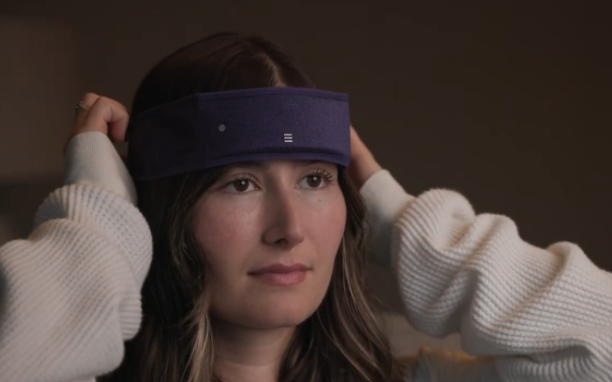
SoundHealth, a San Francisco-based medical technology company, has entered the growing sleep wellness market with a new wearable device designed to personalize sleep using sound and vibration tailored to each user.
The company recently announced the launch of Spatial Sleep, a headband-style device that uses proprietary acoustic technology to help people fall asleep faster, sleep longer and wake up feeling more refreshed. The product is positioned as a drug-free and noninvasive option for individuals who struggle with insomnia, nighttime awakenings or inconsistent sleep quality.
Spatial Sleep is built on SoundHealth’s Acoustic Sleep Harmonization technology, which uses a smartphone selfie scan to analyze a user’s craniofacial anatomy. That scan is processed by machine learning models that identify key anatomical landmarks and generate a personalized acoustic profile. Based on this profile, the headband delivers customized sound harmonies and gentle vibrations through dual bone conduction transducers.
Unlike traditional sleep aids that rely on masking noise or sedative effects, Spatial Sleep is designed to work with the user’s neurobiology. The low-frequency harmonics and vibrations are intended to promote relaxation and support the brainwave patterns associated with deep and restorative sleep. Because the sound is delivered through bone conduction, users experience subtle resonance rather than audible noise.
Spatial Sleep was developed in collaboration with leading experts in sleep medicine and related fields at institutions including Stanford University, Harvard Medical School, Massachusetts General Hospital, Weill Cornell Medicine, Endeavor Health and Sharp Rees-Stealy. Dr. Paramesh Gopi, CEO of SoundHealth, says the technology is grounded in peer-reviewed and published clinical research.
Clinical data cited by SoundHealth show that 90% of users experienced significant improvements in sleep quality after using Spatial Sleep. Participants demonstrated an average improvement of 50% in Insomnia Severity Index scores, a commonly used measure of insomnia severity.
“This is an exciting step forward in non-pharmacological approaches to improving sleep,” said Dr. Elan Hekier, a pulmonologist at Sharp Rees-Stealy in San Diego, who has been involved with the technology. Other clinicians have highlighted the personalized nature of the therapy as a distinguishing feature.
Dr. Robson Capasso, professor of otolaryngology, head and neck surgery, and by courtesy psychiatry and sleep medicine at Stanford University, notes that customization may allow for more targeted and potentially more effective sleep interventions, particularly for patients who have not responded well to standard solutions.
The Spatial Sleep headband is worn at bedtime and delivers a personalized harmony session lasting 45 minutes before automatically shutting off. The headband was designed with comfort in mind, allowing it to be worn throughout the night without disturbing the user or a bed partner.
The system is supported by a companion mobile app that extends the experience beyond sleep. In addition to nighttime functionality, the app includes clinically validated cognitive and behavioral gameplay intended to support daytime focus and performance. It also offers somato-energetic neuromodulation exercises that combine breathwork, posture and body awareness techniques with modern neuroscience principles.
Gopi says many existing sleep products rely on sedation or constant noise. He describes Spatial Sleep as an approach that uses acoustic personalization to support natural sleep without lingering effects.
The Spatial Sleep headband retails for $319 and is eligible for FSA and HSA reimbursement. The companion app is available on the smartphone app stores. Spatial Sleep is available for purchase directly through the company’s website.
As interest in personalized health technology continues to expand, SoundHealth’s latest offering reflects a broader effort to apply artificial intelligence and clinical research to everyday wellness challenges, with sleep remaining one of the most pressing.