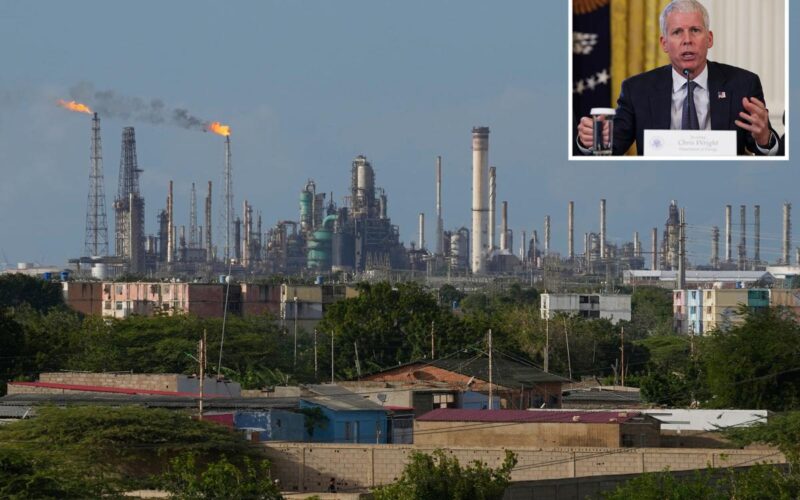
The US is selling Venezuelan oil at 30% higher prices than before as it completed its first sale worth roughly $500 million, according to the US Department of Energy.
The sale came in the wake of the US’ stunning Jan. 3 raid that captured dictator Nicolás Maduro and his wife on charges including narco-terrorism conspiracy.
“We’re getting about a 30% higher realized price when we sell the same barrel of oil than they sold the same barrel of oil three weeks ago,” Energy Secretary Chris Wright said Thursday during an annual US energy forum, though he did go into detail on the price.
The US Department of Energy did not immediately respond to The Post’s request for comment.
President Trump announced last week that Venezuela would sell 30 to 50 million barrels of oil to the US at “market price.” The Department of Energy has said oil sales from Venezuela will continue “indefinitely.”
Trump asserted that he will control what Venezuela can do with the profits to ensure the funds benefit both it and the US, and that oil giants would invest at least $100 billion into the South American nation’s energy sector and “rip out the old crap.”
With roughly 303 billion barrels, Venezuela is home to the world’s largest crude reserves – but its output has plummeted to just 800,000 barrels per day, down from a peak of 3.5 million barrels a day in the 1990s.
Since Maduro’s capture, Trump has met with leaders from Exxon, Chevron, ConocoPhillips, Halliburton, Valero and Marathon at the White House to discuss potential investments in Venezuelan oil.
Exxon and ConocoPhillips both left Venezuela nearly 20 years ago when Maduro’s socialist predecessor, Hugo Chávez, nationalized their assets. Venezuela owes the companies a combined $12 billion in debt related to arbitration cases, according to JPMorgan.

Prior to the raid, Chevron was the only major US oil business operating in Venezuela.
“US majors with experience in complex, politically sensitive environments stand to benefit the most,” Mark Malek, chief investment officer at Siebert Financial, said in a note following the US strike on Venezuela.
“Chevron is the obvious example. It has longtime exposure to Venezuela, deep technical expertise in heavy oil, and the balance sheet to wait out the messy middle. ExxonMobil fits that profile as well, particularly if redevelopment becomes capital-intensive and long-dated,” he added.
“ConocoPhillips, with its heavy oil experience and operational discipline, also stands to benefit if production ramps become feasible under more stable conditions.”
Brent crude oil rose 50 cents, or 0.78%, to $64.26 a barrel Friday morning, on track for its fourth consecutive weekly gain.
US West Texas Intermediate gained 48 cents, or 0.81%, to $59.67.
Both benchmarks notched multi-month highs this week, though analysts warned of greater volatility as protests intensified in Iran and investors feared potential supply disruptions.