


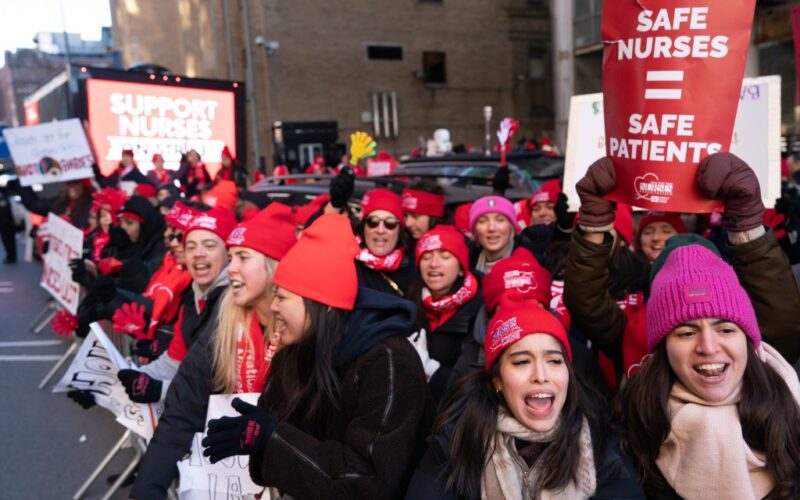
Fifteen thousand nurses in New York City are on strike. They are not striking because they don’t care. They are striking because they care too much to continue working inside a system that normalizes harm — to patients and to health care workers alike.
They are demanding what should never have been negotiable: safe staffing ratios, humane working conditions, livable wages, and the ability to provide care without being physically and morally injured in the process.
This strike is not an isolated event. It is the visible rupture of a system that has been stretched past its ethical limits.
Thursday morning, before work, I went for early-morning lab work. The lab technician drawing my blood looked exhausted. She told me they were chronically understaffed — always short, always rushing, always expected to do more with less.
As she worked, I told her the truth. That I had recently worked eight hours straight, multiple shifts in a row, with no lunch and barely any water — and ended up with a UTI. I told her that after 31 years in health care, this is still treated as normal.
She didn’t look surprised. She nodded immediately and said they are always short too.
Different roles. Same system.
I also told her that I work part-time — capped at under 29 hours a week — with no health insurance coverage at all. This is not accidental. It is by design. Health care systems increasingly rely on part-time labor to avoid providing benefits, even as they demand full-time intensity, availability, and emotional endurance.
And the exploitation doesn’t stop there.
Money is still automatically deducted from our paychecks for lunch breaks we never get. The legally required 15-minute breaks for every four hours worked routinely disappear under staffing shortages and patient volume. On paper, it looks compliant. In reality, it is wage theft — normalized, systemic, and rarely challenged because health care workers are conditioned to put patients first at any personal cost.
Legally, this is not a gray area. Labor laws require that workers be paid for all hours worked and that legally mandated breaks be provided or compensated. Automatically deducting pay for lunch breaks that never occur constitutes wage theft. When I raised this with my supervisor, I was told that “everyone just eats at their desk or when they can.” This is how illegality is normalized — not through written policy, but through workplace culture.
A culture is created in which workers are pressured to comply silently, absorb the loss, and keep the system running. The result is a transfer of unpaid labor from health care workers to corporate health care systems, justified as “how things are done,” and enforced through fear of retaliation, scheduling cuts, or job loss.
This is opportunistic. And it preys on health care workers.
In New York, nurses have unions and the legal right to strike. That matters. Because in states like Delaware, where I currently work, nurses cannot strike — not because conditions are better, but because unions are weak or nonexistent. There is no collective bargaining power, no meaningful leverage, and often no safe way to speak out without risking retaliation.
The result is silence enforced by precarity.
Unions deserve to exist in every state. And while people often fixate on union wages, the truth is that the protections matter far more than the pay scale. The right to safe staffing, to breaks, to due process, to health insurance, to speak without retaliation — these are not luxuries.
In states like Delaware, where unions are weak or nonexistent, nurses with more than 31 years of experience are barely offered a living wage that reflects their skill, responsibility, or institutional knowledge. It is a slap in the face. Especially when hospital administrators — who are far removed from the trenches of humanity — collect enormous salaries while frontline workers absorb the physical and emotional damage.
Nurses are not an accessory to the health care system. They are its nervous system. They are the ones who detect danger early, transmit critical information, respond to crisis, regulate chaos, and hold the entire body together under stress.
Real labor reform must recognize this reality. Nurses need enforceable staffing ratios, guaranteed breaks, paid sick time, access to health care, protection from retaliation, and the right to unionize and strike in every state.
The nurses striking in New York City are not disrupting health care. They are exposing what has already been broken.
A health care system that damages its nervous system cannot heal anyone.
Villabona-Kuntz, a registered nurse for more than 31 years, is writing a book about health care.