




By MEGAN JANETSKY
MEXICO CITY (AP) — Latin American progressive leaders are increasingly being backed into a corner on organized crime by pressure from the Trump administration and from their own voters, who point to the results from El Salvador president’s war on gangs.
The hunger for a more heavy-handed response to endemic problems has been mounting for years in Latin America. El Salvador President Nayib Bukele’s punitive tactics launched against his country’s gangs in 2022, resulted in a sharp decline in homicides and soaring approval by Salvadorans.
Bukele not only touts the success at home, but has also looked to export his approach, winning fans among voters and conservative populists across the hemisphere, including U.S. President Donald Trump.
Over the past year, Trump has taken a more confrontational approach toward Latin America than any U.S. president in recent history. He’s declared a slew of Latin American criminal groups foreign terrorist organizations, deposed former Venezuela President Nicolás Maduro for trial on drug-trafficking charges, threatened military action on an array of countries and pointed to Bukele as an example of what he wants to see for the rest of the region.
That ratcheted up pressure on more progressive administrations in Mexico, Colombia and Guatemala that had pitched more holistic solutions to endemic problems, like rooting out corruption and offering youth economic opportunities.
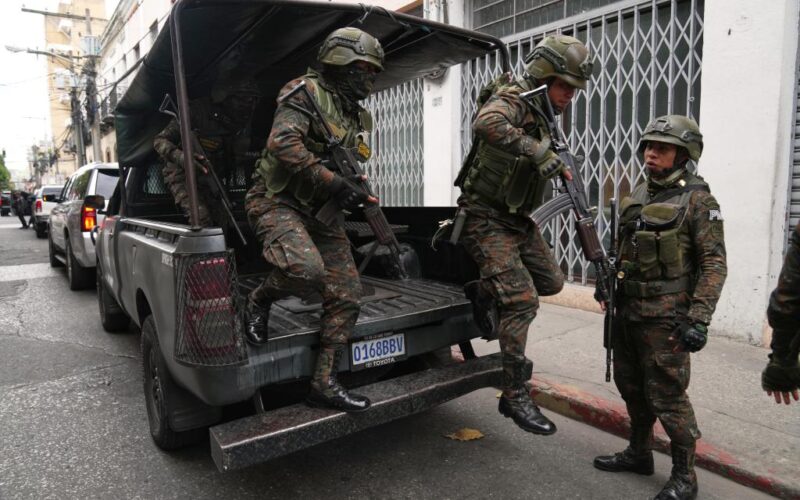
Guatemala President Bernardo Arévalo was the latest to feel that pressure when suspected gang members killed 10 police officers in apparent retaliation for the government denying privileges to imprisoned gang leaders. On Sunday evening, he declared a state of emergency curtailing some constitutional rights.
“The mix of growing U.S. pressure and the rightward reference of Bukele that gives an answer to security issues has … forced governments to pragmatically balance their own principles with the growing requests for a crackdown,” said Tiziano Breda, a senior analyst for Latin America and the Caribbean for the conflict analysis group, ACLED.
-
Soldiers stand guard in front of a poster of former President Jacobo Arbenz who was overthrown in a 1954 coup, near Congress in Guatemala City, Monday, Jan. 19, 2026, after President Bernardo Arévalo declared a state of emergency. (AP Photo/Moises Castillo)


1 of 5
Soldiers stand guard in front of a poster of former President Jacobo Arbenz who was overthrown in a 1954 coup, near Congress in Guatemala City, Monday, Jan. 19, 2026, after President Bernardo Arévalo declared a state of emergency. (AP Photo/Moises Castillo)
Guatemala state of emergency may limit rights
Things came to a head in an eruption of violence in Guatemala over the weekend when inmates in prisons notoriously controlled by gangs rioted and took guards hostage. When authorities retook one prison, suspected gang members in the capital slayed 10 police officers.
Arévalo said the emergency would stay in place for 30 days to combat the gangs, which he described as “violent criminals who commit acts of terrorism.” The declaration can limit some constitutional rights like the freedoms of movement, gathering and protest, and was approved by Guatemala’s congress Monday night.
“We will spare no resources to punish, to pursue, to find those responsible for these crimes,” Arévalo said in a speech Monday at the funeral of the officers.
Arévalo’s move echoed actions taken by his neighbor Bukele in 2022. El Salvador’s state of emergency remains in place nearly four years later and more than 90,000 Salvadorans have been arrested under it, fueling accusations of human rights abuses. But the country recorded just 82 homicides in 2025, compared to 6,656 in 2015.
‘Projecting toughness’
Arévalo is just the latest leader in Latin America to take a page out of Bukele’s book, following in the footsteps of Ecuador, Honduras and Costa Rica, which just last week broke ground on a prison modeled after El Salvador’s infamous prison for alleged gang members.
But efforts to piggyback on Bukele’s political success have largely fallen flat even as the region experiences a rightward political shift. That is in part because many leaders are hesitant to go as far as Bukele, who has detained more than 1% of his country’s population and is regularly criticized for what civil society groups describe as authoritarian tendencies.
When Arévalo was elected in 2023, the son of a former progressive president said bolstering legal institutions, including legislative reforms and rooting out corruption, was a solution to endemic gang violence, straying from competitors who called for a more Bukele-esque approach.
The Guatemalan president also proposed boosting security and building a maximum security prison, but the state of emergency marks an escalation. Arévalo said in a Jan. 15 interview with the Associated Press that combating drug trafficking and organized crime is a shared interest with the U.S.
“A lot of it is political theater and taking strong measures, but from there to actually being effective and actually delivering is the challenge,” said Michael Shifter, a senior fellow at the Washington-based Inter-American Dialogue. “Projecting toughness is a political winner.”
Leaders face political pressure
Breda, the ACLED analyst, attributed the shift both to Trump’s pressure and upcoming judicial elections in Guatemala, a decisive moment for Arévalo’s anti-corruption agenda.
In Mexico, under mounting threats by Trump, President Claudia Sheinbaum has gone after cartels far more aggressively than her predecessor, who instead pushed a policy known as “hugs, not bullets,” which sought to address poverty and the lack of opportunities as “root causes” of violence instead of directly confronting cartels.
In Colombia, President Gustavo Petro is facing a similar dilemma.
Petro, an ex-rebel, became Colombia’s first leftist leader in 2022 on a promise that he would consolidate “total peace” and unravel decades of conflict in the Andean nation. Namely, he aimed to reach peace agreements with a range of illegal armed groups and provide opportunities to youth.
But as peace talks have stalled with guerrillas from the National Liberation Army, known as the ELN, and other armed groups, Petro has failed to follow through on his bold agenda. Frustration toward Colombia’s left has simmered in much of the country in the months leading up to Colombia’s presidential elections.
At the same time, Trump has threatened military intervention in Colombia and accused Petro of being a drug trafficker, most recently days after a U.S. military operation in Venezuela that ousted Maduro. Trump had accused Maduro too of being a drug trafficker and now he awaits trial in U.S. federal court.
Under pressure from Trump and fed up Colombians, Petro has turned to the same entity he once sharply criticized: the Colombian military, said Elizabeth Dickinson, a Colombia analyst at the International Crisis Group.
Last week, in a forceful pivot from his hopeful campaign discourse, the leftist threatened a joint military action with Venezuela if the ELN did not enter a peace process with his government.
“It takes a very long time to mobilize action on these holistic ideas, and even longer for those holistic ideas to yield results,” Dickinson said. “What Bukele did, the reason it’s attractive across the region is that it appears to provide a fast and simple, straightforward solution to a very complex problem.”