



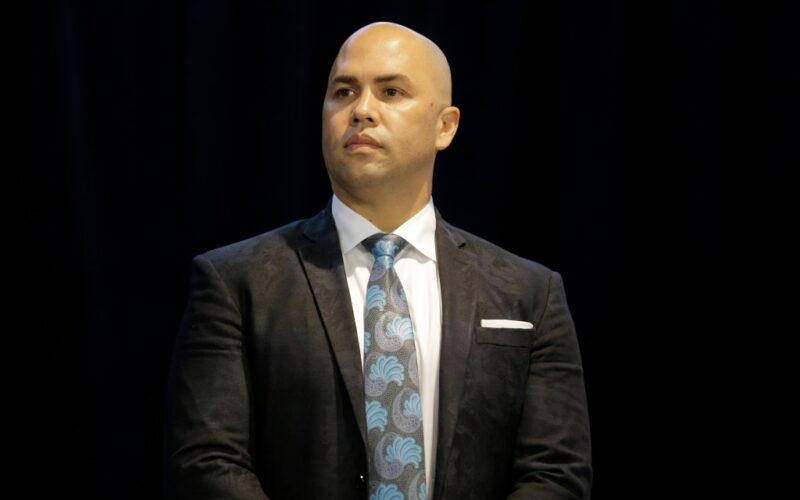
With an 84.2% plurality, the Baseball Writers Association have liberated Carlos Beltrán from baseball purgatory by electing him to the Hall of Fame Tuesday along with Andruw Jones.
In a particularly weak ballot devoid of any sure shot, no-brainers such as Ichiro last year to suck up so much of the voting oxygen, Beltrán, who made it to the doorstep of election a year ago with 70.3%, especially stood out with his career .279 average, 435 homers, eight 100-RBI seasons, nine All-Star selections and a 1999 Rookie of Year award. Normally that would’ve seemingly earned him election to the Hall sooner than his fourth year on the ballot except for his role in the 2017 Houston Astros sign-stealing scandal in which he was the only player named by MLB authorities in the subsequent investigation in 2020 because he was retired. But not only did the sign stealing scandal — in which he was reputed to be the ringleader — tarnish his reputation, it resulted in him being fired as Mets manager after 77 days in 2020 and leaving the organization without ever managing a game for them.
And as popular a player as he was, the switch-hitting Beltrán’s six and a half seasons as a Met were also marred by infamy when he ended their season October 19, 2006 by striking out with the bases loaded in the seventh game of the NLCS without ever taking the bat off his shoulder. In the minds of many Met loyalists that alone was good reason not to ever vote for him for the Hall, although he has said, if elected, he wanted to go into the Hall as a Met.
And time as they say heals all wounds and the Astro sign-stealing scandal continues to fade in memory. Their bench coach Alex Cora and their manager A.J. Hinch were suspended for a year but both resurfaced as managers after being fired — Cora back with the Red Sox and Hinch with the Tigers in 2021, while Beltrán in 2023 was hired again by the Mets as a special assistant to the general manager.
And I suspect a good majority of the voting writers were able to look past Beltrán’s devastating strikeout at the hands of then-rookie Cardinals righthander Adam Wainwright in the 2006 NLCS and instead focused on what is one of the most stellar overall postseason resumes of all-time — a 1.021 OPS (ranked 6th best among players with least 125 postseason appearances), 16 homers, 42 RBI, 11-for-11 in stolen bases and a .307 average in 65 games. In that same 2006 NLCS, he hit .296 with three homers and his 2004 postseason with the Astros in which he hit .435 with eight homers, 14 RBI, six stolen bases and a .516 on base percentage in 12 games may have been the greatest of all time.
Jones, meanwhile, was a flawed candidate in a different way in that he essentially had two distinctly different careers. Although regarded as an elite defensive center fielder throughout his career with 10 Gold Gloves, he seemed well on his way toward a plaque in Cooperstown his first 11 years with the Braves when he drove in over 100 runs five times, had five seasons of 30 or more homers, and in 2005 led the National League with 51 homers (which remains the Braves’ franchise record) and 128 RBI.
But after leaving the Braves as a free agent in 2007 and signing a two-year, $36.2 million contract with the Dodgers, his career literally fell off the cliff. His first season with the Dodgers in which he showed up in spring training some 40 pounds overweight, was an utter disaster. Plagued by injuries, he hit .158 in just 75 games, and only once in his last five seasons played more than 100 games or hit over .230.
Jones finished with 434 homers, 10 Gold Gloves and 1,993 hits (when the Hall-of-Fame bench mark is usually at least 2,000) and his .254 lifetime average is second lowest to 1920s White Sox catcher’s Ray Schalk’s .253 among all Hall-of-Famers. He made the jump from 66.2% to 78.4 in his ninth year on the ballot — which wasn’t helped by a 2012 domestic violence arrest.
The next top vote-getter, Chase Utley with 59.1%, likewise seemed headed for Hall-of-Fame status with five All-Star nominations and top 10 National League MVP votes in three of his first six seasons while being acknowledged as the top defensive second baseman in the NL. But then in 2010 he began experiencing serious knee issues — patella tendinitis, bone inflammation and chondromalacia — from which he never fully recovered. In his last six seasons he hit less than .220 four times and finished up with 1,885 hits.
Still, he has improved steadily in the Hall voting — jumping 20% from last year — and may be helped by Jones’ election. Until this ballot, the Baseball Writers hadn’t elected a single post 1960 player with less than 2,000 hits and the top candidate on next year’s ballot, Giants six-time All-Star catcher Buster Posey, also had a shortened career and finished with only 1,500 hits.
Shouldn’t be a problem for him. For if there is one thing this Hall-of-Election proved, the Baseball Writers have shown themselves to be a very forgiving lot.