




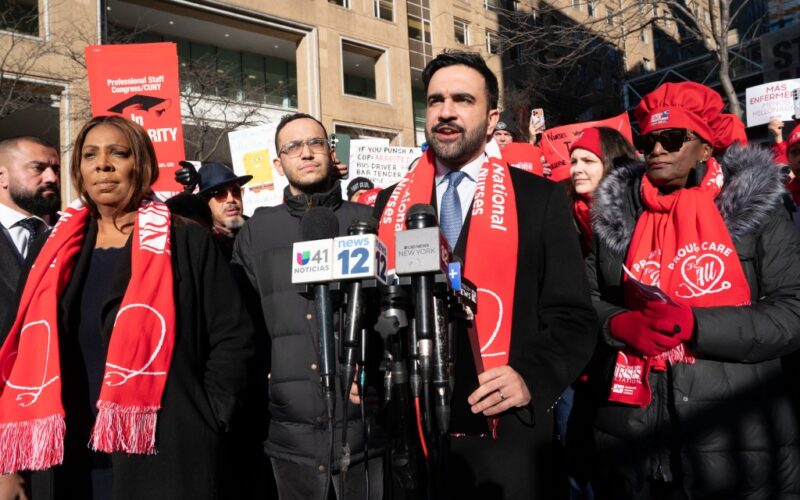
For decades I’ve worked in New York City with union labor. I’ve negotiated with unions, sometimes disagreed with them, but always respected them. Unions created the middle class in this city.
So when I say Mayor Mamdani’s decision to march with striking nurses is wrong, it’s not because I oppose unions. It’s because I understand what a mayor’s job is when patients need care.
The mayor’s job is to help settle the strike. Not join it.
Fifteen thousand nurses are on strike at Mount Sinai, Montefiore, and NewYork-Presbyterian. Patients waiting for critical operations. Pain unrelieved. Emergency rooms understaffed during a flu surge.
The governor declared a disaster emergency because of “severe staffing shortages” threatening “public health and safety.” A 20-year MIT study by economist Jonathan Gruber shows mortality rates go up 19.4% when nurses strike in New York. The stakes here are literally life and death.
What’s especially troubling is that Montefiore Medical Center, where Mamdani appeared on the picket line, serves some of the most vulnerable people in America. Montefiore is a safety-net hospital. More than 30% of its patients are on Medicaid. These aren’t people who can easily go elsewhere. These are the city’s neediest residents — the elderly, the poor, children in underserved communities.
And the strike he’s championing hits Montefiore hardest. While those patients waited.
The history is clear. When critical services are at stake, New York City mayors mediate.
Mayor John Lindsay worked to negotiate the 1966 transit strike settlement. Ed Koch faced an 11-day transit strike in 1980 — he walked the Brooklyn Bridge with commuters but worked behind the scenes to end it. Three years ago, when nurses struck at these same hospitals, Eric Adams urged both sides to keep talking. That strike lasted three days.
This time? Nine days in, negotiations collapsed after Mamdani’s appearance. One bargaining session in nine days.
The principle extends beyond New York. Presidents have used the Taft-Hartley Act 37 times to intervene in strikes that “imperil national health or safety.” Theodore Roosevelt called coal miners and mine owners to the White House in 1902, with winter approaching. The strike ended. That’s leadership.
The question always in my mind is: Who speaks for the patients? The hospital systems are focused on their financial sustainability. The union leaders are fighting for their members, as they should. The mayor? That’s the job. The mayor speaks for everyone, especially those who can’t speak for themselves.
There’s a phrase you hear about health insurance companies: “Profit over patients.” This is “Politics over patients.”
Mamdani is a progressive mayor elected on a platform of standing with workers. But when you become mayor, you represent the city. All of it. The union members and the patients. The people on the picket line and the people in the hospital beds.
Leadership means making hard choices. It means disappointing your allies because you have a larger responsibility. Your job during a strike isn’t to take sides — it’s to end the strike.
Let me be clear: I’m not saying the nurses are wrong to strike. I’m not saying hospitals handled this perfectly. Montefiore barely broke even last quarter, with a 0.01% operating margin. More than 30% of patients are on Medicaid. Federal funding cuts loom.
So what should Mamdani do? Stop going to the picket lines. Convene both parties at City Hall. Bring in mediators. Set a deadline — tell both sides the city will work around the clock for 72 hours to reach a settlement. Focus on patients — every hour in standoff is an hour someone is in pain.
And if they can’t reach agreement in three days? Impose a cooling-off period. Give both sides 10 days to step back, let tensions ease, and return to the table with fresh perspective. Presidents have used this approach for 80 years under Taft-Hartley when strikes imperil public health. The mayor doesn’t have federal authority, but he has moral authority. Use it.
The nurses deserve better staffing, protection from violence, healthcare benefits, and fair pay. But patients are caught in the middle. They need their mayor to help end this strike, not prolong it.
Mamdani has been mayor for three weeks. There’s time to learn. But every day that passes is another day patients wait.
The mayor needs to get both parties in a room and keep them there until they have a deal. That’s what mayors do. That’s what New York City needs.
That’s America.
Ratner is a developer, former official in the Lindsay and Koch administrations, the author of “Early Detection: Catching Cancer When It’s Curable” and the founder of Ratner Early Detection Initiative.