




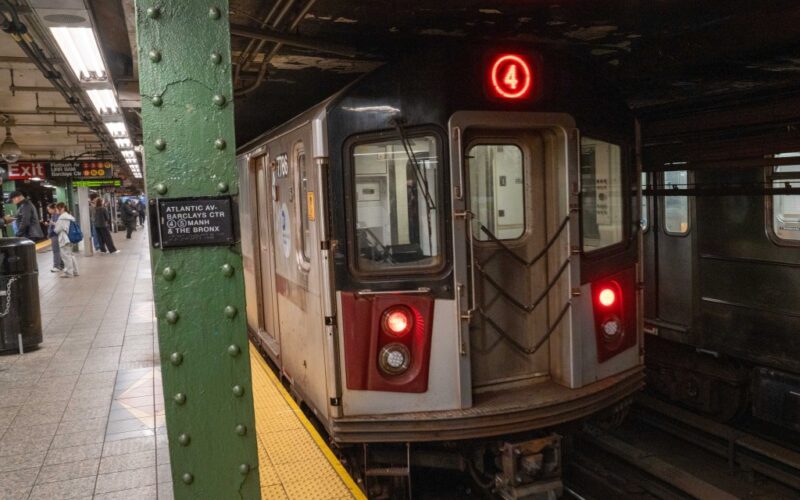
Straphangers on the two major IRT trunk-lines — the Seventh Ave. Nos. 2 and 3 subway trains and the Lexington Ave. Nos. 4 and 5 — should expect a quicker ride come May, transit officials told the Daily News.
That’s when a series of scheduling tweaks — part of an ongoing data-crunching effort by the department of subways — will kick in, meant to reduce delays at switches and junctions between the two lines.
“We continue to use data and analytics to understand how the system is running and look for sources of delays,” said Bill Amarosa, Vice President of Subways for New York City Transit. “Particularly around merge points and terminals and other types of bottlenecks.”
“We were able to make some adjustments, to move some trips from some hours that didnt have as much ridership as they used to into the busier hours,” he said. “You’ll see a little bit more service in the very early morning hours, and then just very slightly less in the 8 – 9 a.m. hour.”
The shift lets subway dispatchers tweak the run-times and sequencing of trains on both lines, so that they can approach switch tracks at the optimal time, Amarosa said.
“For example, up in the Bronx, the No. 2 and the No. 5 come together at E 180th St,” he told The News. “We want those trains to arrive precisely at the right time, get them in the right slot, so that when they get to the next merge point at 149th St. with the No. 4, things are going to run smoothly — and when the No. 2 gets to 135th St. with the No. 3, that merge is going to run smoothly.”
“We think we’ve come up with a really strong schedule that addresses a lot of those issues and should remove some of the waiting time you get when trains are coming together,” the subway boss added.
The changes would shuffle some round-trips out of the traditional rush hours, and slot those runs in the early morning or evening hours. The new schedule would also effectively add one round trip to the No. 3 train on weekdays, while taking away one round trip on the No. 4.
“During the middle of the day, the Nos. 2, 3, 4 and 5 each run every 8 minutes,” Amarosa said. “That makes it really simple to merge things together, because everything’s running on the same frequency and you can come up with a pattern.”
“During the rush hours, you may have seven trains an hour running on one line, 10 on another, 12 on another,” he continued, “so you can’t mesh them as easily — that’s where getting the running times very precise and having the sequencing set up in the schedule to get them to a merge point on time will help smooth it all out.”
The new schedule is expected to go before the the MTA’s board on Monday.
If approved, the changes will go into effect in May.