



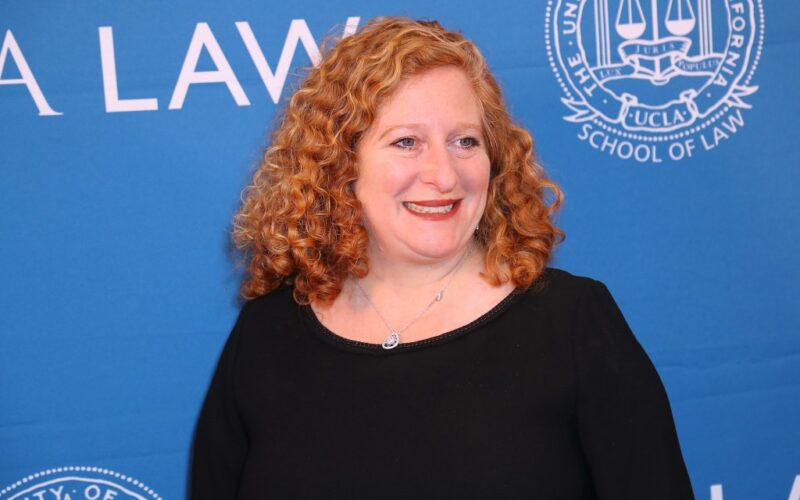
After nearly a year and a half without a permanent leader as pro-Palestinian protests and extraordinary federal scrutiny rocked campus, Columbia University on Sunday tapped Jennifer Mnookin, the chancellor of the University of Wisconsin-Madison, as its next president.
Mnookin, a legal scholar focused on the law’s intersection with science, will be Columbia’s fifth president in four tumultuous years. Her departure from UW-Madison and appointment at Columbia was first confirmed by the University of Wisconsin President Jay Rothman, who said Mnookin will remain at Wisconsin through the end of the spring semester.
In her new role at Columbia, Mnookin is expected to confront a host of challenges, perhaps most notably complying with and addressing the fallout of last summer’s resolution agreement with the Trump administration. She will also be tasked with making inroads with a faculty that has lost faith in their leadership, an alumni base frustrated by the school’s response to both President Trump and campus protests, and students who remain deeply divided since the spring 2024 demonstrations.
“President-designate Mnookin brings to Columbia an exceptional academic and leadership pedigree and a reputation for building trust through listening and engagement,” Columbia Board of Trustees Co-Chairs David Greenwald and Jeh Johnson wrote in a statement. “She is known as a thoughtful consensus builder who strives for excellence in every pursuit, bringing both vision and energy to the work of institutional leadership.”
“She will be a remarkable leader of our great university,” the co-chairs added.
It was not immediately clear how Mnookin would handle protests at Columbia if they were to erupt. At Wisconsin, Mnookin in 2024 authorized police to clear an early pro-Palestinian encampment, before reaching a deal with the Madison chapter of Students for Justice in Palestine to take down tents that were pitched in its place, according to the student newspaper and university statements.
“We must hold on to our commitment to free speech, which does and must include our adherence to the rules, laws and policies that ensure that the space of dialogue is open to all,” Mnookin wrote in a statement at the time. “And we must continue to work to find ways to see each other, to listen, to understand, and to recognize our shared humanity.”
Mnookin’s selection comes after Columbia had to delay its presidential search by nearly a month at the end of last year, following two candidates dropping out of the process, Bloomberg reported. The student newspaper Columbia Spectator reported at the time that it was the longest the university had gone without a permanent president since 1948.
Before she led Wisconsin’s flagship state university, Mnookin was the dean of the UCLA School of Law, where she spent 17 years as faculty, according to her school biography. Before then, she was a law professor at the University of Virginia School of Law, and a visiting professor at Harvard Law School.
She received her bachelor’s degree from Harvard University, her law degree from Yale Law School, and a doctorate in history and social study of science and technology from MIT.
The top post at Columbia has gone unfilled since summer 2024, when former president Minouche Shafik stepped down from the position after facing criticism over her handling of campus protests against the war in Gaza — which some Jewish and Israeli students found offensive. Shafik twice-summoned the NYPD to arrest protesters on campus, including a small group that occupied the university’s Hamilton Hall.
In her place, the university temporarily installed Katrina Armstrong, the medical school dean who was rumored to be a finalist for the permanent position. But she, too, abandoned the post last March when she came under fire by the Trump administration during negotiations to restore critical federal research grants.
Columbia eventually settled with the federal government to restart the funding under Claire Shipman, who until Mnookin’s swearing in is expected to continue as acting president, after she was promoted from her seat on the board of trustees.
That resolution agreement extended to topics unrelated to the antisemitism claims negotiations were purported to address, and sparked renewed, but much smaller protests, near campus at the start of this school year against government overreach and threats to academic freedom.