




In 1990, I found myself at an Anglican Fellowship Center on a hillside between Soweto and Johannesburg. My colleague Arnie Graf and I had been invited to South Africa to conduct training in organizing by Bishop Desmond Tutu, through his relationship with the Trinity Parish in New York.
All during the last years of apartheid, the bishop had sent his top clergy and lay leaders to New York to observe the organizing we were doing in East Brooklyn. Our embattled South African guests sometimes lived in new Nehemiah homes and witnessed how decent, affordable housing could be built at scale in neighborhoods that resembled some of the townships back home.
One afternoon, I was conducting a session on action for about 50 of these remarkable leaders and asked the question we normally ask: “What’s the purpose of action?” The group was silent. So I posited the answer. “The goal of any action is to get a reaction.”
Hands shot up. “Sir,” a young man said, “in our country we didn’t need to run an action to get a reaction. We got a reaction just because we were who we were, because of our very existence. What do you say to that?”
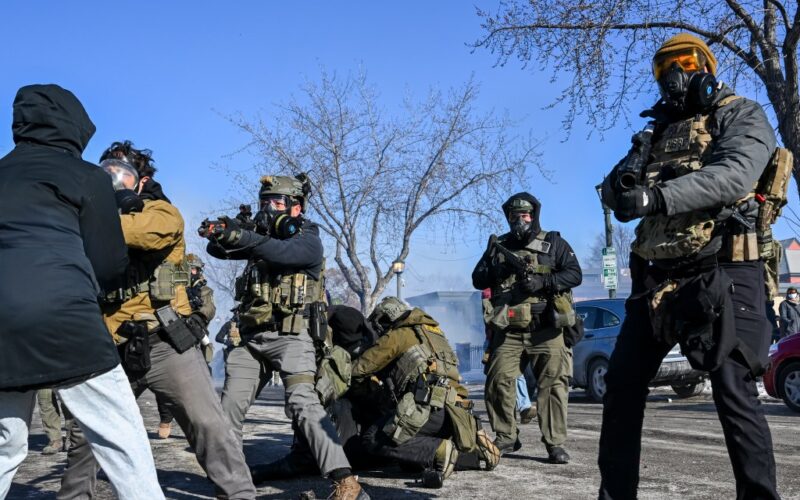
I paused and admitted that my whole notion of how to organize effectively was based on assumptions and experiences that made no sense in a place where unilateral violence and relentless provocation practiced by those with power were the norms. I have been thinking about that polite young man as I’ve watched the unilateral violence and relentless provocation of ICE.
It’s clear to me that the core purpose of ICE deployment is to instigate reactions that can then be used to justify more extreme provocations and more unrestrained violence. ICE isn’t trying to hide its lawlessness. ICE doesn’t care about “bad” publicity. ICE can’t be shamed.
So traditional strategies used effectively for decades that seek to draw attention to ICE’s actions play right into its hands. In-your-face confrontations — great for the media and perhaps satisfying to some — are wins for their team. Appeals to human or democratic values and norms have zero impact on the proud and public violators of those values and norms. So then what?
Let me preface this by saying that my colleagues and I have dealt with groups like ICE before — drug dealers making life in local blocks and housing projects unlivable, shakedowns by a corrupt union and local hustlers, crooked cops, slumlords who hired muscle to try to intimidate our organizers and leaders.
We outsmarted and out-organized every one of them. And we never had a single leader or organizer harmed in more than four decades of work in some of the toughest corners of the city. So I speak from real-world experience, not some political science tract read in graduate school.
First, make sure that people are kept safe. Do not put them in harm’s way with people who are poorly trained, heavily armed, and sure of a pardon if they beat or shoot innocent people.
Second, don’t react in the ways that ICE expects and provokes. If they show up on a block, every window should open, and every resident should blow a whistle — both to alert those being pursued of the danger and to expose the ICE attempt.
Third, work very closely with the NYPD — whose new motto is “Fighting Crime, Protecting the Public.” Today, the NYPD has an obligation to protect the public from the lawlessness of ICE. And the public has an obligation to support the NYPD when it brings actual criminals to justice.
Fourth, explore all state and local avenues to hold ICE agents accountable when they cross the line.
And, fifth, begin to plan for the dismantling of ICE and the reorganization of an effective, humane, and meaningful new immigration and naturalization agency. The fecklessness of the old INS created the vacuum filled by ICE. The failure to use authority effectively opened the door, as it often does, to authoritarianism. We need secure borders and a professional immigration system, not a return to the chaos that led to the current crisis.
This new challenge demands new responses. If reaction arrives without action, if the very existence of people is used as grounds for abuse, then we have to create strategies that won’t play into the hands of the opposition and will lead to the outcome that most Americans still seek – a sane, fair, and safe city and country.
Gecan is a senior advisor at Metro Industrial Areas Foundation and the author of “Going Public.”