




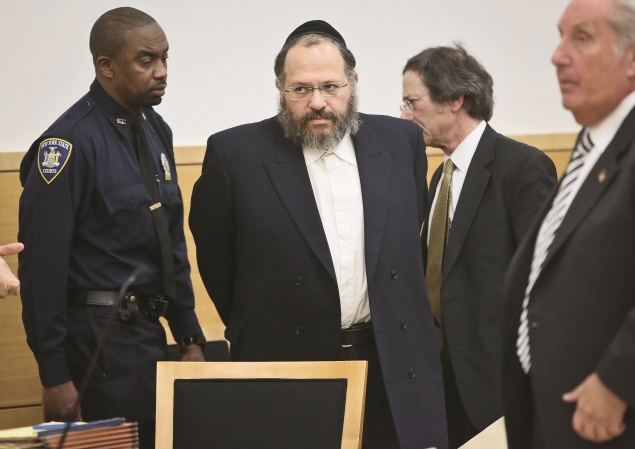
Tomorrow, Jan. 27, Nechemya Weberman, a prominent figure in the ultra-Orthodox Satmar community in Williamsburg, will have a resentencing hearing that could lead to his early release. Weberman was originally sentenced to 103 years in prison, which was later reduced to 50 years, for repeatedly sexually abusing a young girl beginning when she was just 12 when he worked as an unlicensed school counselor in the community.
Weberman is asking that the Brooklyn judge vacate his sentence entirely and resentence him to time served, arguing that his age, health conditions, and, most notably, that he no longer poses a threat to his community, are some grounds for his early release.
As survivor advocates and practitioners of restorative justice for survivors of sexual violence in faith communities and organizations, one of whom is a survivor of abuse within the Orthodox community herself, we support efforts to repair harm by helping harmdoers take accountability outside of the criminal legal system.
We support reducing disproportionate sentences and compassionate release as policies. But Weberman should not be granted early release just 13 years into his 50-year sentence. Doing so, as Brooklyn District Attorney Eric Gonzalez has been consistently showing support for, would not only pose an imminent risk to the many girls he would have access to upon release, but also further erode trust in a legal system that has too often served as the last backstop for justice when insular religious communities fail to protect their own.
Weberman’s early release would place him back into a community that not only protects, but lionizes him. The Satmar community’s unwavering, ongoing support for Weberman makes clear that they would continue to shield him from accountability and amplify his power upon his release, dramatically increasing risk to vulnerable individuals in the community.
For more than a decade, this community has heralded Weberman — a man convicted of child sexual offenses — as a hero. Members of the Satmar community have publicly disparaged the one named victim-survivor in this case whom Weberman sexually assaulted, using language that they would never otherwise publicly use. They attempted to bribe her and held a fundraiser that raised more than $500,000 — charity that was purportedly used to support Weberman’s legal expenses.
Prominent leaders in the community, including the Satmar grand rebbe, have come to Weberman’s spiritual aid. A widely-read Yiddish newspaper gave both Weberman and his powerful supporters a platform to espouse their defense in a series of weekly articles. This context matters.
Weberman has also demonstrated a repeated pattern of sexual abuse over many years. The victim-survivor in this case was not the only child Weberman abused. Six additional survivors reported to the district attorney’s office that, dating back to the 1990s, Weberman sexually abused them in counseling sessions, taking advantage of his communal role — and these are only the survivors we know of. We have major concerns about Weberman’s access to children in a community that thinks he did nothing wrong.
What’s more, Weberman himself has shown no remorse for his crimes, an integral part to proving that he is no longer a risk to his community and is rehabilitated. In one of his own op-eds in KY Weekly, Weberman, in Yiddish, compares himself to Jacob the Patriarch who was tormented “with hatred, lies, and corruption” and, after all of his suffering, returned home “with a beautiful family and great wealth”. Not once does Weberman acknowledge the torment and suffering he caused the girls he abused. Not once does he show remorse for his wrongdoings.
One of the central values of Judaism is teshuva, or repentance. Teshuva requires internal reflection, genuine remorse, and an acknowledgement of the seriousness of harm caused. It is fundamental to any justice process, particularly in the Orthodox community for which it is a central value.
When a community and its people fail to uphold this value, as the Satmar community and Weberman continue to do, that failure becomes a secondary betrayal of survivors that deepens and exacerbates their original trauma. It is also why survivors in these communities have bravely turned to the criminal legal system to seek justice.
Granting Weberman early release now would compound that betrayal and pose an imminent threat to the children of the community which is propping him up. And it would send a grim message to survivors that the very people elected to protect them, even when relied on as a last resort, will side with their abusers.
Benchimol is the director of faith-based and community accountability at Ampersands Restorative Justice. Ackerman is the co-founder and owner of Ampersands Restorative Justice and professor of criminal justice at California State University, Fullerton.