




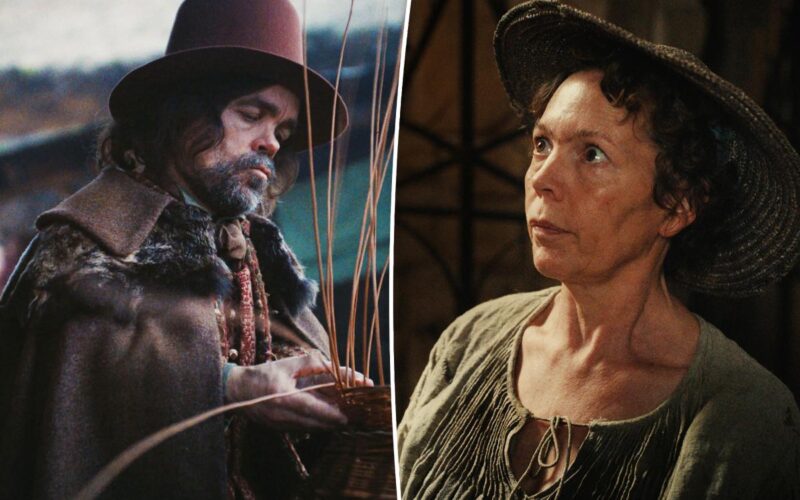
PARK CITY, Utah — Tale as old as time, song as old as rhyme, Olivia Colman and a basket.
movie review
WICKER
Running time: 105 minutes. Not yet rated.
That’s the long and short of “Wicker,” a dark and strange storybook movie that had its world premiere at the Sundance Film Festival.
Weirder still — it’s absolutely wonderful.
Colman, fitting her mangy part like a smudged glass slipper, plays the smelly, outcast Fisherwoman of a medieval village who pays a mysterious magical craftsman (Peter Dinklage) in the forest to weave her a husband.
He’s a kind of enchanted Etsy.
The Fisherwoman — all names are job titles — had been proudly single, dirty and disdainful of her community’s backwards rituals, like women being collared on their wedding day. All of this shtick is “bring out your dead!” dryly humorous.
Still, everybody else seems to have a masculine plus one. And off in her faraway hut, Fisherwoman has been feeling the harsh sting of loneliness.
One month later, the she finally gets her “man”: A soft-spoken Alexander Skarsgård outfitted with a masterful mug and body of entwined reeds created by Weta Workshop, the effects artists behind “Lord of the Rings,” “Dune” and “Avatar.”
Generally speaking, Weta does not work on outre indie romances. They’re more into “King Kong.” So, “Wicker,” directed by Alex Huston Fischer and Eleanor Wilson, punches above its weight visually.
At this point, the plot is still pretty flippin’ weird. But the movie soon takes a sharp toward the touching and human.
If you had any doubts about what a plant and homosapien can achieve behind close doors, Fisherwoman and her bundle of sticks sure do take a roll in the hay. Actually, lots of loud and enthusiastic rolls in the hay. He’s sensitive too. The balsa boy listens, asks questions and does household chores. Perfection in a partner.
And so local frustration mounts. After she weds the former inanimate object, a k a the Wicker Husband, the town doesn’t break out the pitchforks and light the torches like he’s Frankenstein’s monster.
Instead, the citizens become envious of the Fisherwoman and her unique spouse because they’re the only ones in town who are genuinely in love — not in some cold and convenient arrangement.
Women pine for the pine tree, and angry, traditional men want to chop him down.
“The wives are aflutter,” says one irritated husband at the pub.
Not Elizabeth Debicki’s Tailor’s Wife, though. Rigid and sneering, the villainess believes the non-traditional pair are disrupting the town’s natural order.
The women suddenly want deeper meaning out of their lives and marriages. Such desire, if you can believe it, lead to death.
Perhaps, folks realize, the old ways aren’t the right ways anymore.
The movie is chockoblock with zany character turns. Richard E. Grant plays the Tailor’s Wife’s dad, the local doctor who has a penchant for killing his patients.
And Dinklage drags his Tyrion Lannister accent out of storage as the kindly Basketmaker, a tricky fellow who is well aware that his actions will change the village forever.
Only an actress as caution-to-the-wind as Colman could connect so profoundly with a patio chair. Skarsgard’s sensitivity also helps. Speaking of “Frankenstein,” his gentle giant is reminiscent of Jacob Elordi’s recent hulking turn as another misunderstood creature.
Quite like her Oscar-winning performance in “The Favorite,” Colman, who’s never afraid to act ridiculous, is untethered and batty until things get real. Or, as real as things can get when one’s hubby is an oversize vessel for potpurri.
She’s beautifully fragile as the Fisherwoman succumbs to her baser instincts, and the consequences of her passion break our hearts before they get patched up again in the end.
Just as at any fable, lessons are learned, tears are shed and Olivia Colman exchanges vows with decorative furniture.
And, naturally, we leave singing that classic Disney song: Someday my Crate and Barrel package will come!