




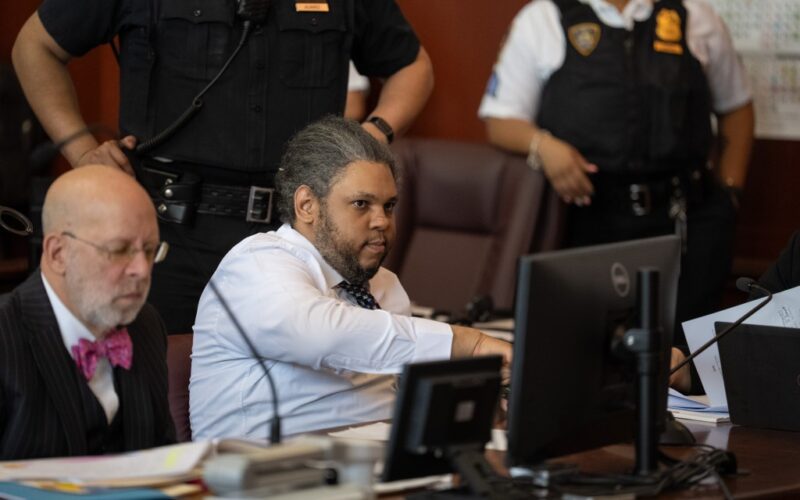
A man on trial for bludgeoning four homeless men to death with a metal bar as they slept on the street in lower Manhattan had been diagnosed with schizophrenia when he left jail months earlier and was hearing voices telling him he needed to kill 40 people or he would die too, his lawyer told jurors on Tuesday.
Randy Santos, 31, is asserting an insanity defense at his trial in state court. Through his lawyers, he has acknowledged committing the 2019 Chinatown rampage. But, they argue, he is not criminally responsible because mental illness has polluted his mind with irrational thoughts and left him prone to violence.
If they succeed, Santos could be sent to a psychiatric treatment facility instead of prison.
“He needed the voices to stop. He needed to save his own life,” Santos’ lawyer, Marnie Zien, said in an opening statement. “He saw no other way out.”
Santos, 31, has pleaded not guilty to charges including first-degree murder in the deaths of Florencio Moran, Nazario Vásquez Villegas, Anthony Manson and Chuen Kok and attempted murder charges for assaults that left two other men severely injured. They were among 319 killings in New York City in 2019, including 52 in Manhattan.
Surveillance video captured Santos “repeatedly lifting the bar up over his head and bringing it down on the head” of one victim, Assistant District Attorney Alfred Peterson told jurors.
A couple out on a date on Manhattan’s Bowery street saw him beating another man with the same weapon, Peterson said. Police found Santos carrying the bar, which was covered with blood and hair. Testing showed it had his DNA on one end and blood from some of his victims on the other, the prosecutor said.
Verdict will determine if Santos goes to prison or mental facility
If the jury convicts Santos, rejecting his insanity defense, he could be sentenced to life in prison. Otherwise, he could be involuntarily committed to treatment for as long as necessary.
Peterson urged jurors to look past Santos’ mental health claims and find him guilty on all charges, telling them that evidence will show that Santos “knew exactly what he was doing and the consequences of what he was doing — that he was killing these men,” the prosecutor said.
Santos looked up and down the street and “saw the coast was clear” before starting the attack, Peterson said. He then paused to let a pedestrian — and potential witness — leave the area before wailing on another man, Peterson said. He knew “it was legally and morally wrong,” the prosecutor said.
Santos even recognized himself in surveillance video of the attack, Peterson said. Shown the footage after his arrest, he told police: “Yea, that’s me.”
Santos, a native of the Dominican Republic who moved to New York as a child, attacked five men between 1:30 a.m. and 2 a.m. on Oct. 5, 2019, bashing their heads repeatedly with a 4-foot bar he found on the street, Peterson said. The victims ranged in age from 39 to 83.
The lone survivor, critically injured 49-year-old David Hernandez, staggered to a nearby street where police officers were trying to revive another Santos victim.
Peterson said Santos had done a “trial run” about a week earlier, badly hurting another man by bashing his head with a wooden stick in a different Manhattan neighborhood.
Santos, who has gone back and forth from jail to psychiatric treatment facilities since his arrest, wore an untucked white button-down shirt and a tie as he sat between his lawyers at the defense table. He listened to Zien’s opening statement through a Spanish interpreter, but moved his headphones off his ear as Peterson spoke.
Prevailing with an insanity defense can be particularly tough in New York. Santos’ lawyers must convince the jury that he didn’t understand the consequences of his actions and didn’t know right from wrong. The strategy has had mixed results.
In 2022, a man who killed a young tourist when he drove his car through crowds of people in Times Square was cleared of responsibility and sent to a mental health facility instead of prison after a jury found he was so psychologically disturbed he didn’t know what he was doing.
But in 2018, a Manhattan nanny was convicted of killing two children in her care while their parents were away after a jury rejected her lawyer’s claims that she had an undiagnosed mental illness, heard voices and saw hallucinations, snapped and didn’t know what she was doing.
Diagnosed with schizophrenia two months before killings, lawyer says
Zien said Santos knew that attacking the men was legally wrong, but — in his mind — he had to do it to save his own life.
The ambush, she said, was the last in a line of increasingly violent episodes that began with a clash with his grandfather.
He has at least six prior arrests, police said, including allegations that he punched a tourist he thought was laughing at him on a subway train, choked a man at an employment agency and punched a homeless man inside a Brooklyn shelter.
During his last jail stint before the killings, Santos was diagnosed with schizophrenia, Zein said. He was released in August 2019 and given referrals for treatment and prescriptions for medication but never used them, Zein said.
Santos was previously diagnosed with schitzophreniform, a shorter-term mental health condition, and turned up at a hospital complaining that he was hearing voices in his head, Zein said.
He was asked about drug use but didn’t get the treatment he needed, she said.