



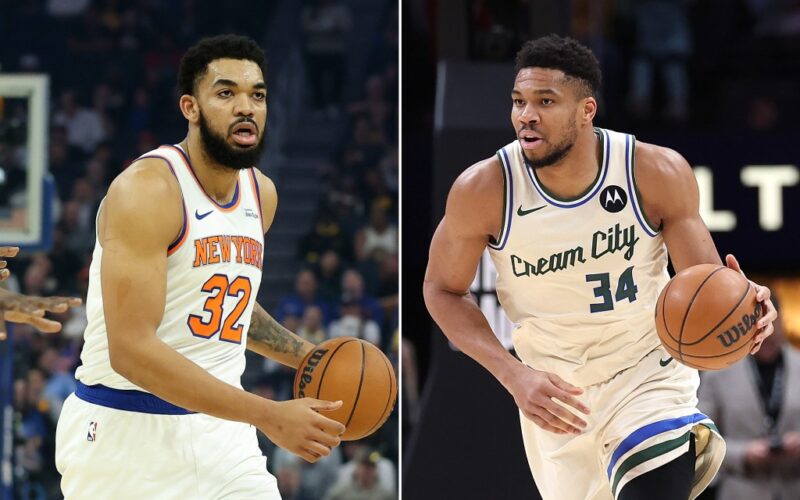
Giannis Antetokounmpo is reportedly coming around to the idea of a trade, which means it’s time to revisit which Knicks chips are actually in play should The Greek Freak decide New York is the only place he wants to play.
Antetokounmpo reportedly named the Knicks as his preferred destination during an offseason meeting with Bucks brass. Since then, the temperature in Milwaukee has dropped fast. The Bucks sit 18–27, 12th in the Eastern Conference, and ESPN’s Shams Charania reported the two-time MVP is now open to a deal ahead of the Feb. 5 NBA Trade Deadline.
So who’s it going to be in New York, where draft capital is thin and the stakes are sky-high? Here are six trade candidates to monitor as the deadline approaches.
KARL-ANTHONY TOWNS
At the start of Knicks training camp in Tarrytown in September, the Daily News asked Towns how he envisioned Mike Brown’s new offense unlocking his scoring potential.
Towns didn’t have an answer. Months later, it’s clear why.
To be clear: Towns is in the middle of a down shooting year. He’s missed an inordinate number of open threes and post looks, and he’s been out of rhythm almost from the jump. He’s attempting nearly three fewer shots per game in Year 1 under Brown than he did in his first season in New York under Tom Thibodeau. His 46.6% field-goal percentage is the worst of his career, and for a player who considers himself the greatest shooting big man of all time, 36.5% from three borders on jarring.
Those are the numbers you expect to normalize. The harder conversations live elsewhere.
Towns was foul-prone long before arriving in the deal that sent Julius Randle and Donte DiVincenzo out of New York, but the issue has been magnified here. He ranks top-five in total fouls for the second straight season. Some of those whistles, Towns fairly argues, aren’t fouls at all. Many others are self-inflicted — habits he hasn’t been able to break. And when the shots aren’t falling, his longstanding defensive miscues become hard to ignore.
As a result, Brown has increasingly staggered Towns’ minutes alongside Jalen Brunson. Over the Knicks’ last three wins, Towns either battled foul trouble, struggled to find rhythm, or both — leading Brown to close games with Mitchell Robinson instead.
The contract matters here. Towns is the Knicks’ highest-paid player, in Year 2 of a four-year, $220 million extension. He’s owed $53 million this season, $57 million next year and holds a $61 million player option for 2027–28.
The money aligns almost perfectly with Antetokounmpo, who is in Year 1 of a three-year, $175 million deal. The difference is obvious: Antetokounmpo is a two-time MVP. Towns, a first-time All-Star starter last season, now needs a coaches’ nod to reach the event again.
If the Knicks want to turn Towns into Giannis, they’ll have to sweeten the pot. That’s the problem. Most of those sweeteners were surrendered two summers ago.
MIKAL BRIDGES
When the Knicks signed Bridges to a four-year, $150 million extension on Aug. 1, it represented both belief and commitment.
It also made Bridges ineligible to be traded until Feb. 1.
That date is here — and it’s fair to say Bridges hasn’t played up to the cost of acquisition or the investment that followed.
The Knicks sent Brooklyn four of their own first-round picks (2025, 2027, 2029, 2031) plus Milwaukee’s top-four protected 2025 pick to land Bridges. Yet in Year 1 under Brown — within an offense designed to maximize his skill set — Bridges has been inconsistent at best. He’s averaging 15.7 points, his lowest output since his rookie deal, and defensively, his point-of-attack impact has fluctuated wildly.
Bridges didn’t set his own price. The Nets did. And now the Knicks no longer have the draft ammunition to chase Antetokounmpo outright. That forces them into personnel decisions.
There are real reasons to hesitate. Bridges’ ties to Brunson and Josh Hart go back to Villanova. His chemistry with Landry Shamet matters. And when the lights are bright, Bridges has delivered — his series-altering stops against Detroit and Boston last postseason still linger.
But January’s box scores don’t lie: 7-of-19, 5-of-14, 6-of-20, 3-of-16, 4-of-10, 3-of-10. A 43% shooting month of January for a wing acquired to stabilize both ends.
The calculus is brutal but real. Portland, desiring a deal that pairs Bridges with longtime friend Damian Lillard, could reroute Milwaukee’s own picks from the Lillard deal back to the Bucks. Jrue Holiday — a Giannis championship teammate and ideal Brunson complement — could factor in as a chip heading to the Knicks, as well.
MILES MCBRIDE
The Knicks don’t want to trade McBride, but value-for-dollar, they don’t have a more appealing asset.
McBride is a starter-caliber guard in Year 2 of a three-year, $13 million deal. Rival front offices know it. The Knicks also know what comes next: an extension decision, similar to the crossroads that led them to move Immanuel Quickley.
The difference? McBride fits next to Brunson. Some of the Knicks’ best lineups feature both. But without tradable first-round picks, acquiring a player of Antetokounmpo’s magnitude may require parting with one of the few young, cost-controlled players who move the needle.
GUERSCHON YABUSELE
The Knicks used their mid-level exception on Yabusele hoping he’d provide an upgrade over Precious Achiuwa as a backup forward.
That calculation hasn’t panned out.
Yabusele, confident he can help an NBA team, has largely fallen out of the rotation while carrying a $5.5 million cap hit. He holds a $5.8 million player option for next season, too — real money for a player struggling to carve out a role.
New York has actively explored packaging Yabusele in deals. San Antonio remains a logical partner given Victor Wembanyama and Yabusele’s shared history with France’s Olympic team.
JORDAN CLARKSON
The Knicks brought Clarkson to New York to score. Specifically, to lift a bench that ranked dead last in points a season ago.
Instead, McBride’s offensive growth has filled much of that void without disrupting flow. Clarkson’s arrival, meanwhile, came with warning signs — starting with his first possession as a Knick, an ill-advised pull-up three. The shot selection followed.
Brown has since removed Clarkson from the rotation, and the Knicks have won three straight. Clarkson knows he can help teams. He also knows New York won an NBA Cup with him playing meaningful minutes.
But he’s become expendable on a team prioritizing pace, movement and collective offense. Clarkson is on a minimum deal, averaging 9.5 points on 42.5% shooting and 33.3% from three — movable salary, movable role.
PACOME DADIET
Draft-night math forced the Knicks’ hand last June. Up against the second apron, they needed a player willing to sign below rookie scale at No. 25. They selected Dadiet, a long-term French forward project.
So far, the return has been minimal.
Under two head coaches, Dadiet hasn’t earned consistent minutes, even on a roster desperate for wing depth. He’ll make under $6 million combined this season and next, but his fourth-year option jumps to $5.4 million — a meaningful commitment for a player who remains largely unproven a year-and-a-half into his NBA career.