



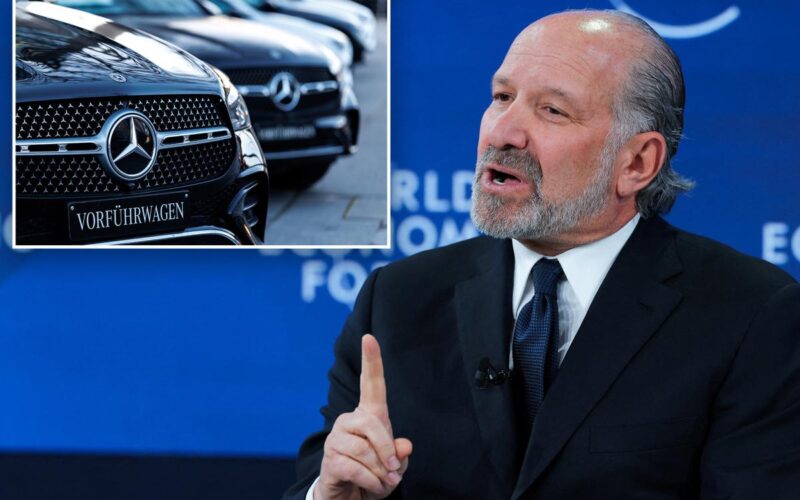
The chief executive of German automaker Mercedes-Benz reportedly rebuffed the Trump administration’s offer to relocate company headquarters to the United States.
Ola Källenius told German-language publication The Pioneer that Commerce Secretary Howard Lutnick made the pitch about moving Mercedes’ HQ last year.
Källenius told Lutnick that while the company was global, it could not be “uprooted,” according to the publication.
“The star has been a global company for more than 100 years, but we are rooted in Swabia,” the CEO told the German-language publication.
“Those roots cannot — and should not — be pulled out of the ground.”
“The star” is a reference to Mercedes-Benz’s three-pointed logo. Swabia, which is known in German as Schwaben, is the region in southwestern Germany where the company’s Stuttgart headquarters are located.
Källenius — a Swedish-born executive and the first non-German to be chairman and CEO of Mercedes-Benz Group — noted that Lutnick’s proposal reflected “the fierce global competition for capital that industrial center in Europe are facing.”
While he rejected the idea of moving the HQ, Mercedes later announced it would shift production of a sport utility vehicle from Germany to its plant in Tuscaloosa, Ala., Bloomberg noted.
The Post has sought comment from Mercedes-Benz and the Commerce Department.
The Trump administration has used tariffs as a tool to encourage companies to build and expand manufacturing operations in the United States.
The White House has raised or threatened duties on imported autos, steel, aluminum, semiconductors and pharmaceuticals, arguing that higher import costs make domestic production more economically attractive.
Several major US and foreign corporations have announced plans to expand manufacturing capacity in the US since Trump returned to office.
In the technology and semiconductor sector, companies including Apple, Intel, Taiwan Semiconductor Manufacturing Co. and Micron have committed tens to hundreds of billions of dollars to new or expanded chip plants and related facilities, citing supply-chain security and incentives tied to federal policy.
Pharmaceutical firms such as Eli Lilly, Johnson & Johnson and Novartis have also pledged large investments in US-based drug and ingredient manufacturing.
Automakers and industrial firms have made similar commitments.
Ford and Stellantis have announced new investments in US vehicle and battery plants, while Hyundai has unveiled plans for major US manufacturing projects spanning electric vehicles and steel production.
Other companies, including John Deere, have said they will expand or add domestic factories as part of broader efforts to increase US output, with many of the announcements highlighting trade policy, tariffs or federal incentives as factors in their decisions.
Mercedes-Benz traces its roots to the birth of the automobile in 1886, when rival companies Benz & Cie. and Daimler Motoren Gesellschaft helped lay the foundation of modern auto manufacturing.
In 1926, the two firms merged to form Daimler-Benz, a company that went on to become a global luxury automaker headquartered in Stuttgart — now known as the Mercedes-Benz Group.