



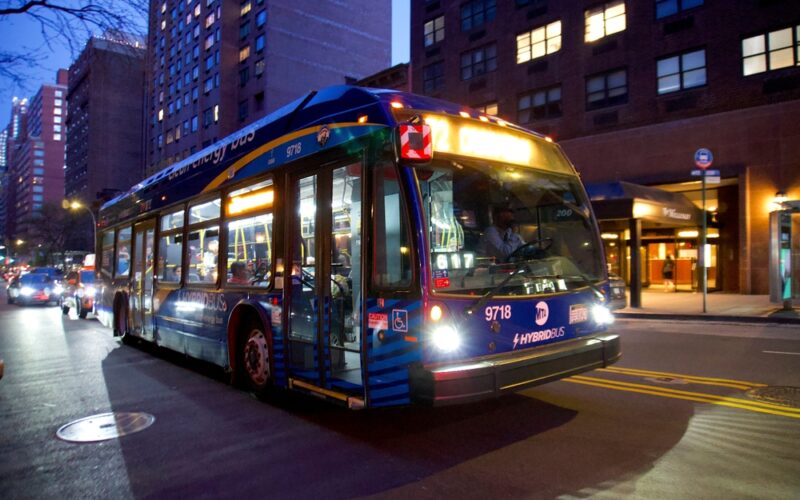
The President of the Transport Workers Union Local 100 said Wednesday that ongoing issues with the two-way radios on buses are a danger to his drivers — while transit officials say system glitches shouldn’t stop bus drivers from talking.
“This morning there were still buses without operational radios on the streets of New York, and this is unacceptable,” John Chiarello told reporters. “There are countless bus operators who are unable to reach command at the push of a button, like they should be able to.”
“This is a very, very serious safety issue,” he said.
Chiarello said that the bus radio didn’t work on Friday when bus driver Christopher Accettulli was delivering a baby on the B37, and that “seven female bus operators assaulted on duty” have had trouble getting through to the bus command center.
One of them, bus operator Bibi Bano told reporters that she hadn’t been able to get through to bus command on Oct. 7 of last year, when she was assaulted and spit on by a passenger aboard the B60. She eventually pulled over to use her cell phone to call authorities.
The MTA began transitioning from traditional analog two-way radios to a computerized digital communications system in 2022. The new system also allows text messaging with bus command, as well as GPS tracking of individual buses.
But multiple bus drivers have told the Daily News that the new digital system has a tendency to go down. Several drivers described being unable to raise bus command on the new digital units, and said the outages left them without a reliable means of contacting a dispatcher or emergency services.
The News reviewed several photographs taken by bus drivers, showing the “push-to-talk” button greyed out on their radio’s digital screen.
But the MTA says that digital outages does not mean a loss of voice communication.
A number of alerts, sent to bus drivers and reviewed by The News, indicate several instances in recent weeks of the system entering “fallback” mode. In that mode, digital services like bus location and data transfer are disabled, as is the “trunking” system that keeps communication channels separate. In fallback mode, multiple sources told The News, bus operators can hear chatter from other drivers throughout the system until a dispatcher can find a quiet channel.
Asked about those failures last month, NYCT President Demetrius Crichlow told reporters that communications were still operable even when the digital side of the system went down.
“In the instances where the [new] system is not operable, the bus operator still has communications with the command center,” Crichlow said. “Hard stop right there — that communication is still live, they’re still able to communicate directly with the command center.”
Chiarello said he’d sent a letter to Crichlow on Monday, asking for an explanation of the technical issues. Union officials say they’ve yet to hear back.
Internal MTA memos reviewed by The News instruct bus drivers to use a phone to call bus command if their radio won’t connect and there are no nearby buses with a working radio.
NYC Transit rules forbid a bus operator from having a cell phone on their person while driving, though an MTA spokesperson confirmed Wednesday that drivers are allowed to use the phones in case of emergency.
Chiarello demanded clarity on that policy Wednesday.
“I’m demanding that a cellphone ban for our members be lifted immediately,” he said.
Regardless, the union boss said of his drivers, “they need a fully functioning radio system that will operate at the push of a button,”
“That’s what they paid for,” Chiarello said of the MTA, “That’s what the city deserves.”