




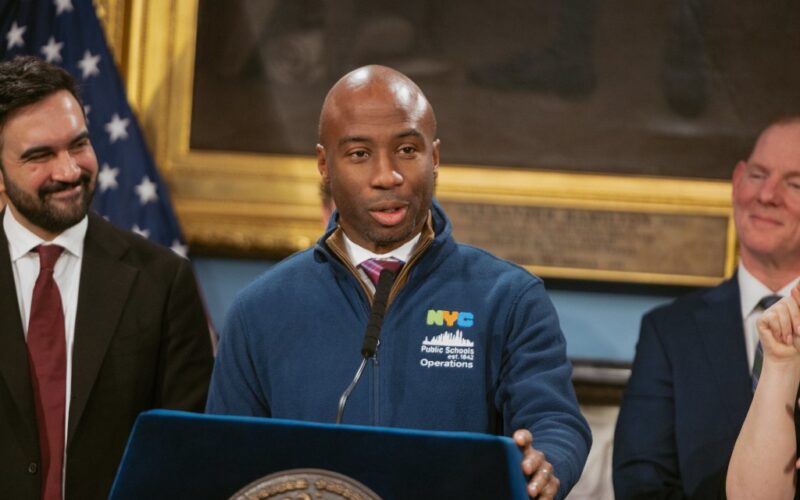
Despite assurances that mayoral control of New York City’s schools would look different under Mayor Mamdani, his chancellor Kamar Samuels on Thursday backed Gov. Hochul’s status-quo proposal to extend it without major changes for Mamdani’s full first term in office.
Progressive advocates had urged Mamdani and Samuels to push for a shorter extension outside of budget negotiations — as the governor has proposed — so that lawmakers could hold a full public debate and hearings on the matter. Despite its inclusion in Hochul’s budget plan, mayoral control has no fiscal impact.
“Please know that while Mayor Mamdani and I support the governor’s proposal, we are committed to democratizing the process to ensure that families and communities have more of a say in how our school system runs,” Samuels said during a hearing in Albany on the governor’s education budget plan.
Instead, the schools chancellor said he would host “community conversations” on mayoral control in each borough as soon as next month. A schools spokesperson said those dates were not yet available.
On the campaign trail, Mamdani pledged, if elected, to end mayoral control of schools, raising eyebrows among New York’s political class but earning praise from some parent advocates who see the agency as unresponsive.
As he prepared to take office last month, Mamdani backed off that promise, but said he still planned to make changes, such as propping up parent coordinators or making parent meetings easier to attend. More significant reforms, such as remaking the city’s school board — known as the Panel for Educational Policy — or allowing for remote participation in public meetings, would require sign-off by the state.
Earlier this week, 43 education advocacy groups called on lawmakers to extend mayoral control by only two years and strip the mayor of his majority appointments to the panel, while a commission drafts a proposal for a new form of school governance. The advocates also held a virtual “watch party” for the hearing, urging parents to contact their state representatives and post on social media with the hashtag “#WatchToActNYC.”
“This is the floor — it’s not the ceiling,” Zakiyah Shaakir-Ansari, co-executive director of Alliance for Quality Education, which endorsed Mamdani for mayor, told the Daily News.
“We’re not necessarily shocked. We’re disappointed in the [request for] four years, but we’re going to continue to do what we do,” she added. “The (state) senators and Assembly members work for us. Our goal is to make sure that they know that this is not what we want.”
It was not immediately clear if the New York State Legislature would approve the extension as part of the budget due this spring or address it outside of negotiations, which could give the issue more time and attention. Mayoral control is also set to be the focus of a City Council hearing next month.
“It’s a possibility that we say in the Legislature, we don’t want to include that in the budget,” Assemblyman Michael Benedetto (D-Bronx), chairperson of the Education Committee, said at Thursday’s hearing. “Maybe this is policy and should not be put in the budget.”
“I got a feeling there are some opinions that might be coming out of my conference that might change school governance in some way,” he added.
Sen. Liz Krueger (D-Manhattan), chairperson of the influential Finance Committee, said she did not have an opinion on whether mayoral control should be handled in the budget or saved for later this legislative session, but pushed Samuels to elaborate on the Mamdani administration’s position on the measure.
“(When) Mayor Mamdani was running for mayor, he said he wanted to end mayoral control,” said Kreuger. “And then, he decided to change his position.”
“I’m not criticizing it, I’m just saying, what does that mean?” she asked emphatically. “What does this mean — we’re going to have more parental participation, but we’re not going to end mayoral control?”
While offering few specifics, the chancellor countered: “I, for one, I don’t believe those two things are mutually exclusive.”
“I think you can have mayoral accountability and have a strong, robust parental empowerment and engagement strategy for our city,” Samuels added. “I don’t think I can come up with that by myself. The mayor and I need to engage with parents themselves, advocates themselves, to really come up with what can we do to ensure not just that your voices are heard, but that we are solving big problems together, and that you are a part of that decision-making process.”
During his testimony, Samuels also asked for the state’s support on a number of “critical needs” that were not addressed in the governor’s budget proposal.
He said New York’s class size law will require that city schools hire 6,000 more teachers by September than are currently onboarded during an average year, at an annual cost of at least $602 million. The law caps class sizes between 20 and 25 students based on grade level.
Samuels also advocated for changes to the state’s Foundation Aid formula, which determines how education funding is divided up across school districts. New York City’s school system is expected to see at least a 3.5% increase under the governor’s proposal, but that remains hundreds of millions of dollars short of what it would have been had lawmakers not altered the formula last year.
The asks came one day after Mamdani in a sweeping City Hall address warned of a possible $12.6 billion city budget gap over two fiscal years, blaming former Mayor Eric Adams for under-budgeting known expenses, such as private special-education tuition or housing vouchers.
Echoing his new boss, Samuels, who was a school superintendent under Adams, said, “These needs are especially urgent given the city’s stark financial realities — a result of choices made in the last mayoral administration.”