




Though Harlem has changed dramatically since its storied Renaissance, the magic remains, and the history is still palpable — if one knows where to look.
“Signs of the Times: Harlem Markers Project” is ready to take you there, with a series of plaques dotting the neighborhood that highlight the people, organizations and even buildings that fostered Black creativity and invention during the 1920s and ’30s.
Karen D. Taylor, who spearheads the project as the founder and executive director of its nonprofit parent, While We Are Still Here, told the Daily News, “We want to demonstrate the richness of that culture and the fact that people here contributed enormously to the culture of the United States of America.”
With all 25 purple-and-gold Signs of the Times plaques installed or in the pipeline, Taylor is focused on making the written history come alive. The public should “not only perceive Harlem as this den of poverty, drugs and criminality,” the neighborhood’s reputation after a decline in the 1960s, ’70s and ’80s, but also as “a place that spawned many influential movements around the world,” Taylor told the Daily News.
Luckily, there’s now an app for that.
The free “Signs of the Times” app, launched last summer, invites users to “step into the heart of Harlem and uncover its vibrant history,” and to “join us in keeping history alive — because every story matters.”
Each app entry corresponds with a plaque and denotes its distance from the user’s current position, along with its location on a map and an option to request directions.
The app makes for a self-directed tour that Taylor hopes will “expand the visitor experience when they come to Harlem.” Eventually, businesses and project sponsors will be able to advertise in the app, she said.
Taylor and volunteers also brought small groups of people to a handful of sites on two “mini tours” last year, an initiative she plans to expand into fully guided tours with more stops. The markers run from West 110th Street near Central Park, to West 162nd Street between Amsterdam and Edgecombe avenues at the project’s northern end.

“It’s not going to be like a drive-by tour,” Taylor said. “They will get out of the bus, instead of just having people sitting in the bus looking out the window.”
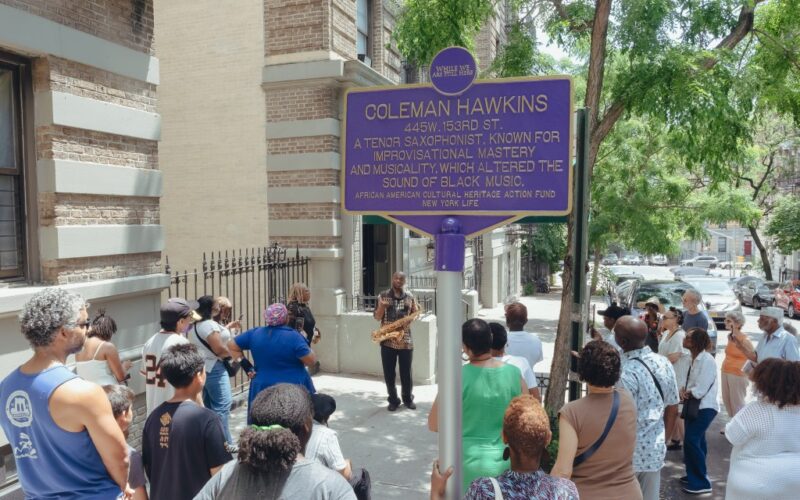
The personal, intimate look invited explorers to travel back in time and imagine what once was. At the plaque commemorating acclaimed tenor saxophonist Coleman Hawkins, the tour group was greeted by saxophonist James Carter, who played Hawkins’ signature song, “Body and Soul,” and told them about the musician whose improvisational, genre-bending mastery boosted the once-scoffed-at horn to center stage and dissolved racial barriers.
Outside the Modern School, founded by Mildred Johnson, alumnus Deidre Bennett Flowers spoke lovingly of her alma mater, which she is writing a book about, Taylor said.

Taylor credits Lehman College professor emeritus William Seraile, who also serves on the While We Are Still Here advisory board, for helping conceive the project by compiling the names and places to be highlighted. With that phase complete, Taylor has a few more markers on her wish list.
She would like to honor George Edmund, co-founder of the National Urban League and a groundbreaking sociologist, with a small sign outside the Urban League building.
Also on her list is the New Amsterdam Musical Association, founded in the early 1900s when most concert halls barred Black musicians and the American Federation of Musicians Local 310 refused to admit minorities. Eubie Blake, Jelly Roll Morton and many others were among its prominent members.
What is now the Tsion Café at St. Nicholas and West 149th Street was once Jimmy’s Chicken Shack, where both Malcolm X and Redd Foxx were dishwashers in the 1940s — a trivia tidbit that even inspired a play imagining their forged friendship, “Malcolm X and Redd Foxx Washing Dishes at Jimmy’s Chicken Shack in Harlem,” currently touring U.S. regional theaters.
Throughout, the markers and historical context emphasize Harlem’s role in shaping American culture overall.

The vision is primed to keep expanding, dovetailing with a number of upcoming events. On Feb. 21, a community forum will be held at the George Bruce Library to encourage community input. A similar gathering in 2020 drew about 50 people, and Taylor hopes for even more this time. June 27 will see the organization’s ninth annual Sugar Hill Music Festival, with guests and other activities to be announced.
Wish list aside, Taylor said she is pleased with where the project stands now and where it’s going. If 25 markers end up being the limit, “at least we’ve gotten that much to inspire people to look more deeply into the history,” she said. “The history is very rich, and it’s very deep.”