


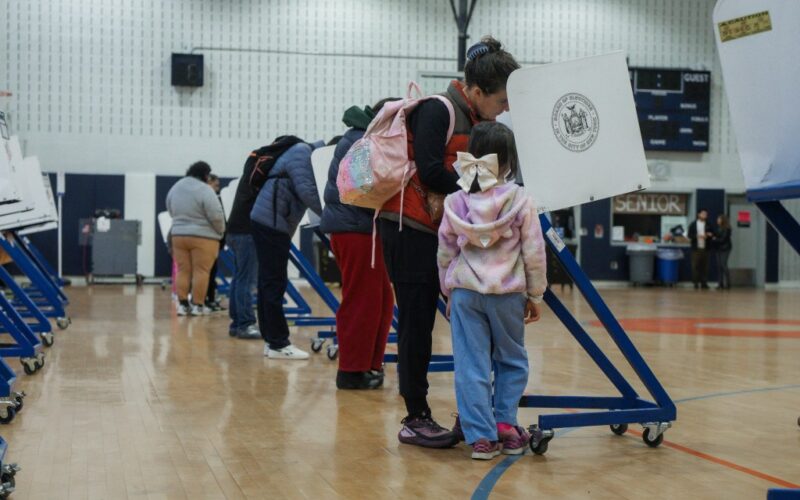
Today, hundreds of thousands of New Yorkers will be asked to vote in special elections in New York City and Buffalo. But the real decision about who will fill the Senate and Assembly seats created when Zohran Mamdani, Sean Ryan, Brad Hoylman-Sigal, and Harvey Epstein were elected to city offices won’t be made by the voters of those districts. The outcome is essentially predetermined, having been set behind closed doors by party insiders weeks before ballots are cast.
If that sounds wildly undemocratic to you, you’re not crazy. It is. Elections are supposed to give voters an opportunity to choose their representatives. But New York State’s special elections shut voters out, replacing democratic choice with a process that looks more like a coronation than a contest.
Under state law, special elections are conducted without primaries. Instead, candidates are selected behind closed doors by local party officials. In districts dominated by one party (which is the case in much of New York City and in Buffalo), a handful of party insiders have picked their favored candidate, and the election that follows is often a formality.
All the likely winners in today’s state special elections are Democrats chosen by county party leadership. Voters are left with little choice and little reason to turn out.
This is not a rare occurrence. Nearly one in five members of the New York State Legislature initially won their seats through special elections.
It doesn’t have to be like this. Just look to New York City for a better model.
When vacancies occur in New York City offices — including City Council, borough president, and even citywide positions — the city holds nonpartisan special elections. The result is more competition, more campaigning, and far greater voter engagement.
The difference is striking. Turnout in New York City’s nonpartisan special elections is double that of state legislative special elections held under the current insider-controlled system. When multiple candidates — often several Democrats — compete for the same seat, they are forced to knock on doors, articulate positions, and energize supporters. Voters respond when their choices feel real.
By contrast, state special elections discourage competition by design. Party insiders pick a nominee, campaigns are truncated to a few short weeks, and challengers are locked out before the public ever hears their names. In overwhelmingly Democratic districts, the outcome is almost always predetermined, further depressing turnout and weakening accountability.
This system doesn’t just dampen participation; it actively promotes party patronage.
An example of the deep flaws in this process has been illustrated in Buffalo over the last few weeks. When state Sen. Sean Ryan was elected mayor, his Senate seat became vacant. Assemblyman Jonathan Rivera announced his interest in running, as did others. But the rules governing special elections allowed the Erie County Democratic Party chair to take the nomination for himself.
This is precisely the kind of scenario that erodes public trust. It reinforces the perception that political power flows through party hierarchies rather than from voters, and that insider status matters more than grassroots support.
Gov. Hochul acknowledged the problem last year and publicly committed to reforming the special elections process. Yet no changes have been enacted. Now, in 2026, voters across the state are once again being asked to head to the polls under this broken system.
New York should adopt a nonpartisan special election model for state legislative vacancies, similar to the one already used successfully in New York City. Such a system would open the field to more candidates, reduce the power of party gatekeepers, and give voters a genuine choice — without leaving districts unrepresented for long periods of time.
Standalone special elections already suffer from chronically low turnout. At a moment when faith in democracy is fragile, the state should be doing everything possible to increase voter engagement — not run elections designed to minimize participation.
With four special elections on the ballot today, Albany has yet another reminder that the current system is failing. If state leaders are serious about strengthening democracy, this is a reform they can no longer put off.
Rauh is executive director of Citizens Union, New York’s oldest good government group.