




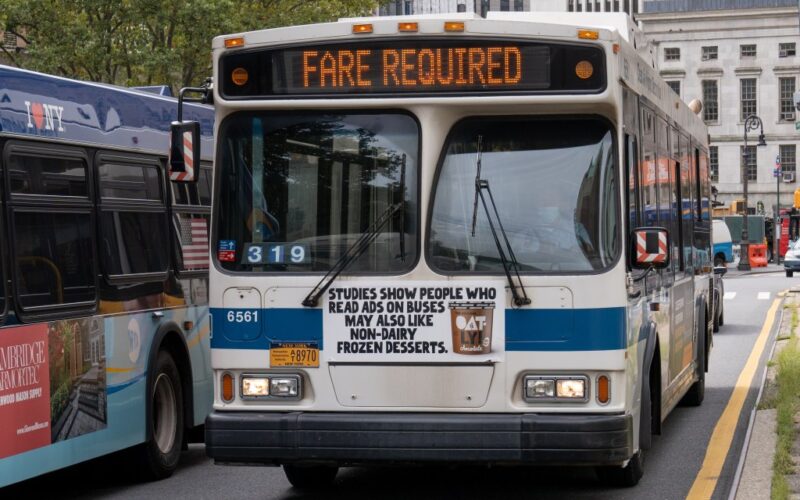
On the heels of Mayor Mamdani’s successful election campaign, many New Yorkers are hopeful that some of the city’s most vexing problems will finally get addressed. One of his core election promises was to make New York City’s buses “fast and free.” While the plan has doubters, it remains a potent promise against which his mayoralty will be judged.
But as a guiding vision for how ossified public institutions can be re-imagined, “fast and free buses” falls short of what a truly transformational end-game vision could target. Public transit should be safe, reliable, affordable, and pleasant.
Imagine our city with truly integrated transit, combining subways, buses, bikes, and carshare, with seamless infrastructure designed to offer the best option for any given trip. To get there we need a series of coordinated, transparent steps, each one building consensus through its success.
It’s actually not fast buses we want, it’s fast trips. If you’ve waited for a bus in the cold or rain, you know that faster buses are not the same as shorter door-to-door trips. The challenge is more about frequency, and the spacing of stops, than the speed of the vehicle.
Some cities have experimented with fare-free transit. But there is no place in North America that approaches the scale and complexity of New York’s system, which carries more than 5 million people daily. Is it a well-planned system? Consider that subways and surface transit systems were historically operated by separate companies, competing for ridership. Even when unified, transfers between systems were poorly managed until the introduction of the MetroCard in the 1990s.
The current redundancy of system coverage is a vestigial carryover from before unified fare cards, leaving a legacy of attempts to speed up isolated transit modes without targeting what should be the central mission: efficient trips for individuals. “Fast and free buses” reflects the persistence of this mind-set, revealing more in what it omits than what it targets. Today, long segments of many bus lines essentially parallel the subway lines below. Encouraging just buses risks discouraging subway use and reducing the overall efficiency of the combined system.
In a wider historic context, subsidizing buses at the expense of trains looms as just the latest chapter in handicapping rail in favor of rubber tires on streets. The history of how bus companies diverted ridership from streetcars has left its mark on our cities by privileging buses and cars over far more efficient ways to move people at scale.
On redundant lines, why would people pay $6/day for a return trip by train when they could travel for free by bus? If the free bus plan is successful, it will draw additional users to it. While some may be new transit riders, others could come from the not-free subway routes. To avoid cannibalizing subway ridership with free buses, we need to rethink train/bus redundancy in a combined transit plan. Buses should extend and complement the subway system, especially for people with mobility issues, not compete with it.
Providing a no-pay bus system that competes with a pay train system risks putting more traffic on the street in the form of buses, not less. It would privilege surface transportation while disincentivizing the far more efficient rail system, further congesting and polluting our streets and degrading the public realm.
To reduce traffic on our streets for a safer, quieter, better quality of life, we should incentivize all public transit, especially the most efficient mode, the one that makes our city so successful and differentiates us from other cities, and that we’ve invested the most in: the subway.
Cohn is an architect and urban designer based in Brooklyn.