




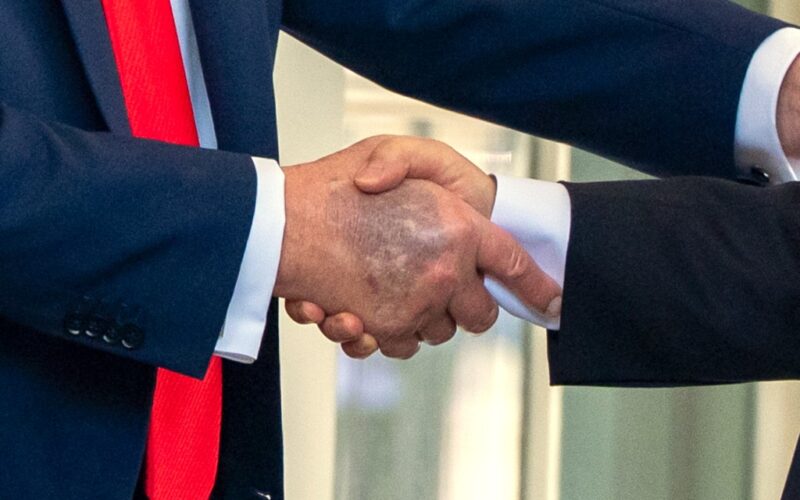
In between global and domestic crises, and despite intense coverage of everything from his ICE deployments to his Greenland envy, President Trump still manages to stir frequent speculation about his health. And nothing fuels the rumor mill more often than glimpses of the swollen, bruised right hand he tries so hard to conceal, but invariably reveals in a gesture, a handshake, or a raised middle finger.
When pressed for an explanation, White House Press Secretary Karoline Leavitt has offered: “President Trump is a man of the people and he meets more Americans and shakes their hands on a daily basis than any other president in history. His commitment is unwavering and he proves that every single day.”
Leavitt adds that “unwavering commitment” to handshaking that causes visible “minor soft tissue irritation,” augmented by “the use of aspirin, which is taken as part of a standard cardiovascular prevention regimen.” (As we know, the president takes a daily dose of blood-thinning aspirin far greater than doctors recommend for cardiac health — apparently because he’s “superstitious.”)
As we approach Abraham Lincoln’s birthday, it is worth recalling that Trump is not the first chief executive to show the literally bruising effects of political gladhanding. Lincoln, to whom he often — and always favorably — compares himself, experienced similar symptoms. Even in the age before videos and spot photography, he proved similarly unable to escape scrutiny.
One comparison no camera could disguise: Lincoln had enormous, rail-splitter’s hands, and Trump’s are, well, smaller. German-American leader Carl Schurz (after whom the park near Gracie Mansion is named), never forgot shaking Lincoln’s giant paw in 1860. As Schurz reported to his wife: “Ouch.”
That year, Lincoln ran for president and endured the same hands-on scrutiny Trump faces today. When word of his nomination reached his Springfield hometown, neighbors marched to his home to celebrate. Lincoln appeared outside his front door and announced he “would invite the whole crowd into his house if it was large enough to hold them,” to which a voice in the crowd shot back: “We will give you a larger house on the fourth of next March” — inauguration day. Then Lincoln decided he would “invite as many as could find room” after all.
As a local newspaper reported, “The invaders were warmly received and many of them had the pleasure of shaking the right hand of the hospitable host.” By the time the crowd thinned, Lincoln’s hand was sore. By the next morning, it was swollen.
The disfigurement struck at an inopportune time. Arriving in town that same day was Chicago sculptor Leonard Volk. He had recently made a life mask of Lincoln’s face, intending to adapt it into a statue. Now he asked to take a plaster cast of the nominee’s hands. As Volk remembered, “those two great hands took both of mine with a grasp never to be forgotten… . I thought my hands were in a fair way of being crushed.”
That night, Lincoln welcomed yet another round of visitors, including an official delegation dispatched from the Republican Convention to officially notify him of what he already knew: that his party had chosen him as its nominee. Greeting them, Lincoln risked yet more injury by announcing: “I will not longer defer the pleasure of taking you, and each of you, by the hand.” That hand must have ached profoundly by the time the group departed.

(Metropolitan Museum of Art)
The next morning, the delegates insisted that a photograph be made to commemorate the nomination. Posing for local photographer William Marsh, Lincoln took care to enfold his puffy right hand in his left — as eager to conceal it as Trump has become eight score years later.
However, there was no hiding from Volk. On Sunday morning, May 20, the sculptor returned to the Lincoln home to take his casts. Observing Lincoln’s dilated right hand, Volk suggested he “hold something” to deflect the puffiness. “I told him a round stick would do.” Within minutes, Volk heard the sound of a saw cutting through wood. Lincoln returned from his woodshed “whittling off the end of a piece of broom-handle.”
Volk told him there was no need to round off the edges. For his statue, Volk intended to fashion the prop into a scroll. “Oh, well,” Lincoln replied, “I thought I would like to have it nice.”
Volk would later fashion two Lincoln statues: one for Springfield, another for a park in Rochester. A savvy marketer, Volk also issued plaster replicas of the hands. Every major Lincoln sculptor since has consulted them as models. Check the puffy right hand on Daniel Chester French’s Lincoln Memorial, or the same feature on Augustus Saint-Gaudens standing Lincoln in Chicago. Our own Metropolitan Museum displays a copy of that swollen right-hand — cast in bronze for Saint-Gaudens in the 1880s.
Here is evidence of both the raw strength Lincoln would soon summon to preserve the Union and the pain he would endure during the exhausting presidency he was destined to win six months after it was cast in plaster.
There are timeless lessons to be learned from this episode. First, there is no way any president can avoid the lens of scrutiny, whether by artists or cameramen, whether slathering a right hand in wet plaster or gummy concealer.
Second: Then and now, a president’s right hand symbolizes his warmth, or lack of it. Even if Donald Trump has truly shaken more hands than any president in history — a highly doubtful claim — it makes a profound difference whether a presidential hand is extended in welcome or disdain, and whether a handshake is genuine or perfunctory.
Lincoln may have displayed a clenched fist for sculptor Volk, but otherwise offered an open hand with malice toward few. Trump once described himself as “better than Lincoln.” Perhaps he has never read the old saying, “Those with open hearts always have open hands” — swollen or not.
Holzer, director of Hunter College’s Roosevelt House, has published more than 50 books on Lincoln and the Civil War.