


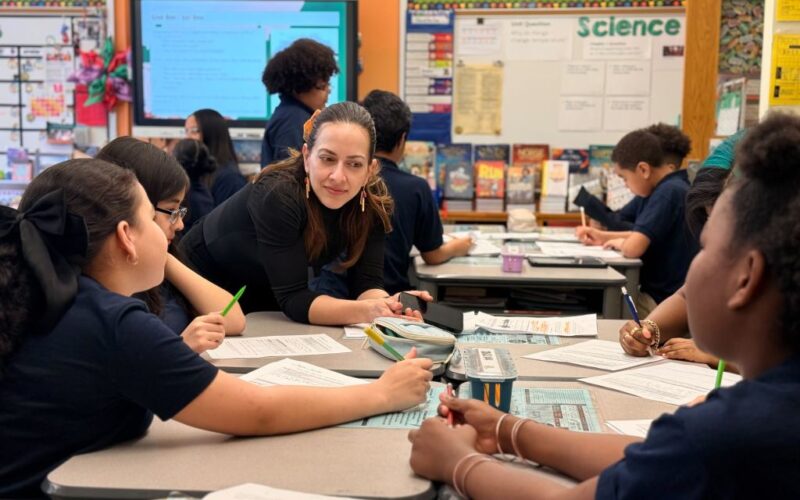
On the first day of school during Black History Month, Ruth Duran assigned her sixth graders in the Bronx the story of a key figure overlooked in most history books.
The civics class at P.S. 315 The Lab School for Children in Kingsbridge centered around the life and legacy of Henrietta Lacks, whose cells led to scientific breakthroughs, including the polio and COVID-19 vaccines. The cells were taken from Lacks’ cervical tumor in the early 1950s, before she died of cancer.
Lacks did not consent to the taking of her cells, nor was her family made aware of their use in medical research until decades after her death.
“Henrietta Lacks was a Black woman,” Duran said on Monday. “At this time when she was going to segregated hospitals, do you think she was receiving the same kind of care as other people?”
“No,” students responded in unison.
“Not so much,” Duran agreed. “So, let’s think about how racism has affected the way Black people are treated in medicine.”
The reading was adapted from “Hidden Voices,” a set of curriculum supplements developed by the New York City Public Schools Department of Social Studies & Civics to introduce students to the stories of people “hidden” from the historical record. The Henrietta Lacks profile was pulled from one of two volumes released over the last few years on the Global African Diaspora.
In his first month as Mayor Mamdani’s chancellor, Kamar Samuels indicated that Hidden Voices will be part of his vision for “truly integrated” schools, which he said alongside safety and academic rigor are his top three priorities as schools chief.
“True integration is not only about student demographics,” Samuels said at last month’s meeting of the Panel for Educational Policy. “It also goes beyond that and includes learning experiences that are providing our kids with a holistic experience.”
“We have already invested in the Hidden Voices curriculum that really brings culturally responsive teaching to life in our schools. And that is [how] we’re going to [teach] our students [to] really be empathetic citizens in this polarized world,” he added.
Along with the African Diaspora books, the city has also released Hidden Voices volumes on seven other groups underrepresented in the curriculum, including figures who are LGBTQ+, Asian American, disabled, Latino, Jewish and Muslim. This school year, the social studies and civics department is offering a dozen professional development days and a couple of three-day “teacher institutes” on Hidden Voices.
While the city does not track how often teachers use Hidden Voices, which is optional, in their classrooms, the guides have been downloaded more than 100,000 times, and lesson plans and posters 50,000 times, according to local education data.
“It’s very difficult, even as an adult, much less as a middle schooler, to think, ‘I can do this’ if nobody that looks like you or has your own background has done it before,” Duran told the Daily News after the lesson. “And at this point, there are so many people from different backgrounds that have done so many things — but we don’t know about them.”

The Hidden Voices project aims to change that: “I think that is great for them to see if they could do it then, then I can do it now,” Duran said of her class, which has 28 students.
Though Hidden Voices dates back to 2018 through a partnership with the Museum of the City of New York, the materials have taken on new meaning in the Trump era, as the federal government has moved to restrict educational programs it sees as related to diversity, equity and inclusion. Most recently, the Trump administration dropped its appeal of a lower-court order that barred the U.S. Education Department from requiring a written anti-DEI attestation or the loss of federal funding.
The city says it’s clear that Hidden Voices is helping students progress academically. Over the last six years, the Regents exams with the highest pass rates and average scores citywide are the two social studies exams, education officials said.
At the Lab School, Duran used artificial intelligence to rewrite Henrietta Lacks’ Hidden Voices profile to make it age-appropriate for her sixth graders.

Over the special combined two-period class, she led students through a lesson that touched on race, consent, science, and the importance of speaking up for what’s right. In each slide, she offered a big idea, how it applied to Lacks’ life, and how it continues to be relevant today, with opportunities for students to share among themselves or with the class.
“It was medical racism,” said Monserrat, one of the students. “Because of the way she looked, they didn’t give her fair treatment, and they also didn’t get consent from other people even though she died.”
“Something that stuck with me throughout the whole story is that no matter who it is, what color they are, you should always ask people for consent before you do something with their body,” chimed in another student, Jesus.
Before students go on mid-winter break, Duran plans to assign a Black History Month project for students to pick a figure from the African Diaspora list — for example, Shirley Chisholm, Roberto Clemente and James Baldwin — write a short essay or Google slides, and get ready to present their research.
Alongside the African Diaspora volume, Duran keeps almost all the Hidden Voices guides in her classroom, and has used or expects to use the Jewish, Muslim, Latinx and Asian Americans books in her lesson plans. While she hopes her students can learn more about themselves, the teacher wants to expose her class to the backgrounds of other people too.
“I want my students to see themselves in the curriculum. But at the same time, I want them to know about other people,” Duran told The News.
“We live in New York City, she added. “We get to learn about all these people that we might see, especially as they are in middle school. And I am hoping that when they go to high school, they get to go to different parts of the city and meet all kinds of people from all over the place.”