



Just how putrid was the New England Patriots’ offense in Super Bowl LX?
When Bad Bunny began the halftime show by carrying a football around his detailed Levi’s Stadium set, jokes that the artist had accumulated more yards than the Patriots flooded social media.
And while a viral post assigning an actual yardage total to Bad Bunny’s route turned out to be nothing more than a believable quip, there are plenty of real stats that capture the Patriots’ historic ineffectiveness in Sunday’s 29-13 loss to the Seattle Seahawks in Santa Clara, Calif.
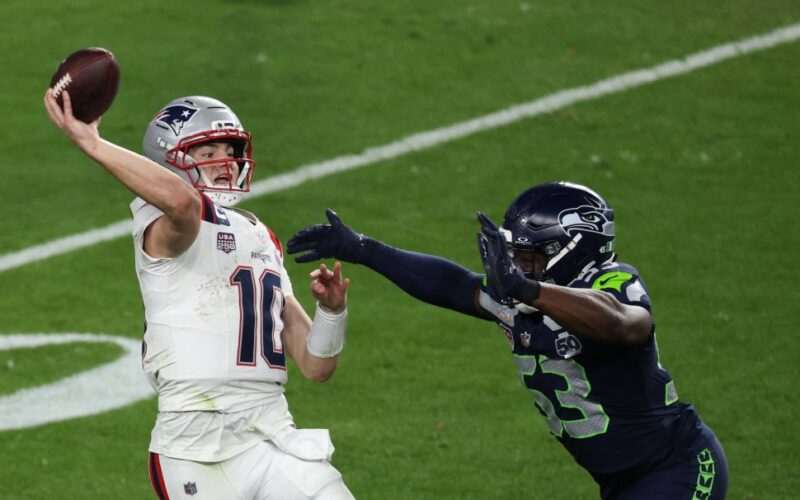
Drake Maye’s Total Quarterback Rating (QBR) of 16.3 was his worst ever in a game he started and more than 60 points lower than the NFL-best 77.1 QBR he produced in the regular season.
Rookie left tackle Will Campbell surrendered a whopping 14 pressures, the most by an offensive lineman in a game all season, according to NFL Next Gen Stats.
Maye’s Expected Points Added (EPA) per dropback — an advanced metric demonstrating the effectiveness of a quarterback’s performance — was -0.34, the sixth-lowest mark in a Super Bowl since 2000.
The Patriots punted on eight of their first nine drives, managed 51 yards of offense in the first half and were shut out until there was 12:27 left in the fourth quarter.
A dominant Seattle defense recorded six sacks, finishing one shy of the Super Bowl record, and forced three Maye turnovers, including a fourth-quarter pick-six that served as the dagger.
“I’d like to go back to the beginning and redo it. There’s so many plays that can decide and change the game,” Maye, 23, said.
“I have the [interception] and they return it for a touchdown. There’s numerous plays in the first half where I feel like I could have made a better throw or made a better decision. It really comes down to who makes the plays and who doesn’t, and they made the plays tonight.”
The jarring statistics underscore that the Patriots, while certainly a good team, were ahead of schedule in advancing to the Super Bowl after back-to-back four-win seasons.
New England’s regular-season strength of schedule of .391 was the lowest of any team since 1999 and the third lowest in the last 50 years.
The Patriots finished 14-3 but defeated only one team with a winning record in the regular season, beating up on the likes of the Jets (twice), Giants, Tennessee Titans, Cleveland Browns and Joe Burrow-less Cincinnati Bengals en route to an AFC East title.
New England did defeat three winning teams in the AFC playoffs, though the Los Angeles Chargers, Houston Texans and Jarrett Stidham-led Denver Broncos are far from Murderer’s Row.
“That’s the best team we faced, obviously, this year,” first-year Patriots head coach Mike Vrabel said of Seattle. “[Losing is] only valuable if we understand what it takes and what we’re going to need to do to improve. If we don’t do that, then it wouldn’t have been very valuable.”
The Patriots’ defense was the driving force in their three playoff victories. On offense, New England averaged only 1.13 points per drive over four postseason games, according to ESPN, which was the lowest rate by a Super Bowl team since 2001.
Maye, the runner-up for NFL MVP, finished his first postseason with a 58.3% completion percentage and seven touchdown passes against eight turnovers, including four lost fumbles.
“That’s what I told the guys in the locker room: It’s fuel,” Maye said. “If it’s not, then I don’t know what this feeling would do for you, because this is tough.”
The Patriots have plenty of room to improve.
Maye now has a postseason under his belt. Another year of seasoning should benefit an offensive line that started rookies at left tackle and left guard. Adding weapons to an offense in which 32-year-old Stefon Diggs was the leading receiver figures to be an offseason priority.
The Patriots were only seven years removed from their previous Super Bowl appearance, which resulted in Tom Brady and Bill Belichick’s sixth Super Bowl victory together.
Sunday did not mark the start of a new Patriots dynasty. That will have to wait.
“Every year is a new year,” Vrabel said. “We continue to try to improve the roster, continue to improve what we do, continue to improve how we do it, continue to believe in people, continue to get the right people in the building, and start over.”