




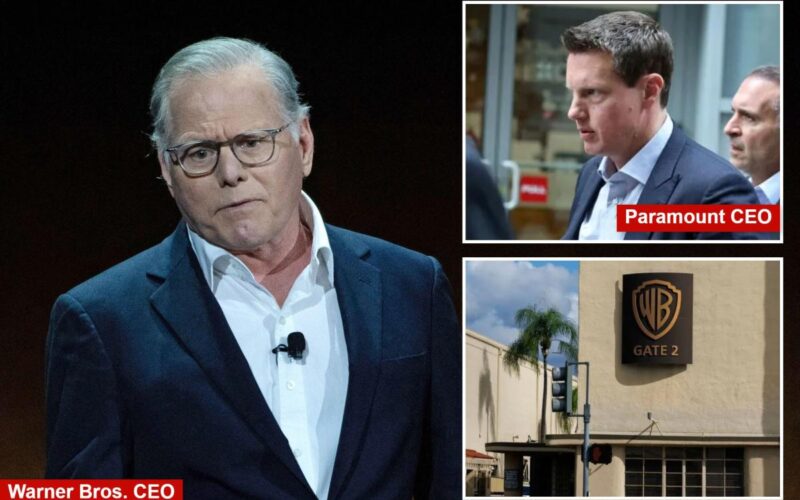
Warner Bros. Discovery may have no choice but to seriously consider the latest sweetened takeover offer by Paramount Skydance to scuttle its megadeal with Netflix — and it’s not because the offer is particularly sweet, On The Money has learned.
New terms of Paramount’s $78 billion offer for WBD revealed on Tuesday include little more than covering a $2.8 billion breakup fee to walk away from the Netflix agreement and a so-called “ticking fee” of 25 cents a share extra if regulators delay approving the Paramount offer, paid every quarter after Dec. 31 that the deal remains in limbo.
On the face of it, the revised offer sounds like a clunker. It fails to deliver a $3-a-share bump that WBD CEO David Zaslav wants from Paramount Skydance on top of its $30-a-share, all-cash bid. It also fails to address Zas’s demand that Larry Ellison, the billionaire father of Paramount’s CEO David Ellison, personally guarantee the $50 billion in debt on the deal as he has done with the deal’s equity.
And yet, just hours after Paramount’s revised bid hit the tape, WBD issued a statement saying it “will carefully review and consider Paramount Skydance’s offer in accordance with the terms of WBD’s agreement with Netflix.”
I know that sounds like boilerplate, the same boilerplate used to reject the other 8 (or is it 9?) Paramount offers, but consider: The major issue for WBD is that the antitrust cops in the US and abroad that have turned sharply against Netflix – calling into question the streaming giant’s ability to close on its planned $73 billion purchase of WBD’s Warner Bros. studio and HBO Max streaming service, according to people close to WBD.
As the Post has reported, Netflix’s entire business model is also under some scrutiny as a monopoly under Section 2 of the Sherman Antitrust Act.
It was just a few days ago, WBD’s plan was to proceed with the shareholder vote, which WBD’s lawyers at Wachtel Lipton believe will be easily approved by investors when the tally is taken later this month or early next. Shareholders don’t want to to roll the dice on rejecting Netflix because the stock will fall back where it was before the bidding war began at around $12.
Plus, many don’t think there’s that much daylight between Paramount’s $30 a share all cash bid and the $27.75 now all cash proposal by Netflix, which will be combined with the value of an “equity stub” from the planned WBD spinoff of its cable properties in the coming months.
That calculus is rapidly changing. Paramount’s bid offers far less regulatory concern and overlap (two studios), which is why it’s willing to pay the aforementioned ticking fee. On top of the DOJ scrutiny, a Senate Judiciary Committee hearing on antitrust recently featured a bipartisan chorus pounding Netflix CEO Ted Sarandos, with the GOP senators taking special aim at the alleged woke nature of his programming.
All that signals a muddle of regulatory scrutiny on top of a likely lawsuit by the Trump administration to block the WBD purchase.
Through a spokeswoman, Netflix’s chief legal officer David Hyman said: “Netflix operates in an extremely competitive market. Any claim that it is a monopolist, or seeking to monopolize, is unfounded. Our success stems from innovation and investment that benefit consumers. We neither hold monopoly power nor engage in exclusionary conduct and we’ll gladly cooperate, as we always do, with regulators on any concerns they may have.”
The company’s top outside counsel also tells the Post: “We have not been given any notice or seen any other sign that the DOJ is conducting a monopolization investigation.”
All that might give WBD enough room to reject this latest Paramount Skydance offer like the rest. Zas seems to feel comfortable dealing with Sarandos; he doesn’t have the same chemistry with either Ellison, and his money target hasn’t been met. WBD will likely respond in the next day or so.
That said, sources close to WBD tell The Post that regulatory risk surrounding the Netflix deal has senior WBD officials weighing what might happen if Netflix needs to walk away. That would mean WBD shareholders get a slimmed down company with the cable properties being sold.
On the positive side, there will be less debt, as much of WBD’s legacy borrowing will be put on the cable spinoff). WBD also will have a $5.8 billion windfall on its balance sheet from the breakup fee paid by Netflix to walk away.
Unfortunately for shareholders, this also would come with a much lower stock price.