




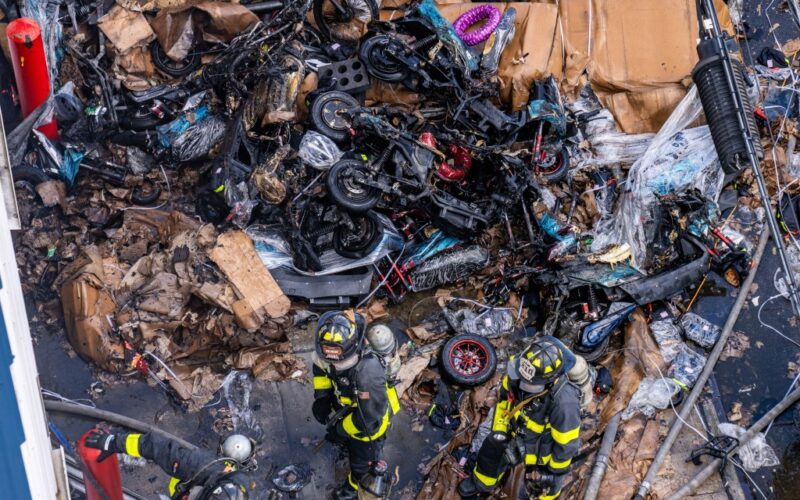
Days after I was sworn in as FDNY commissioner in 2022, fire marshals delivered alarming news: Lithium-ion batteries in e-bikes had suddenly become a leading source of fire deaths in New York City.
This was unheard of in the fire service, and we moved fast to do something about it. The city launched targeted education with delivery workers, passed laws blocking unsafe devices from the market, shut down illegal sellers, and advanced national legislation banning unregulated batteries. Within a year, deaths tied to e-bike battery fires fell sharply — and they have continued to decline.
But that progress risks creating a false sense of security. Fires caused by these batteries remain as frequent as they were in 2022. The decline in deaths reflects changes in behavior, not safer products. Online marketplaces continue to undermine local enforcement, selling banned devices and fake certification stickers directly to consumers.
There is one thing that has proven to reduce these fires permanently: a widely available outdoor charging network that keeps these batteries out of homes, businesses, and transit systems. When these batteries fail, it is more like an explosion than a typical fire. There is no such thing as a safe battery inside. Outdoors, the margin for error is much greater.
New York can build this network now.
There is rightly a lot of focus on delivery apps, but roughly 30% of delivery workers operate independently of the apps, and thousands of New Yorkers rely on e-bikes to commute. If outdoor charging is going to reduce risk, it must serve all riders.
Today, charging providers must negotiate site by site with private businesses and Community Boards, making large-scale deployment nearly impossible. A citywide network requires coordination between public and private partners to make enough space available to create a network.
Private industry can help secure access to parking lots, warehouses, and garages. City government can open municipal properties. Utilities can streamline power connections and expand incentives to make outdoor charging accessible and financially viable.
New Yorkers and property owners should rethink how they view charging cabinets: as a choice between visible safety and hidden danger. If there isn’t one on your block, it means dangerous batteries are charging inside nearby apartments.
Safe charging equipment is ready to deploy today, but it’s sitting in warehouses unused. Conflicting agency approvals, outdated rules, and understaffed technical review teams delay installations for months or years.
That doesn’t make New Yorkers safer. It protects large corporations that ignore regulation, flood the market with dangerous products, and vanish when a fire happens — while responsible small businesses wait for permission and drown under red tape.
We need to help the right companies scale. New York already has a tool to do this: regulatory variances. Variances allow agencies to quickly approve innovative safety solutions from trusted companies. The city should use them to support charging providers that demonstrate the following: existing safety records, strong maintenance standards, transparent data-sharing, and accountable local operations.
When safe, affordable charging is easy to access, workers don’t have to rely on unsafe devices. When we make it an advantage to act responsibly, we push bad actors out of the market.
A city with safe charging infrastructure within reach of every rider is achievable now, without waiting for legislation or new technology. Right now, thousands of these batteries are inside your apartment building, the lobby of your office, or on your subway car. We need to get them outside today.
If we do, we won’t just prevent the next deadly fire, we’ll prove innovation and public safety don’t have to be at odds, and that government can actually work.
Kavanagh was FDNY commissioner from 2022 to 2024.