




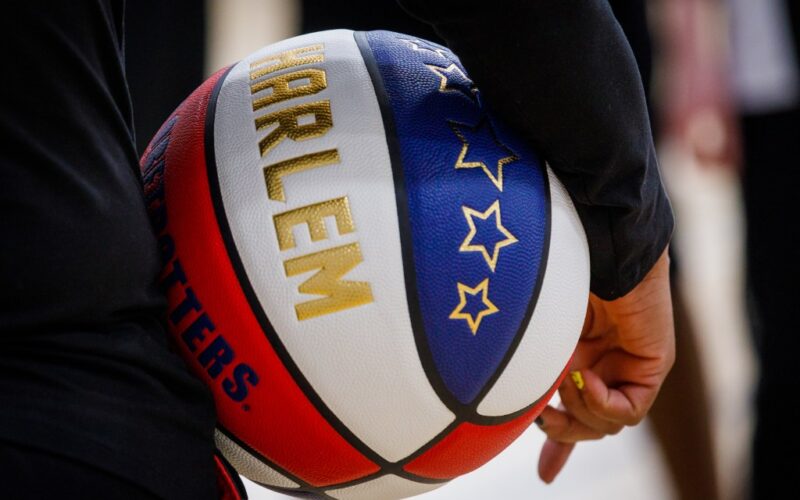
As Darnell “Speedy” Artis sat in the backroom at a Brooklyn basketball clinic he was running, a few wide-eyed children peered through the window.
Between drills, more and more kids peeked through the glass, catching glimpses of Artis in his red, white and blue uniform as he spoke with the Daily News at the Brooklyn Basketball Training Center across the street from Barclays Center.
Such is life for a Harlem Globetrotter.
“That is my favorite part of the job, the way we get to interact with kids on a daily basis, and families get to see their kids smile and see their kids having fun and loving the game,” Artis told The News during that interview.
“I’m gonna stop shooting jump shots sooner than later, and most people do. So giving back to those kids that have dreams and aspirations is what a lot of us wake up to do.”
Those kinds of intimate connections — along with their incredible skills, trick shots and fun-loving theatrics — have helped the Globetrotters prevail as a cultural staple for the past century.
This year marks the 100th anniversary of the Harlem Globetrotters, who were founded by inaugural coach Abe Saperstein in 1926 — not in Upper Manhattan, but in Chicago.
The Globetrotters are celebrating their 100th birthday with a sprawling tour, which includes stops at Barclays Center on Sunday; in Atlantic City on Monday; and at Nassau Coliseum on Feb. 21.
“For something to last 100 years, you have to really think about what are the bones of it, and the tradition itself, having been an event that’s family-friendly, something that families look forward to,” Artis, 32, said.
“You’ll have a dad that came with his dad, that came with his dad. So when you have that type of a pull and [can] connect with families, you don’t have to reinvent the wheel all the time.”
The 5-7 Artis is in his 10th year on the Globetrotters and is renowned for his blazing speed. Others on the roster are known for their high-flying dunks, jaw-dropping ball-handling or seemingly limitless range.
That confluence of talents allows the players to entertain audiences with moves they would never see in an NBA game — all while the Globetrotters defeat the rival Washington Generals virtually every time.
But there is much more to the Globetrotters’ legacy than spectacular showmanship.
Founded during segregation, the Globetrotters broke down barriers as a showcase for Black athletes. Their “Harlem” moniker was a nod to the neighborhood’s presence in Black culture and stuck even though the team did not play there until 1968.
Before they became an exhibition team, the Globetrotters were highly competitive, winning the World Professional Basketball Tournament in 1940 and defeating the Minneapolis Lakers (then of the National Basketball League) in 1948.
“There might not be LeBron James or Kevin Durant or Steph Curry in the NBA if it wasn’t for the Harlem Globetrotters in 1950, when Nat ‘Sweetwater’ Clifton became the first African American player to sign an NBA contract [with the Knicks],” Artis said.
“All of these things are important for us to be able to spit back into news articles, on TV, so that kids can see that the Globetrotters aren’t just a sports brand. We’re a historical brand. We’re a brand that carries tradition and carries legacy.”
Attending Globetrotters games in Philadelphia with his father and brothers every year helped Artis fall in love with basketball.
Artis went on to play at Gwynedd Mercy University outside of Philly, where he remains the Griffins’ all-time assists leader and last year became the school’s head coach.
He now aims to inspire the next generation of basketball players, whether it is at a youth clinic, in a summer league or during a Globetrotters game.
“We have different things going on throughout the game and throughout the tour that I don’t really want to reveal in an article, in an interview,” Artis said. “We want people to come out and see it and be like, ‘Wow, that’s something truly amazing and truly special.’”