




By ADITHI RAMAKRISHNAN, AP Science Writer
NEW YORK (AP) — The first solar eclipse of the year will grace Antarctica, and only a lucky few will get to bask — or waddle — in its glow.
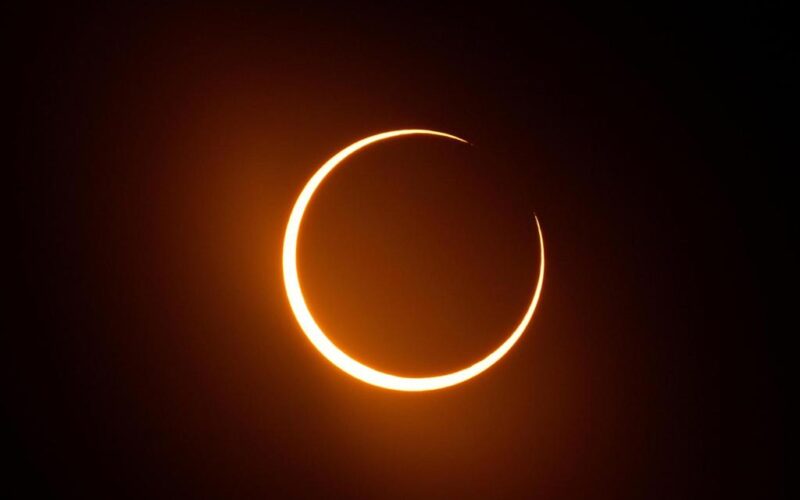
Tuesday’s annular solar eclipse, known as a “ ring of fire,” will only be visible in the southernmost continent, home to research stations and diverse wildlife.
“The penguins down there are going to have a great show,” said astronomer Joe Llama with Lowell Observatory.
Clear skies permitting, more people can catch a partial eclipse with small bites taken out of the sun from the tips of Chile and Argentina and bits of southeastern Africa including Madagascar, Lesotho and South Africa.
Solar eclipses happen when the sun, moon and Earth align just so. The moon casts a shadow that can partially or totally block out the sun’s light from Earth.
It’s “this beautiful coincidence between the size and the distance of the moon and the sun,” said astrophysicist Emily Rice with the City University of New York.
During an annular, or ring-shaped, eclipse, the moon just happens to be farther away from Earth in its orbit so it doesn’t totally cover the sun. Only a thin sliver remains visible.
“The sun essentially gets its core taken out,” Llama said.
Solar eclipses happen a few times a year, but are only visible from places in the path of the moon’s shadow. Two partial eclipses happened last year, and the last total solar eclipse swept across North America in 2024.
Looking directly at the sun is dangerous even when most of it is covered, so make sure to grab eclipse glasses. They block out ultraviolet light from the sun and nearly all visible light. Sunglasses and binoculars aren’t protective enough.
Eclipse glasses should say they comply with ISO 12312-2 standards, though fake suppliers can also list this on their products.
There are also ways to enjoy solar eclipses indirectly. Make a pinhole projector using household materials or hold up a colander or cheese grater to the sky and look down to see images of the eclipse projected onto the ground.
There is a total solar eclipse in the cards in August for skygazers in Greenland, Iceland, Spain, Russia and part of Portugal. Swaths of Europe, Africa and North America will be treated to a partial eclipse.
The Associated Press Health and Science Department receives support from the Howard Hughes Medical Institute’s Department of Science Education and the Robert Wood Johnson Foundation. The AP is solely responsible for all content.