

What is the perfect Valentine’s Day movie? Why, “Rio Bravo,” of course.
According to Quentin Tarantino: “There are certain movies that you hang out with the characters so much that they actually become your friends.”
But what makes “Rio Bravo” a bonding experience for lovers is its timelessness.
To paraphrase Italo Calvino, “A classic film is a movie that has never finished saying what it has to say.”
“Rio Bravo” celebrates the virtues of loyalty, kinship and a camaraderie of the heart.
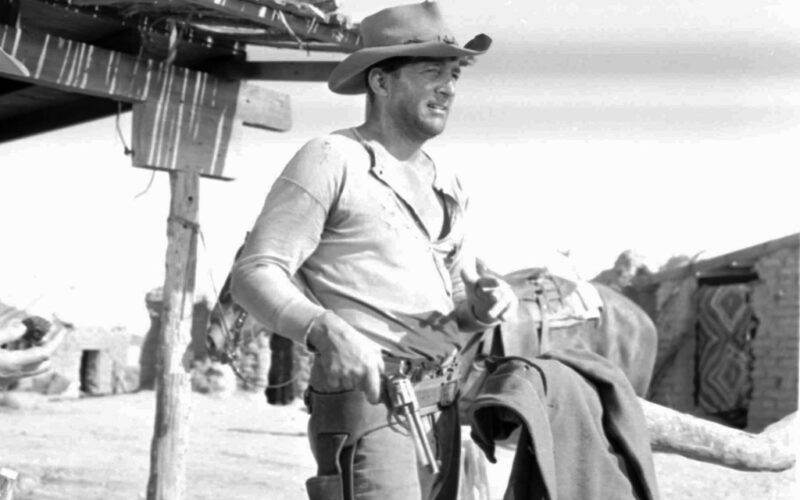
And the linchpin of this greatest of all Westerns is none other than Dean Martin.
Yes, Dean Martin — the comedic crooner turned dramatic actor.
Valentine’s Day, which has its origins in the Roman feast of Lupercalia, calls to mind the artistry of Publius Ovidius Naso.
When it comes to motion pictures, no entertainer embodied Ovid’s concept of Ars est celare artem — “The art is to hide the art” — more than the man born Dino Paul Crocetti.
Still, Dino’s sense of sprezzatura, or effortless stagecraft, sometimes confounded reviewers.
One such doubting Thomas was Terry Teachout, the Wall Street Journal’s late drama critic.
Nearly 18 years ago, I took this redoubtable Renaissance man to task in the pages of American Cowboy.
While agreeing with Terry that “Rio Bravo” is “the most entertaining movie ever to come out of Hollywood,” I said the film’s center of gravity wasn’t John Wayne but Dean Martin.
Martin’s Oscar-worthy performance as the alcoholic deputy brings a gritty sensibility to this Howard Hawks western. Dino eschews the drunken pagliaccio. Instead, he depicts Dude as a fallen hero in search of redemption — a lawman who reclaims his honor and the kinship of his peers.
Duke Wayne’s John T. Chance affords his deputy a sturdy shoulder to lean on, but Dude is the agent of his own absolution.
Martin also conveys an uncommon warmth in his whimsical exchanges with Walter Brennan’s older deputy, Stumpy. And Dean’s mellifluous baritone elevates “Rio Bravo’s” cowboy melodies, “My Rifle, My Pony, and Me” and “Cindy.”
In an essay for the British Film Institute, Matthew Thrift argued that if “The Young Lions” and “Some Came Running” — Martin’s prior films — “proved the adaptability of Dino’s movie star charisma, it was ‘Rio Bravo’ that gave him the against-type role of his career.”
Thrift quotes Ward Bond’s Pat Wheeler, who is startled by the drunken deputy’s slovenly appearance: “I don’t think I’ve ever seen you like this before.”
Indeed, “the beaten and humiliated Dean Martin that sidles into that [film’s] wordless opening with a thirst and a sweat on, his skin scorched by the Texas sun, is a world away from “the coolest man who ever walked the earth,” as more than one YouTube hagiography of Martin would have it.
Richard Corliss, Time magazine’s longtime movie critic, explained the method to Dean Martin’s thespian art: “[Martin] spends most of 1959’s ‘Rio Bravo,’ his best film, staring mournfully at a whiskey bottle he’d like to suck dry. Defeat glazes his eyes; it’s the rare movie portrait of an alcoholic that skirts both sensation and sentiment.”
In an interview with Peter Bogdanovich, director Howard Hawks explained what makes this movie such an iconic western: “The crux of ‘Rio Bravo’ is not Wayne; it is Dean Martin’s story — everything happens because of the drunk.”
And mirabile dictu, American Cowboy’s editor Jesse Mullins informed me that Teachout had come to appreciate my take on “Rio Bravo.”
So, today, after sending a dozen roses to your sweetheart and sharing a romantic candlelight dinner, screen the cowboy classic that will warm your hearts as it lifts your spirits.
Iaconis, chairman of the Italic Institute of America, is writing a novel about Harry S. Truman.