



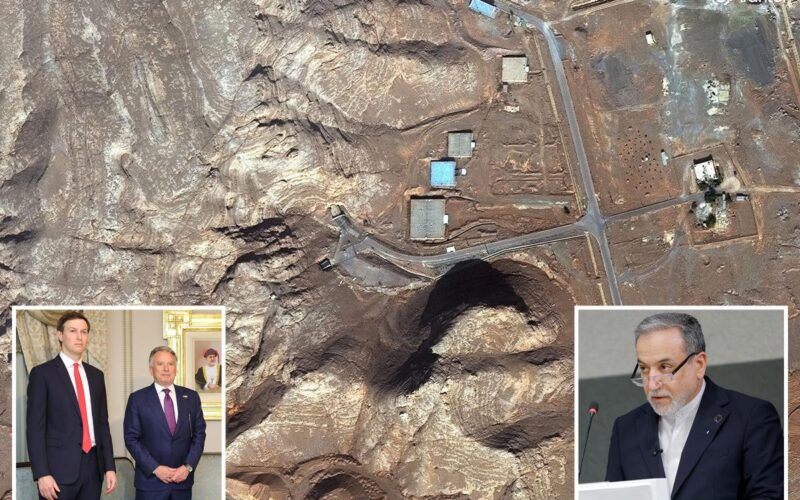
WASHINGTON — American and Iranian negotiators have hashed out “guiding principles” for an agreement during the second round of talks on Tehran’s nuclear program, according to Iran Foreign Minister Abbas Araghchi.
“We were able to reach a general agreement on a set of guiding principles, based on which we will proceed from now on and move toward drafting a potential agreement,” Araghchi told state TV earlier from Geneva, where the talks were held.
“This does not mean that we can quickly reach a final agreement, but at least the path has begun.”
A US official agreed that “progress was made, but there are still a lot of details to discuss. The Iranians said they would come back in the next two weeks with detailed proposals to address some of the open gaps in our positions.”
Vice President JD Vance told Fox News Tuesday afternoon that “in some ways” the talks went well, “but in other ways, it was very clear that the president has set some red lines that the Iranians are not yet willing to actually acknowledge and work through.”
The Trump administration has insisted that Iran expand the negotiations — led by US special envoys Steve Witkoff and Jared Kushner — to cover its ballistic missile program and the treatment of anti-regime protesters, topics that Tehran has insisted are off the table.
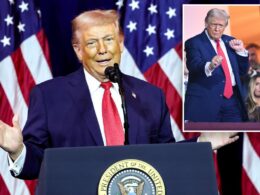
“It’s got to be a good deal: no nuclear weapons, no missiles, no this, no that, all the different things that you want,” President Trump told Fox Business Network host Larry Kudlow of a potential agreement last week.
“Our primary interest here is we don’t want Iran to get a nuclear weapon,” agreed Vance Tuesday, adding that “everything is on the table.”
“We do have a very powerful military,” he told “The Story” host Martha MacCallum. “The president has shown a willingness to use it. He also has a remarkable diplomatic team. He’s shown a willingness to use that too.”
“But of course, the president reserves the ability to say when he thinks that diplomacy has reached its natural end,” Vance continued. “We hope we don’t get to that point. But if we do, that’ll be the president’s call.”
“We certainly want Iran to stop being a state sponsor of terrorism, one of the world’s largest state sponsors of terrorism,” the VP went on. “There are a lot of ways in which they endanger America’s national security. But the most important way they could is if they acquired a nuclear weapon.”
The Geneva talks followed indirect discussions Feb. 6 in Oman, which both sides described as positive.
As talks got underway Tuesday, Iranian Supreme Leader Ayatollah Ali Khamenei openly taunted Trump that America’s powerful naval buildup in the region could be “slapped so hard, it cannot get up.”
“The US president says their army is the world’s strongest, but the strongest army in the world can sometimes be slapped so hard it cannot get up,” the 86-year-old tyrant sneered in comments published by Iranian media.
Khamenei also threatened on X to sink US warships.
“The Americans constantly say that they’ve sent a warship toward Iran,” his team posted on his English X account. “Of course, a warship is a dangerous piece of military hardware. However, more dangerous than that warship is the weapon that can send that warship to the bottom of the sea.”
Additionally, Iran has carried out drills in the Strait of Hormuz, the Persian Gulf and the Gulf of Oman.
During those exercises, Iran claimed to have briefly closed parts of the Strait of Hormuz, through which roughly one-fifth of the world’s seaborne oil trade travels annually.
Meanwhile, Trump revealed last week that he had dispatched the world’s largest aircraft carrier, the USS Gerald R. Ford, to the Middle East to join the USS Abraham Lincoln and its associated strike group. However, the Ford is at least 10 days away from arriving in the region.
Trump has repeatedly declined to rule out the possibility of taking military action against Iran, with the US buildup in the Middle East reminiscent of the fleet assembled in the Caribbean before the Jan. 3 raid to capture Venezuelan strongman Nicolas Maduro.
“I think they want to make a deal. I don’t think they want the consequences of not making a deal,” Trump told reporters Monday evening aboard Air Force One.
In June last year, Trump ordered the bombing of three of Iran’s top nuclear sites, a mission he claimed “completely and totally obliterated” those facilities.
Iran has repeatedly denied that it has been pursuing a nuclear weapon, despite having at one point enriched uranium to 60%, far above the threshold needed for nuclear power plants.
“It seems like that would be the best thing that could happen,” Trump told reporters Friday when asked about the possibility of regime change in Iran.
When pressed about whether the US could target the Tehran regime’s nuclear sites again, Trump replied, “If we do it, that would be the least of the mission.”