



Among the many sins former Mayor Eric Adams must answer for is leaving his successor, Zohran Mamdani, a colossal budget deficit of roughly $12 billion this fiscal year and next.
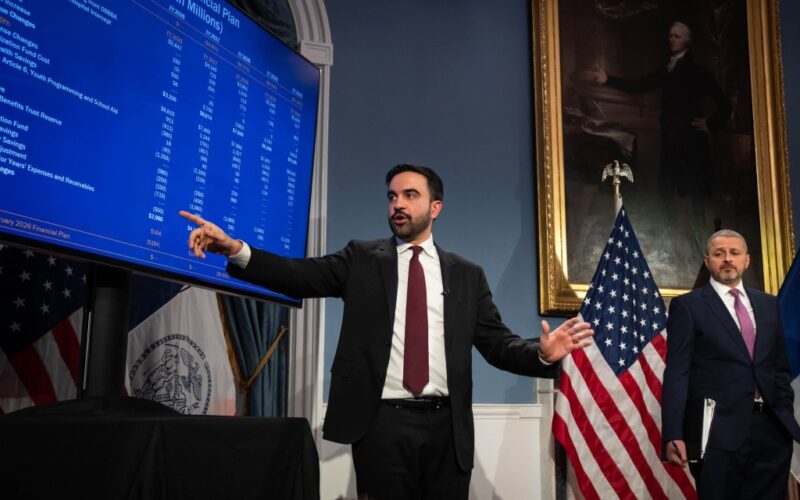
Earlier this week, Mamdani released a revised financial plan where he asserted that closing the deficit would be possible in only two ways.
Since increasing tax rates for high earners is a nonstarter for Gov. Hochul, the mayor offered an alternative. Raise the city’s real property tax rate by about 9.5%, which requires only the approval of the City Council.
But he got backlash for this too. Council Speaker Julie Menin and Finance Committee Chair Linda Lee promptly poured cold water on Mamdani’s property tax ploy. In an interview, Lee noted that the property tax increase “would have a negative effect on a lot of homeowners” in her district in eastern Queens and others. Not only that, the proposal would exacerbate the fiscal problems of rent-stabilized housing, even before Mamdani’s proposed freeze on rents.
Mamdani’s announcement risks annoying voters without gaining meaningful leverage over Hochul and the Legislature. Neither would appreciate being strongarmed by the mayor.
The mayor asserted that there is no third way, but of course there is. As noted in Menin’s and Lee’s statement, the city can reduce spending more and raise new revenues.
Previous mayors closed budget gaps with “PEG cuts,” an acronym for “Program to Eliminate the Gap.” Agencies would be assigned targets representing percentage reductions in the expense (operating) and capital (long-term investment) budgets.
Mamdani, wanting to be different, has eschewed this terminology but followed much the same practice, requiring agencies to designate Chief Savings Officers (CSOs) to identify potential efficiencies. The CSOs are tasked with saving 1.5% in the current fiscal year (FY 2026) and 2.5% in the next (FY 2027).
The mayor stated, dubiously, that agencies could not tolerate larger cuts and sustain services. But history says otherwise.
Amid the Great Recession, Mayor Mike Bloomberg proposed in his January 2010 financial plan savings of 4.7% in FY 2011. I was working for the city’s Planning Department at the time, and I can vouch that the city lived within its constrained means.
Moreover, Mamdani has alternatives to drastic across-the-board agency cuts. The Citizens Budget Commission (CBC), for example, recommends targeting cuts to services where demand is shrinking, or where costs are skyrocketing.
Mamdani could follow their leads. School funding has not declined with school enrollment. And the cost per ton of recycling has shot up.
He can also stretch out capital spending, reducing annual debt service. One of the biggest components of the capital program is the construction of replacement jails to enable, in theory, the closure of Rikers Island. That construction is already well behind schedule and could be delayed more.
The mayor can also look for ways to utilize technology to improve employee productivity as has been attempted in sanitation.
Mamdani can align benefits with national practice by implementing cost-sharing for employee and retiree health benefits.
Finally, Mamdani can raise revenue by more aggressively monetizing the value of the city’s on-street parking spaces. NYC can also dispose of unneeded assets, including land and buildings.
There are many possible paths to budget balance. If Hochul and the Council leadership stand fast, the alternatives will come into play. New York City should be able to balance its budget without a tax increase in a year when base tax revenues are rising by 4% and the state is offering an additional $1.5 billion in aid.
Kober is a senior fellow at the Manhattan Institute.