


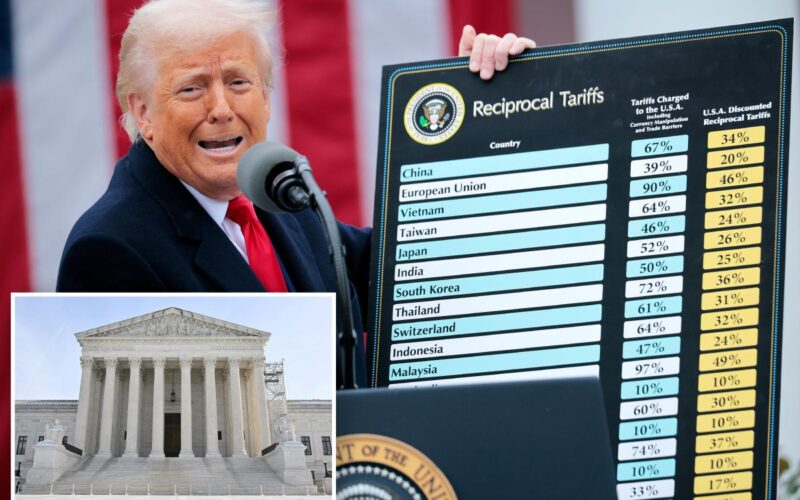
The Supreme Court ruled Friday that President Trump cannot use emergency powers to impose sweeping tariffs on foreign imports.
In a 6-3 vote, the justices found that the International Emergency Economic Powers Act (IEEPA), which Trump used to apply broad, across-the-board levies — including a 10% baseline rate and an extra 10% tariff on China for its role in shipping fentanyl to the US — does not authorize the imposition of duties.
Chief Justice John Roberts wrote the majority opinion, joined by conservative Justices Amy Coney Barrett and Neil Gorsuch, as well as liberal Justices Ketanji Brown Jackson, Elena Kagan and Sonia Sotomayor.
In his opinion, Roberts noted that the “lengthy list of powers” articulated by the IEEPA does not include “any mention of tariffs or duties.”
“That omission is notable in light of the significant but specific powers Congress did go to the trouble of naming,” the chief justice went on. “It stands to reason that had Congress intended to convey the distinct and extraordinary power to impose tariffs, it would have done so expressly—as it consistently has in other tariff statutes.”
The White House has previously pledged to use other legal avenues to impose tariffs, including Section 232 of the Trade Expansion Act of 1962 and Sections 201 and 301 of the Trade Act of 1974, if the high court did not rule his way.
The president has also floated the possibility of repackaging his IEEPA tariffs regime as licensing fees.
However, those methods are far more cumbersome and often restricted to certain types of imports or subject to expiration.
As of mid-December 2025, IEEPA tariffs had taken in $174.49 billion — about 70% — of the roughly $251 billion worth of tariff revenue collected in fiscal years 2025 and 2026, according to data from US Customs and Border Patrol.
The opinion by Roberts made no mention of whether that money would have to be refunded, while conservative Justice Brett Kavanaugh noted in his dissent that “[a]s was acknowledged at oral argument, the refund process is likely to be a ‘mess.’”
“In addition, according to the Government, the IEEPA tariffs have helped facilitate trade deals worth trillions of dollars—including with foreign nations from China to the United Kingdom to Japan, and more,” Kavanaugh continued. “The Court’s decision could generate uncertainty regarding those trade arrangements. In any event, the only issue before the Court today is one of law.”
Until Trump, no president had used IEEPA, which became law in 1977, to impose tariffs — though Richard Nixon did use its precursor law, the Trading with the Enemy Act of 1917, to impose an emergency 10% tariff on almost all imports in 1971.
During oral arguments this past November, a majority of the conservative-leaning Supreme Court seemed skeptical of Trump’s use of IEEPA, pummeling Solicitor General John Sauer with tough questions.
“Congress, as a practical matter, can’t get this power back once it’s handed it over to the president,” Gorsuch had contended at the time.
“It’s a one-way ratchet toward the gradual but continual accretion of power in the executive branch and away from the people’s elected representatives.”