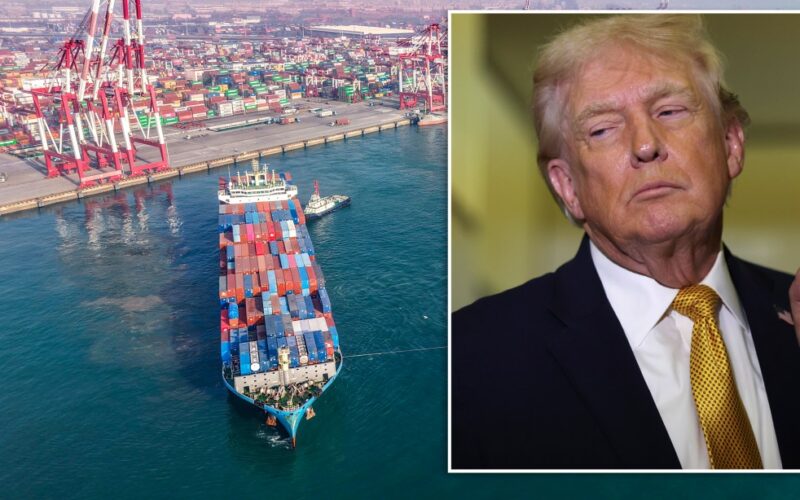
The Supreme Court Friday struck down some of President Trump’s sweeping tariffs on imported goods, but left the door open for the White House to use other tools to impose the controversial levies.
In a significant blow to Trump, the conservative-dominated top court ruled 6-3 that the president overstepped his authority by imposing the wide-ranging levies, a signature policy of his second term. Justices Kavanagh, Alito and Thomas dissented.
“IEEPA does not authorize the President to impose tariffs,” Chief Justice John Roberts wrote in the decision, referring to the International Economic Emergency Powers Act.
Roberts noted that Trump claims the act gives him nearly limitless authority to impose any tariffs for any reason, an assertion that defies reason.
“No President has invoked the statute to impose any tariffs, let alone tariffs of this magnitude and scope,” Roberts wrote. “That ‘lack of historical precedent,’ coupled with the breadth of authority that the president now claims, suggests that the tariffs extend beyond the president’s ‘legitimate reach.’”
The White House has vowed to quickly move to replace the tariffs that the Supreme Court struck down with other import levies. It wasn’t immediately clear how long that might take or what legal obstacles the administration might face.
Along with the legality of the tariffs, the high court had to decide the thorny question of how to potentially refund the billions of dollars collected so far, which the plaintiffs demanded.
It wasn’t immediately clear what the decision means for the nearly $300 billion that the U.S. has already collected from companies that import goods covered by the act.
The ruling sends the case back to a lower court to hash out whether the cash must be returned.
“That process is likely to be a mess,” argued Justice Brett Kavanaugh in a dissenting argument.
The case centered on the the 1977 International Emergency Economic Powers Act, which gives the president the right to “regulate … importation or exportation” of goods if he declares an “unusual and extraordinary threat.”
Trump invoked the act to impose two sets of tariffs. One targeted products from China, Canada, and Mexico, which Trump says have not done enough to stop the flow of fentanyl into the U.S., without even claiming any possible link between that issue and trade.
He’s also recently threatened to impose a new set of tariffs on European allies over their opposition to his demand that the U.S. takeover Greenland, although he later backed down.
The other taxes on imports from almost all trading partners in the world were designed to end what Trump called the urgent threat of large trade deficits, even though the U.S. has run trade deficits for decades and actually has trade surpluses with some of the countries targeted.
A group of small businesses and Democratic-led states separately sued, noting that the IEEPA has never been used to impose tariffs and that only Congress has the right to impose such taxes on goods sold in the U.S. They won in lower courts, setting up the battle before the conservative-led top court.
The justices sounded mostly skeptical of Trump’s claims in a lengthy oral argument in November, but court-watchers warned they don’t always signal how they will rule.
Trump has repeatedly stressed the importance of a favorable ruling, calling his unfettered right to impose tariffs an essential tool to maintain U.S. power on the global stage.
Tariffs are taxes paid by the companies that import products, not the foreign nations themselves as Trump has claimed. Firms eventually pass on the extra costs to consumers to avoid taking a hit to their bottom line but some analysts say they often delay or disguise the price hikes to avoid losing customers or market share.