



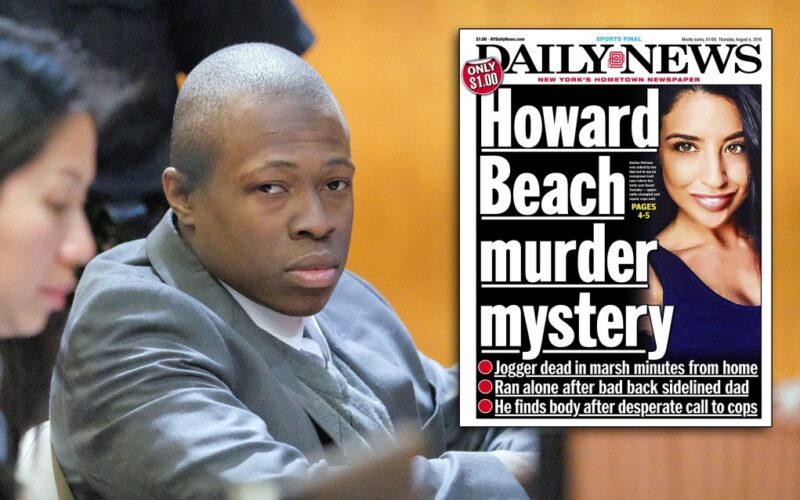
A Queens judge shot down a bid to vacate the conviction in the murder of Howard Beach jogger Karina Vetrano, claiming allegations that an “improper racial dragnet” was used to track down a suspect didn’t play a direct role in the killer’s apprehension.
In court papers released late Thursday, Queens Supreme Court Judge Michael Aloise denied a motion to vacate the conviction of Chanel Lewis and order a new trial in the Vetrano murder.
Lewis’ attorney Ron Kuby alleged his client was linked to the killing after the NYPD used an unapproved lab to do racial phenotyping testing on evidence recovered from Vetrano’s body.
The testing conducted by Parabon NanoLab determined that the killer was of African descent and “led to a sweep of minority suspects prior to the testing of (Vetrano),” Kuby’s motion claimed.
“How this racial dragnet led specifically to Chanel Lewis’ door remains unknown; the fact that it did and that it was withheld is newly discovered, and undeniable,” the court papers allege. “Important questions remain about the reliability of DNA phenotyping and the methodologies employed by Parabon NanoLabs.”
Court papers cited a 2019 story in the Daily News reporting 360 Black and Hispanic men previously questioned by police in Howard Beach “were harassed, surveilled and swabbed on questionable consent.”
“The arrest was immediately mythologized as dogged police work and good luck,” Kuby told The News in 2023 after filing his motion to have the conviction vacated. “The DA’s office and the police worked very hard to to make this look like it had nothing to do with race.”
“Usually when white people insist the the prosecution of Blacks has nothing to do with race, it’s always about that thing,” he said.
Aloise disagreed, claiming that, even if the racial dragnet allegations were true, Lewis’ wasn’t considered a suspect in Vetrano’s murder until “six months” after the phenotype testing was conducted.
Citing evidence brought out in trial, Aloise said NYPD Det. Lt. John Russo remembered seeing Lewis in the area where Vetrano was murdered a few days before the killing and that “he had odd behavior and odd attire for the weather on those dates,” which led to them questioning him as a suspect and getting his DNA, which matched the evidence left at the crime scene.
“Without sworn allegations connecting the defendant’s testing and arrest to the Parabon report, the defendant cannot establish that the report was specifically utilized in any way in the apprehension of this defendant and cannot establish a legal basis for his claim that he was illegally targeted as part of a racial dragnet,” Aloise noted, dismissing Kuby’s motion.

Vetrano, 30, was sexually abused and killed as she went jogging in a park near her Howard Beach home on Aug. 2, 2016, with Lewis convicted and sentenced three years later to life without parole.
According to testimony at his trial, Lewis’ DNA was found on the victim’s body. His first prosecution ended with a hung jury before his conviction on April 1, 2019.
Critics of Virginia-based Parabon say private labs receive less scrutiny than public labs.
Queens District Attorney Melinda Katz said Friday “the evidence of Chanel Lewis’ guilt was proven beyond a reasonable doubt at trial.”
“Among all the other evidence presented at trial, the DNA evidence was credited by the jury and showed the presence of the defendant’s DNA on the victim’s neck and cell phone,” Katz said. “The profile is so rare that it is expected to be found in 1 in 6.8 trillion people. We continue to be prepared to litigate any challenges related to this conviction.”

Kuby said he plans to appeal Aloise’s conviction, noting that the judge should have granted a hearing before rendering a decision.
“Our motion was denied because we couldn’t prove our claim of a racial dragnet. But the court made sure of that because we could not a hearing,” Kuby said, noting that the Queens DA’s office has insisted the claim of a racial dragnet “is speculative.”
“But they have never denied the existence of a racial dragnet — just that it was speculative,” Kuby said.