


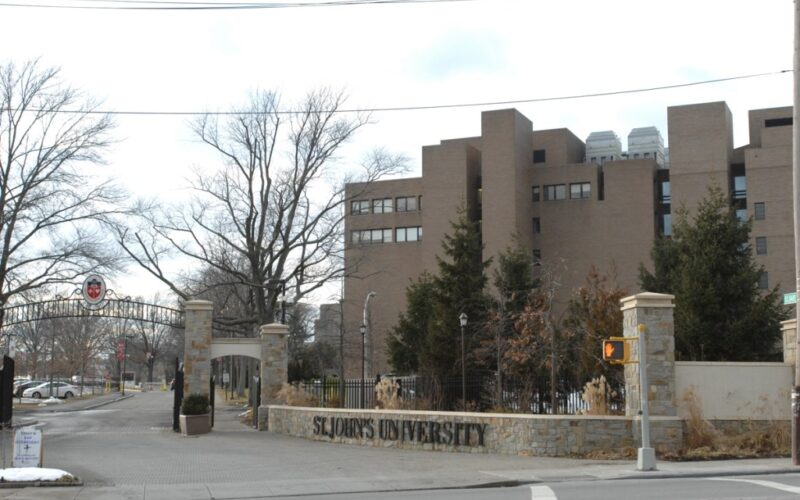
As contract negotiations reached an impasse, St. John’s University this week told two long-standing unions it would stop recognizing them as representatives of the faculty, according to an email to members obtained by the Daily News.
The unions — the American Association of University Professors (AAUP) and the Faculty Association — and school administration had been negotiating a new contract for about a year before St. John’s took the drastic action. The most recent collective bargaining agreement expired last June.
“This decision was not made lightly or rashly,” wrote St. John’s President Rev. Brian Shanley and Simon Moller, the provost and senior vice president for academic affairs, on Thursday afternoon.
“In recent years, it has become clear that the university does not have the flexibility required to fulfill its Catholic-centered mission while its core academic decisions are entangled in a collective bargaining relationship. This decision allows us the ability to innovate while continuing to support our faculty and, most importantly, deliver on our promise to our students.”
School officials said the administration would honor the last offer it made during negotiations, including a 3% raise for full-time faculty this year and two 3.25% raises over the 2026-27 and 2027-28 school years.
The unions represented some 1,300 full-time and part-time faculty members, officials said. St. John’s faculty had been unionized since the 1970s.
The move appears to be based on a 2020 National Labor Relations Board decision that the independent federal agency that investigates unfair labor practices does not have jurisdiction over faculty at religious schools.
Since then, more Catholic colleges and universities across the country have claimed the religious exemption to shut down union activity on their campuses, including the likes of Boston College, Marquette University and Loyola Marymount University, according to the National Catholic Reporter, an independent news source on issues related to the Catholic Church.
St. John’s faculty started fearing the same fate last fall.
In October, the faculty unions filed an unfair labor practice charge with New York’s Public Employment Relations Board, alleging the school administration was not sharing legally required information about how it calculates health insurance premiums. The university has denied the allegations.
“The university responded by saying, ‘We don’t have to cooperate because we don’t think we have to recognize you, but here’s some information anyway.’ We were concerned about that reaction,” said Granville Ganter, an associate professor of English and a member of the AAUP bargaining team.
“That was the first sign the administration was basically bargaining, saying, ‘Well, we’re going to do this the easy way or the hard way. Agree to a contract that we want? Fine. If not, we’ll just de-recognize them and take away their contract’ — which is what happened.”
The memo comes against the backdrop of enrollment declines at St. John’s, meaning less revenue in the form of student tuition. At the start of this academic year, the university registered 20,435 students — up from fall 2024, according to school data. But on the whole, St. John’s, like other universities nationwide, is enrolling fewer first-year students than it did before the COVID-19 pandemic, school officials confirmed.
In response, union officials said they were told multiple programs could be closed, including toxicology, modern languages, museum studies and chemistry — which members could petition against under the expired contract. The unions also had concerns about new accelerated online programs, who would teach the courses, and whether these would undermine the traditional in-person programs — which had become sticking points in negotiations.
A St. John’s spokesperson said the university was undertaking a “comprehensive program review” to ensure curriculum offerings align with student demand and long-term priorities, based on factors such as enrollment and labor market trends. No final decisions have been made, and there will still be opportunities for faculty input. The university also defended the online courses as meeting a need for flexible learning.
“As the landscape of higher education undergoes a profound transformation, our commitment to providing an exceptional and sustainable educational experience consistent with our mission requires us to be agile and innovative,” said the spokesman, Brian Browne. “Withdrawing recognition from the faculty union was not something we did lightly, but it is necessary to be able to advance our organizational mission.”
Christopher Denny, a theology professor and the president of the Faculty Association, pushed back against the idea that withdrawing recognition of the faculty unions was aligned with St. John’s Catholic mission, citing a 2022 quote from Pope Francis: “There are no free workers without a union.”
“That’s what I would call ‘Cafeteria Catholicism,’” Denny said, comparing the move to picking and choosing Catholic teachings like food in a cafeteria, or as he put it: “I acknowledge something is true in Catholic teaching in the abstract, but it doesn’t apply in this situation.”
“What happened after 56 years [of faculty unions at St. John’s] that they came to this revelation? It wasn’t a problem for over five and a half decades,” he added. “So, that’s the pointed question I would ask Brian Shanley: What changed? It didn’t seem to be Catholic teaching.”